
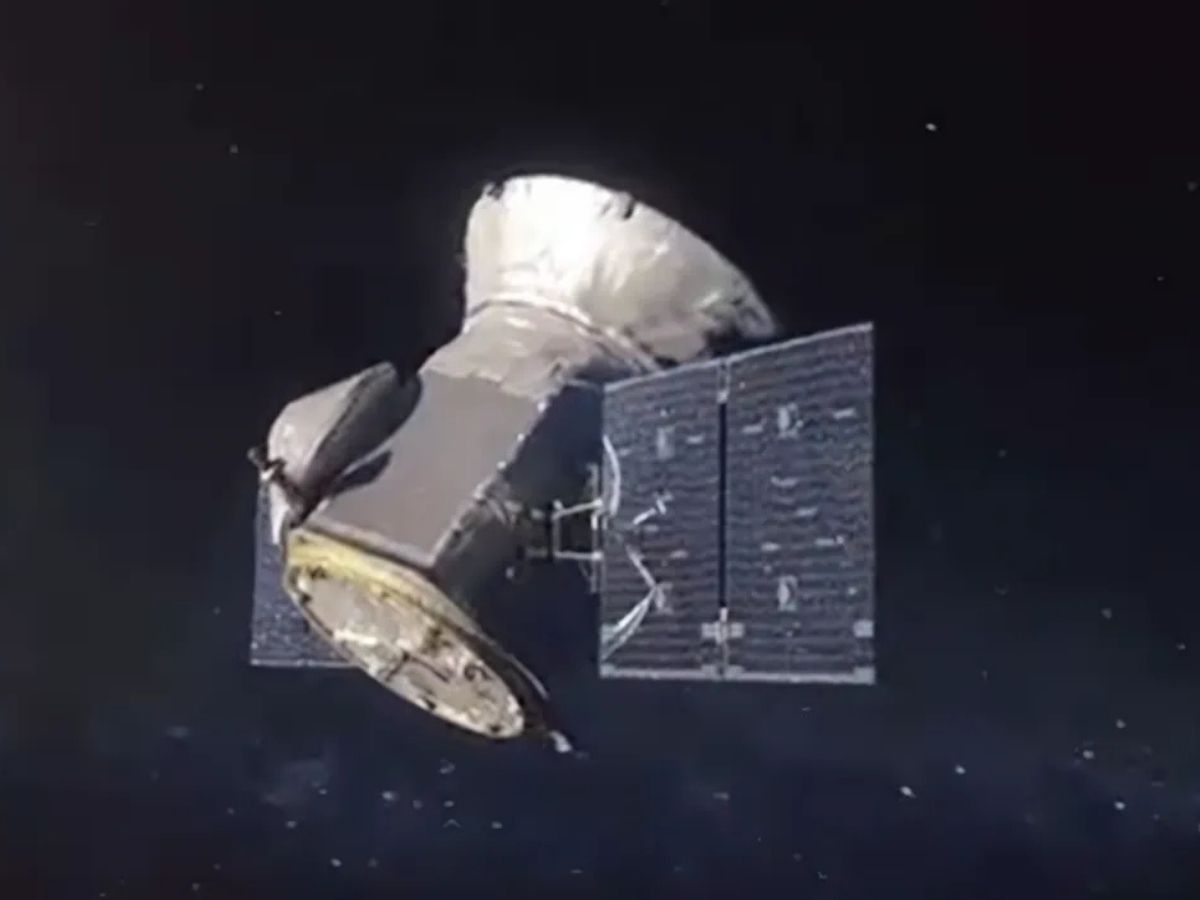

Astronomers have discovered two rocky exoplanets orbiting a nearby K-type star TOI-2322, using the NASA’s Transiting Exoplanet Survey Satellite (TESS), Daily Galaxy reported. These worlds, roughly the size of the Earth, and orbiting close to their star, have offered some key insights into how rocky planets form beyond our solar system, reports suggest.
TESS Mission Keeps Expanding Our View of Exoplanets
Since its 2018 launch, NASA’s TESS has been scanning the skies, focussing primarily on 200,000 bright nearby stars. It looks for tiny dips in starlight caused when planets pass in front, known as transits. So far, TESS has reportedly flagged over 7,600 candidate planets – called TESS Objects of Interest (TOIs) — and 686 have been confirmed by follow-up studies.
According to the report, TESS – in this case – detected signals from the star TOI-2322, located about 195 light-years from Earth. The star is smaller and cooler than our Sun, classified as a K4-type star.
According to phys.org, lead researcher from the University of Geneva Melissa Hobson explained that the planets were “first identified as candidates by the Transiting Exoplanet Survey Satellite mission”.
“We confirm and characterise these planets using radial velocities and activity indicators from the Echelle SPectrograph for Rocky Exoplanets and Stable Spectroscopic Observations (ESPRESSO),” Melissa reportedly said.
Meet the Planets: TOI-2322 b and TOI-2322 c
TOI-2322 b – the inner planet – is very similar in size to Earth with a mass less than 2.03 times that of our home planet. It orbits its star every 11.3 days at a distance just 0.09 AU (where one AU is the Earth-Sun distance). Despite being rocky, its surface temperature is estimated at 603 K (about 330 degrees Celsius), effectively meaning that it’s too hot for liquid water.
The outer planet – TOI-2322 c – is larger and heavier. With a radius nearly twice that of Earth and weighing in at around 18 Earth masses, it boasts a density of 14.69 g/cm³, which observers say is very similar to the Earth’s internal structure. Reports suggest it circles the star every 20.2 days at 0.13 AU with an estimated temperature of 500 K (227 degrees Celsius), which is still far too warm for life.
A Star with Its Own Challenges
According to the report, TOI-2322 is about 30% smaller and less massive than our Sun, with a surface temperature of 4,664 K and an age around 3.9 billion years. One interesting twist is its rotation period – 21.28 days – which is close to the orbital period of TOI-2322 c. This overlap, experts say, makes it tricky for astronomers to separate the star’s natural activity from the signals caused by the planet.
The TOI-2322 system is an excellent place to test methods of disentangling planetary and activity signals in radial velocity measurements, researchers say.




