
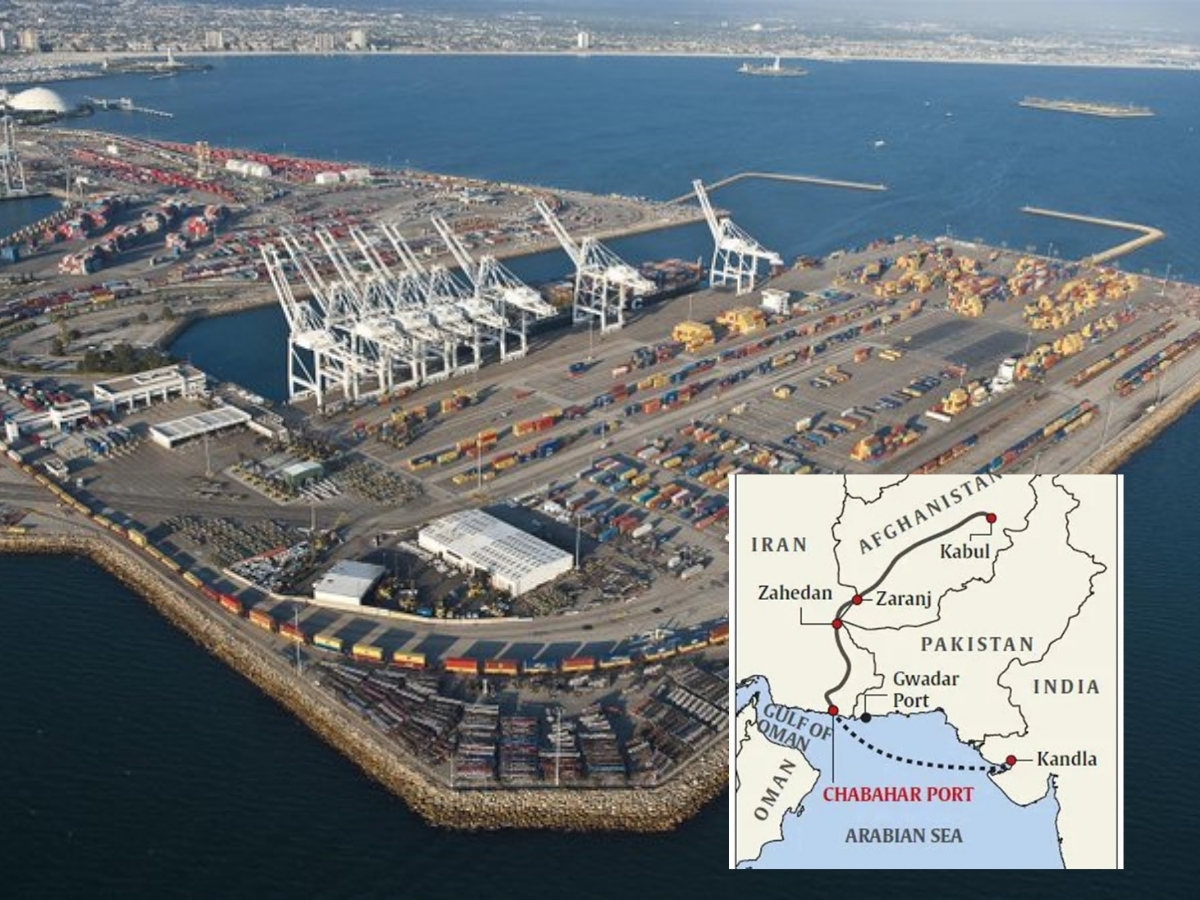

The US State Department has announced that starting September 29, individuals and entities involved in operating Iran’s Chabahar Port or participating in related activities will face sanctions under the Iran Freedom and Counter-Proliferation Act (IFCA). The decision delivers a fresh setback to India’s long-delayed plan to develop the port, which has already struggled under the weight of broader US sanctions on Tehran.
India’s Ministry of External Affairs (MEA) has not formally commented on the announcement.
India’s Investment In Chabahar Port
India and Iran signed a 10-year contract in 2024 that granted New Delhi the right to equip and operate a cargo terminal at Chabahar. At that time, India had made a financial commitment of 120 million dollars. India had also pledged a 250-million-dollar credit line to develop the surrounding infrastructure.
Chabahar is a key node in the International North-South Transport Corridor (INSTC). It is an ambitious initiative for India designed to connect Indian markets with Central Asia and Europe. The port offers a critical alternative to traditional trade routes.
Chabahar Port: Years of Negotiations and Delays
India’s engagement with Iran over Chabahar dates back to 2003. After years of talks, the two nations signed a Memorandum of Understanding in 2015 to develop the Shahid Beheshti Terminal. A year later, India, Iran, and Afghanistan entered into a tripartite agreement to turn the port into a regional hub with rail links that would allow Indian goods to bypass Pakistan and reach Afghanistan and Central Asia.
Initially, New Delhi committed 85 million dollars to develop the terminal, providing equipment such as rail-mounted gantry cranes, tack masters, forklifts, trailers, and tractors. In 2018, India Ports Global Limited (IPGL), a state-owned company, assumed operational control.
However, the re-imposition of Western sanctions on Iran over its nuclear program complicated procurement.
US Waiver On Chabahar Port, Granted and Revoked
Recognizing Chabahar’s role in Afghanistan’s economic development, the U.S. granted India a sanctions waiver in 2018. That exemption enabled India to proceed with port operations despite wider U.S. measures against Tehran.
The waiver’s rationale weakened after the collapse of the U.S.-backed Afghan government in 2021 and the Taliban’s return to power. The State Department this week officially revoked the waiver, reintroducing the threat of penalties for Indian operations.
Despite obstacles, India has already used the port to ship 2.5 million tonnes of wheat and 2,000 tonnes of pulses to Afghanistan, including 75,000 metric tonnes of wheat in 2020 as humanitarian aid. Between 2018 and 2022, IPGL handled 215 vessels, 16,000 TEUs, and four million tonnes of bulk and general cargo at Chabahar.
What It Means For India
Strategic affairs expert Dr. Brahma Chellaney sharply criticized the move, calling it “an India-specific punitive step.”
“Trump administration tightens squeeze on India: Not content with slapping 50% tariffs on Indian goods, it has now taken an India-specific punitive step by revoking the 2018 sanctions exemption for Iran’s Chabahar Port, operated by India,” Chellaney said.
Trump administration tightens squeeze on India: Not content with slapping 50% tariffs on Indian goods, it has now taken an India-specific punitive step by revoking the 2018 sanctions exemption for Iran’s Chabahar Port, operated by India.
That waiver allowed India to sign a…
— Dr. Brahma Chellaney (@Chellaney) September 18, 2025
“That waiver allowed India to sign a 10-year deal in 2024 to develop and run Chabahar, a gateway for its trade with Afghanistan and Central Asia – and a strategic counter to Pakistan’s Gwadar port, a Chinese Belt and Road project. By killing the exemption effective Sept. 29, Trump is threatening sanctions on Indian state-run firms at Chabahar – punishing India for building a counterweight to China’s influence. The irony is striking: India once curbed its own interests by halting all Iranian oil imports to comply with Trump’s first-term sanctions. That compliance handed Beijing a windfall, making it the near-exclusive buyer of Iran’s cut-rate crude – the world’s cheapest – thereby fortifying China’s energy security at India’s expense. Trump’s ‘maximum pressure’ has consistently meant maximum payoff for Beijing, with India left to pay the price.”
Michael Kugelman, a South Asia analyst, added, “This would be a strategic blow to India. Chabahar is a major part of India’s connectivity goals.”
The Trump admin plans to revoke sanctions waivers re Iran, meaning India’s development of the Chabahar port (named specifically here) could face sanctions.
This would be a strategic blow to India. Chabahar is a major part of India’s connectivity goals. https://t.co/t5UryfUodf
— Michael Kugelman (@MichaelKugelman) September 18, 2025
Zubair Amin is a Senior Journalist at NewsX with over seven years of experience in reporting and editorial work. He has written for leading national and international publications, including Foreign Policy Magazine, Al Jazeera, The Economic Times, The Indian Express, The Wire, Article 14, Mongabay, News9, among others. His primary focus is on international affairs, with a strong interest in US politics and policy. He also writes on West Asia, Indian polity, and constitutional issues. Zubair tweets at zubaiyr.amin




