

A Pentagon report submitted to the US Congress has flagged China’s claim over India’s Arunachal Pradesh as part of its stated “core interests”, underscoring Beijing’s broader national strategy aimed at achieving the “great rejuvenation of the Chinese nation” by 2049.
Arunachal Pradesh, Taiwan Part Of China’s Core Interest
The report notes that China’s leadership has expanded the scope of its “core interests” to include Taiwan, sovereignty claims and maritime disputes in the South China Sea, the Senkaku Islands, and the northeastern Indian state of Arunachal Pradesh.
Chinese officials have described the unification of China and contested territories, particularly Taiwan, as a “natural requirement” for national rejuvenation.
Under this strategic vision, a rejuvenated China would operate at a new global level and field a “world-class” military capable of “fight and win” operations, while “resolutely safeguarding” the country’s sovereignty, security and development interests.
China’s Rejuvenation Plan
The document outlines that China identifies three “core interests” that are central to national rejuvenation and not open to negotiation or compromise.
These include the control of the Chinese Communist Party (CCP), the promotion of China’s economic development, and the defence and expansion of China’s sovereignty and territorial claims.
The assessment points out that the CCP remains highly sensitive to any perceived threats to its rule, whether external or domestic, including criticism that it is failing to defend Chinese interests.
Pentagon Report Highlights ‘Unfriendly’ Political Voices In Hong Kong, Tibet
To reinforce party control, the CCP labels unfriendly political voices in Hong Kong, Xinjiang and Tibet, as well as political leadership in Taiwan, as separatist elements influenced by so-called “external forces,” viewing them as unacceptable threats to its legitimacy and power.
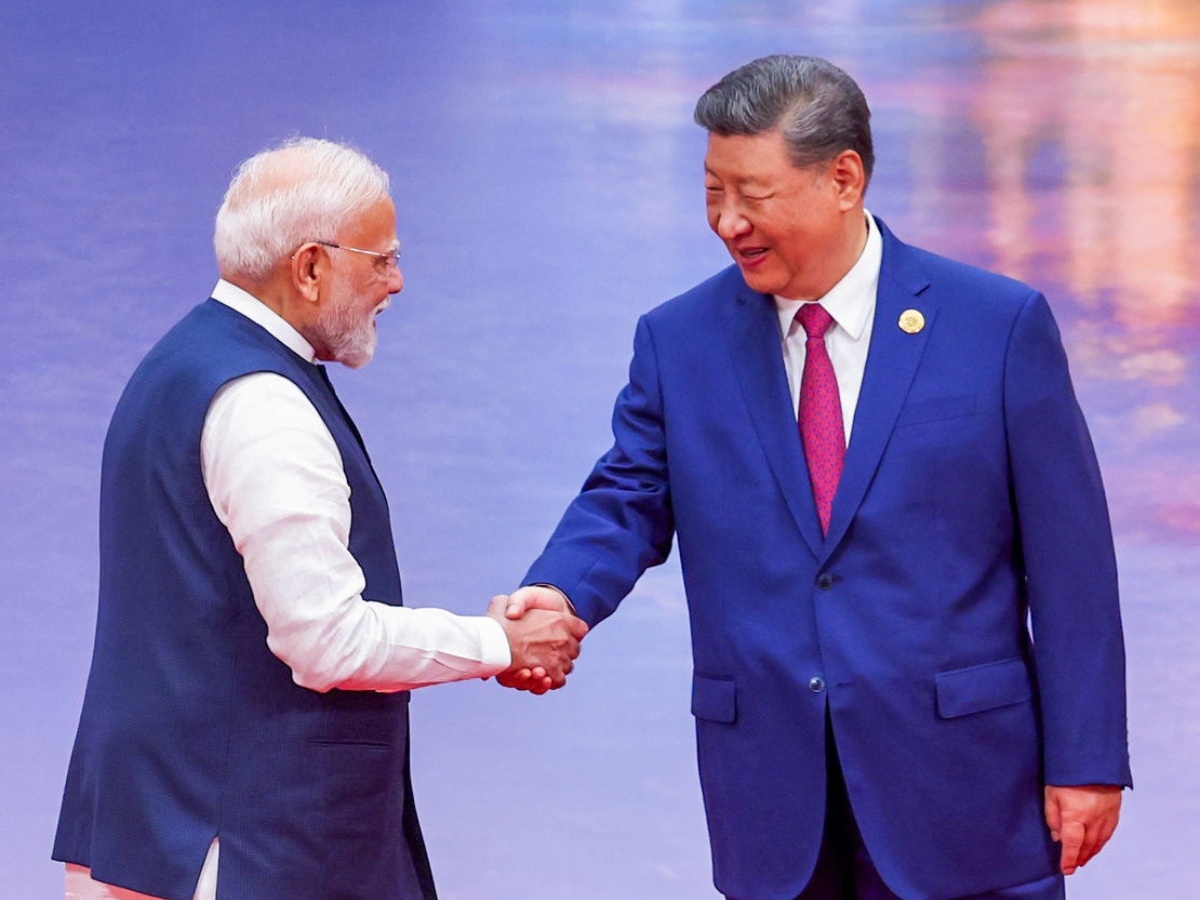
On developments along the Line of Actual Control (LAC) with India, the report highlights that in October 2024, Indian leadership announced an agreement with China to disengage from remaining standoff sites along the LAC, two days before a meeting between President Xi Jinping and Prime Minister Narendra Modi on the sidelines of the BRICS Summit.
It states that the Xi-PM Modi meeting marked the beginning of monthly high-level engagements between the two countries, during which the two sides discussed border management and next steps in the bilateral relationship.
These steps included direct flights, visa facilitation, and exchanges of academics and journalists.
China is seen as seeking to capitalise on reduced tensions along the LAC to stabilise bilateral relations and prevent a deepening of US-India ties.
At the same time, the report notes that India is likely to remain sceptical of China’s actions and intentions, adding that continued mutual distrust and other irritants are almost certain to limit the bilateral relationship.
(With inputs from ANI)
Zubair Amin is a Senior Journalist at NewsX with over seven years of experience in reporting and editorial work. He has written for leading national and international publications, including Foreign Policy Magazine, Al Jazeera, The Economic Times, The Indian Express, The Wire, Article 14, Mongabay, News9, among others. His primary focus is on international affairs, with a strong interest in US politics and policy. He also writes on West Asia, Indian polity, and constitutional issues. Zubair tweets at zubaiyr.amin




