
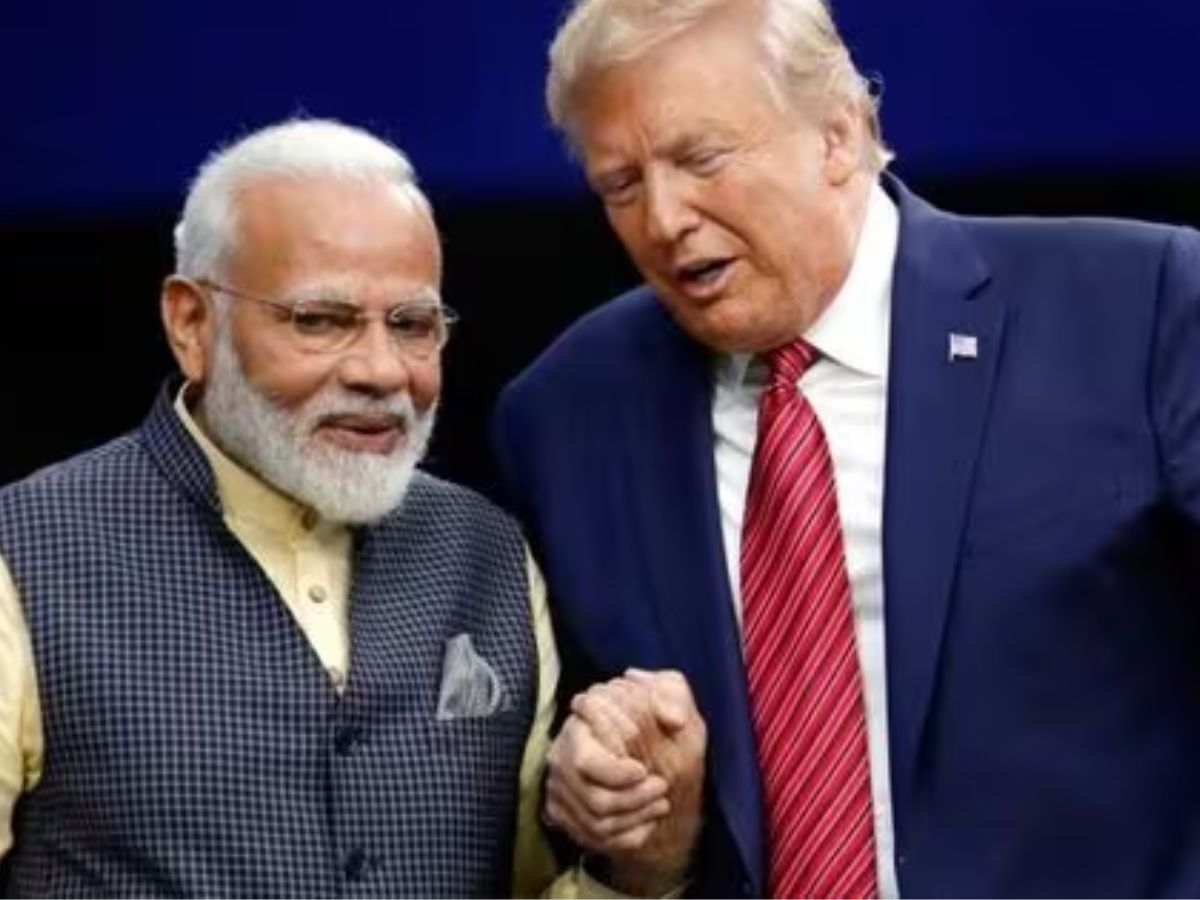

Prime Minister Narendra Modi and US President Donald Trump had “a very warm and engaging conversation” on Thursday and the two leaders decided to cooperate closely in order to tackle common challenges and to build up their mutual interests.
Through the telephone call, the two leaders looked over the ongoing lively and positive relationship between India and the U.S., and they also told each other their opinions about major developments in regions and worldwide.
The two of them affirmed that the two countries, India and the U.S., would never stop working together to bring about global peace, stability, and prosperity.
“Had a very warm and engaging conversation with President Trump. We reviewed the progress in our bilateral relations and discussed regional and international developments. India and the U.S. will continue to work together for global peace, stability and prosperity,” PM Modi said in a post on X.
The two leaders have gone through the milestones of the India-U.S. Comprehensive Global Strategic Partnership and consider the steady strengthening of the bilateral cooperation in every aspect a source of satisfaction.
PM Modi and President Trump highlighted the need to keep up the hard work that has been done already to improve trade relations between the two countries.
The doing of this swap was also with regards to the future partnership that includes engagement in critical technologies, energy, defense and security, other priority areas that are to be addressed through the India-U.S. COMPACT (Catalyzing Opportunities for Military Partnership, Accelerated Commerce and Technology) for the 21st century, and thus the leaders’ main areas of concern were actually laying down the partnership in these very times.
The leaders also discussed various regional and global developments and agreed to work closely to address shared challenges and advance common interests. The two leaders agreed to remain in touch.
Commerce and Industry Minister Piyush Goyal said on Thursday that negotiations are progressing well for the trade deal between India and the United States.
Interacting with the media in Mumbai, Piyush Goyal noted that a deal is done when both sides stand to benefit and it should not be negotiated with deadlines because there can be mistakes.”Negotiations are progressing well.
We’ve had substantive discussions over several rounds of negotiations. In the past, I think five rounds have happened. The current visit is not a negotiating round. The current visit is a new deputy United States Trade Representative (USTR) who has joined about three months ago. It’s his first visit to India. We’re getting to know each other…We had very good substantive discussions,” he said.”But I have said on record that a deal is only done when both sides stand to benefit. We should never negotiate with deadlines because you tend to make mistakes then,” he added.
Answering a query about reported remarks of United States Trade Representative Jamieson Greer that the US has received best best-ever trade deal from India, Goyal said, “the happiness of the United States Trade Representative (USTR) is very much welcome.”I do believe that if they are very happy, they should be signing on the dotted line,” he said.
Commerce Secretary Rajesh Agarwal said last week that the first tranche of Bilateral Trade Agreement with the US could be finalized by the end of this year.
“I think our expectations, we are very optimistic and very hopeful that we should find a solution within this calendar year,” he said. The Commerce Secretary cautioned, however, that trade negotiations are unpredictable, noting that “with any trade negotiations, the final deadlines cannot be because even if there is one sticking point or one sticking issue which is in the mind of even one of the partners, the trade deal may not meet that deadline.”
India and th US were initially aiming to complete the first tranche of an India-US bilateral trade agreement by the fall of 2025.
Talks were first announced during Prime Minister Narendra Modi’s visit to Washington earlier this year.
Trump imposed a 25 per cent tariff on Indian goods starting August 1, followed by another 25 per cent increase days later, citing India’s continued purchase of Russian oil. The US had imposed reciprocal tariffs on several countries with whom it faces trade deficits.
India had earlier this week welcomed the US National Security Strategy 2025.
MEA Spokesperson Randhir Jaiswal said at the weekly media briefing that the report reflects and underscores the importance that the United States attaches to India as a key partner.
“We have a multifaceted relationship with the United States. Both countries enjoy a comprehensive global strategic partnership and continue to work to further strengthen these ties,” Jaiswal said.
Last week, the White House released the US National Security Strategy 2025, which positioned India as a critical partner, signalling Washington’s intent to deepen cooperation with New Delhi across economic, technological and defence sectors.
The strategy document explicitly calls for improved commercial relations with India and encourages New Delhi to “contribute to Indo-Pacific security” through continued cooperation in the Quadrilateral Security Dialogue (QUAD) alongside Australia, Japan and the United States.
“We must continue to improve commercial (and other) relations with India,” the document states, marking a significant diplomatic emphasis on the bilateral relationship.The strategy identifies the Indo-Pacific as “already the source of almost half the world’s GDP” and frames the region as amongst “the next century’s key economic and geopolitical battlegrounds.”
US officials have made clear their intention to work with treaty allies and partners – whose combined economies total USD 65 trillion – to counteract what the document describes as “predatory economic practices” in the region.
India, with its growing economy and strategic position, features prominently in this calculus. The administration has also emphasized technology cooperation, particularly in artificial intelligence, quantum computing, and defence technologies, as areas for enhanced partnership, and reaffirms the US commitment to quadrilateral cooperation through the Quad, which has emerged as a key diplomatic and security framework in the Indo-Pacific.
All Inputs From ANI.
A recent media graduate, Bhumi Vashisht is currently making a significant contribution as a committed content writer. She brings new ideas to the media sector and is an expert at creating strategic content and captivating tales, having working in the field from past four months.




