
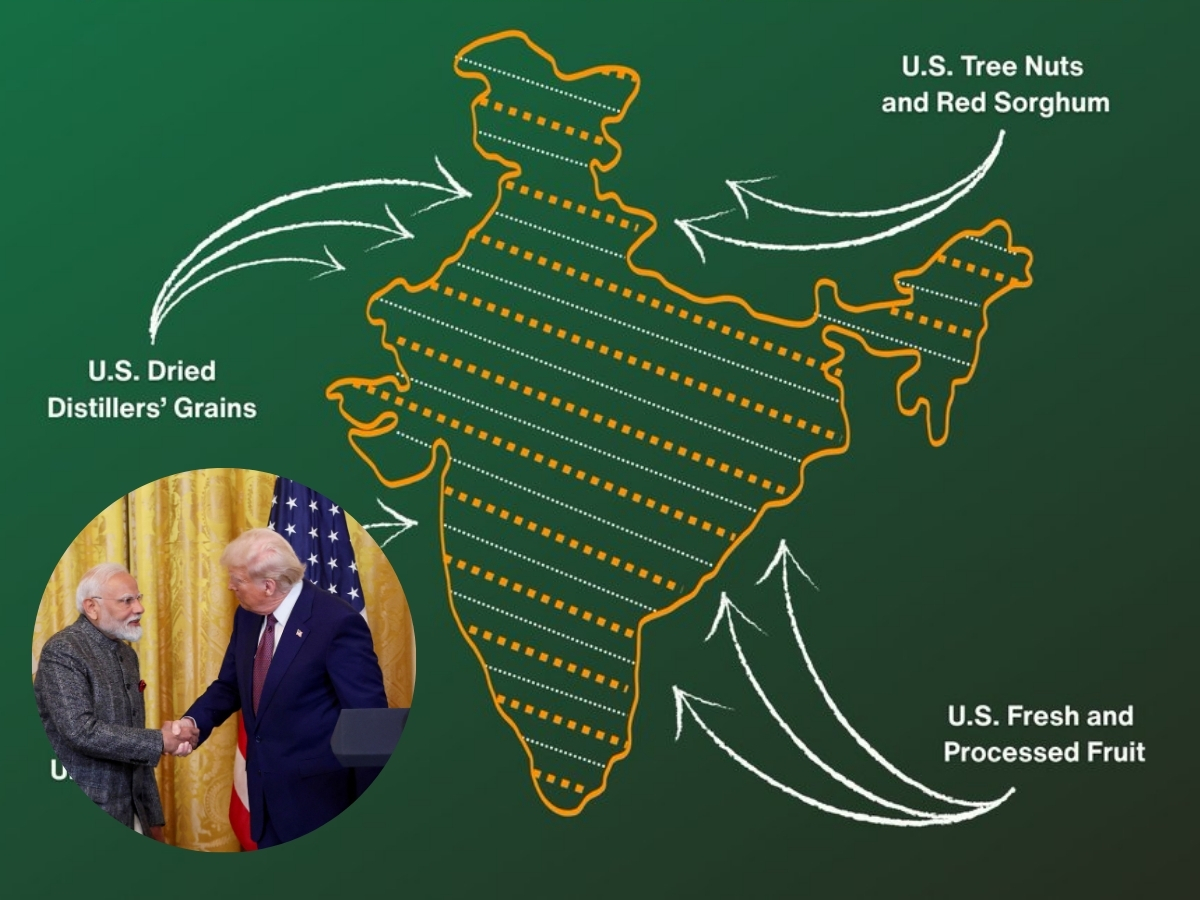

The US has made a big U-turn related to India and Pakistan. The Office of the United States Trade Representative (USTR) has deleted a social media post that featured a map of India showing the entire region of Jammu and Kashmir in its correct form, including Pakistan-occupied Kashmir (PoK), and Aksai Chin as part of Indian territory.
The image was shared last week as India and the United States announced details of their interim trade deal. At the time, the map drew widespread attention, with many interpreting it as an indication that Washington aligned with India’s political map and did not endorse competing territorial claims.
As of now, the post containing the map has been removed from the USTR’s official X handle.
What The US Trade Representative Map Showed
The now-deleted graphic portrayed the whole of Jammu and Kashmir, including areas under Pakistan’s occupation, as part of India. It also marked Aksai Chin, a region located in northeastern Ladakh and claimed by China, within India’s boundaries.
On earlier occasions, maps circulated in international contexts have often included demarcation lines to indicate disputed territories such as PoK and Aksai Chin. However, the map shared by the USTR did not include such distinctions. Instead, it presented the entire region of Jammu and Kashmir, including both PoK and Aksai Chin, as integral parts of India.
The depiction of Aksai Chin was particularly notable. China has consistently asserted its claim over the territory, despite India’s repeated objections.
This tweet has been deleted now…
This image is released by Executive office of President of the US, #Trump.
PoJK shown as Indian territory. Pakistan gonna cry. 😅 https://t.co/E10fbsPXiF pic.twitter.com/LimYn1wZtF
— Rupsy Saini (@ZiviiBloom) February 11, 2026
India’s Position On PoK, Aksai Chin
The post quickly acquired political overtones beyond trade diplomacy. It was widely viewed as a setback for Pakistan Prime Minister Shehbaz Sharif and Army Chief Asim Munir, who have been seeking stronger engagement with the United States to secure greater influence at the global level.
The map’s portrayal was interpreted by many observers as a tacit endorsement of India’s territorial claims.
India has long maintained its position that the entire region of Jammu and Kashmir belongs to it. The Ministry of External Affairs (MEA) has consistently objected to what it describes as inaccurate depictions of India’s borders. In particular, New Delhi has raised concerns over representations of Jammu and Kashmir and Arunachal Pradesh in maps published by the US State Department and other international agencies.
Social Media Reactions In India And Pakistan
The development triggered contrasting reactions on either side of the border.
In India, the post sparked a brief surge of nationalist sentiment on social media. The hashtag #AkhandBharat began trending, with several users describing the map as international validation of India’s territorial integrity.
In Pakistan, however, the response was marked by concern. Many users characterised the move as a departure from long-standing diplomatic conventions.
Zubair Amin is a Senior Journalist at NewsX with over seven years of experience in reporting and editorial work. He has written for leading national and international publications, including Foreign Policy Magazine, Al Jazeera, The Economic Times, The Indian Express, The Wire, Article 14, Mongabay, News9, among others. His primary focus is on international affairs, with a strong interest in US politics and policy. He also writes on West Asia, Indian polity, and constitutional issues. Zubair tweets at zubaiyr.amin




