
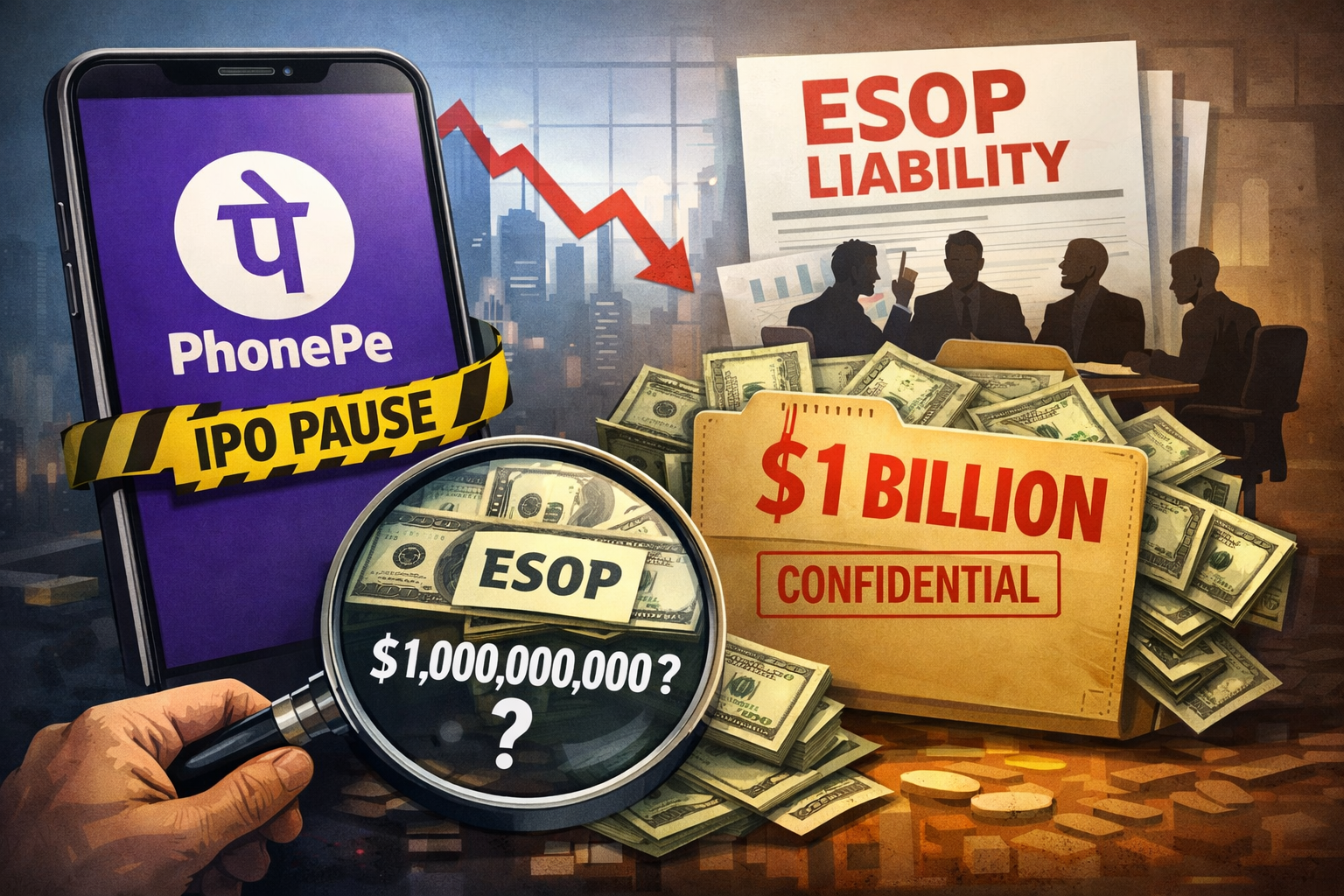

New Delhi | Mumbai: Digital payments company PhonePe’s decision to pause its initial public offering has thrown a spotlight on a set of governance concerns that had already begun surfacing during its pre-IPO investor engagements and roadshows, including a nearly $1 billion discrepancy in reported ESOP expenses and concerns around a structured secondary share sale that benefited its founders.
The Bengaluru-based fintech, which counts Walmart among its largest shareholders and processes a significant share of India’s UPI transactions, had been widely expected to list on domestic bourses by April this year. However, at least three sources familiar with the investor discussions say ESOP-related disclosures had emerged as a recurring point of concern well before the pause was announced.
At the heart of investor unease is a significant divergence between the employee stock options PhonePe has granted and what it has actually recognised as an expense. Between FY23 and H1 FY26, the company granted ESOPs worth ₹17,810 crore ($1.9 billion) to its employees. Of this, only ₹8,421 crore has been charged to its profit and loss account, as disclosed in its Updated Draft Red Herring Prospectus (UDRHP). The remaining ₹9,389 crore, nearly $1 billion is yet to be expensed.
What sharpened investor concerns further was an apparent disconnect between the company’s public filings and what its management communicated privately.
According to multiple investors who met PhonePe during its pre-IPO roadshows and spoke on condition of anonymity, said the company’s management guided that future ESOP-related costs would amount to approximately ₹5,000 crore. That figure is nearly ₹4,400 crore short of the ₹9,389 crore in unrecorded ESOP expenses that the company itself has disclosed in the DRHP.
Further, these market participants stated that the divergence between private guidance and public disclosure is a matter that will need to be addressed clearly and on the record before any listing process can credibly resume.
The unrecorded liability is not a minor accounting footnote. When this charge begins flowing through the income statement, analysts say it will materially deepen losses and substantially delay any credible timeline for the company to turn profitable.
PhonePe’s losses had already widened 20% to ₹1,444.4 crore in H1 FY26 compared to the same period in the previous fiscal year. According to Macquarie Research, the company’s ESOP expenses alone stood at 46% of its H1 FY26 revenues, a ratio that has also raised eyebrows among institutional investors reviewing the filing.
Alongside the accounting concerns, a $600 million secondary share transaction that PhonePe executed with General Atlantic in September 2025 has drawn scrutiny over its governance rationale. Co-founder and CEO Sameer Nigam stated publicly over social networking platform, X, that neither he nor co-founder Rahul Chari receive personal liquidity from the deal, clarifying that proceeds were routed through the company to discharge tax obligations arising from founders and employees exercising their vested ESOPs. The company said approximately ₹6,000 crore in TDS was deposited with tax authorities as a result.
However, the head of a proxy firm that didn’t want to be named, stated that taxes on ESOP exercise are a personal liability of the individual, not an obligation of the company or its investors. The board’s decision to facilitate a structured investor buyout to meet personal tax obligations of its founders, they said, is an arrangement that warrants greater transparency.
The terms of the transaction add a further dimension. General Atlantic’s investment was made at a 15-20% valuation premium, pegging PhonePe at $14.5 billion. At that elevated price, founders and employees needed to sell fewer shares than they would have at fair market value to generate the same proceeds, effectively allowing them to retain more of their shares, the proxy firm head stated.
The future ESOP cost burden extends to PhonePe’s senior leadership. According to the DRHP, CFO Adarsh Nahata, Lending CEO Hemant Gala, and Head of Investor Relations Karthik Raghupathy each hold ESOPs valued between ₹300 crore and ₹450 crore, grants that will add to the company’s expense obligations in the years ahead.
The scale of stock-based compensation at the senior management level, alongside the pending ₹9,389 crore charge, has led analysts and governance observers to question whether PhonePe’s compensation structure adequately accounts for the interests of prospective public shareholders.




