
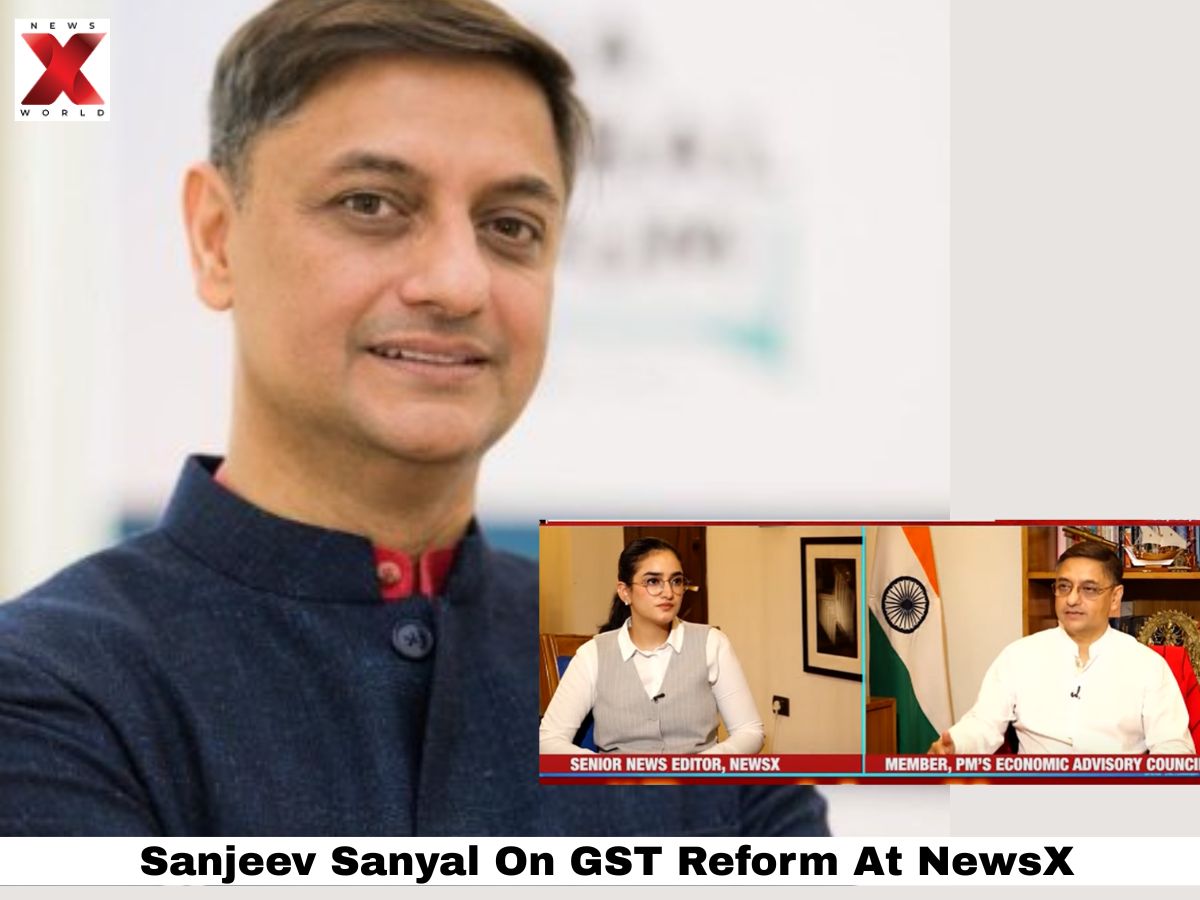

In an exclusive interview with NewsX, Mr. Sanjeev Sanyal, Member of the Prime Minister’s Economic Advisory Council, offered a detailed breakdown of the Government of India’s historic overhaul of the Goods and Services Tax (GST) framework. Shedding light on the motivations behind the shift from a four-tiered GST structure to a simplified two-tier regime, Mr. Sanyal emphasized that the reform is primarily aimed at increasing efficiency and reducing friction across the economy—not just stimulating consumption.
“Let me be clear,” Mr. Sanyal said. “This is first and foremost a process reform, an efficiency improvement. It is not, as some suggest, merely a consumption-boosting move.”
The GST Reform: From Legacy Complexity To Logic
Tracing the origins of GST, Mr. Sanyal recalled how India’s pre-GST tax regime was so fragmented that “it was easier for Mumbai to trade with Shanghai than with Delhi.” With different states having their own sales taxes, octroi, and excise duties, GST acted as a free trade agreement India signed with itself, creating a unified national market.
The initial introduction of GST was designed to minimize disruption. Existing tax rates were essentially moved into the closest available slabs without a deep reevaluation. Over time, however, this approach led to inconsistencies such as caramel popcorn being taxed differently from salted popcorn, and commonly used items like cement falling into the highest tax bracket.
With the system now stabilized, Mr. Sanyal explained, the government has taken the opportunity to rationalize the structure based on first principles. The new two-tier GST framework puts items into more logical and predictable categories, enabling businesses and consumers to better anticipate tax implications.
Easing Compliance And Ending The ‘Inspector Raj’
One of the most underappreciated aspects of the reform, according to Mr. Sanyal, is the simplification of GST registration and compliance, particularly for small businesses. Over time, there had been a creeping return of the infamous “Inspector Raj”, as state-level authorities imposed excessive friction during registration.
The new framework ensures that 97% of new GST registrations are now processed within three days, significantly reducing bureaucratic delays.
Impact On Consumers And The Economy
While the reform is not primarily about boosting consumption, Mr. Sanyal acknowledged that lower taxes on a wide range of goods will inevitably leave consumers with more money to spend. However, quantifying that benefit is difficult:
“There’s no sensible way of calculating exactly how much more consumers will spend. But we do have estimates of revenue loss, and the expectation is that higher growth will eventually compensate for this.”
Additionally, lower taxes can reduce inflation, create room for monetary easing, and ultimately support broader economic growth.
Inverted Duty Structures And Sectoral Impact
The reform also addresses long-standing issues like inverted duty structures, where input costs exceeded output taxes—hurting specific industries. Mr. Sanyal emphasized that the restructuring was not designed to favor specific sectors but to restore logical consistency across the board.
He dismissed concerns about high GST rates on so-called “sin goods” such as tobacco and luxury cars, stating, “For sin goods, I have no sympathy. There is no reason to keep taxes low on items we want to discourage.”
Health Insurance And Input Tax Credits
Addressing concerns over the removal of GST on health insurance, Mr. Sanyal argued that while input tax credits for insurers may be broken, the 18% tax cut provides a massive demand boost.
“If you are a company that now has a dramatically larger consumer base, it is fair to expect you to absorb some of that input cost and work more efficiently.”
India’s Stance On US Tariffs And Trade
Turning to recent US tariff tensions, Mr. Sanyal clarified that GST reform was not a response to external pressures.
“This was in the works for a long time. It’s not a reaction to the US. But if needed, we have the fiscal and monetary space to support affected sectors.”
India, he said, is negotiating with the US on a free trade agreement (FTA) but will not back down on core interests like agriculture. “We are not escalating, but we’re also not backing down,” he stated firmly.
Economic Resilience And Reform Mindset
Mr. Sanyal stressed the importance of policy frameworks that are resilient to random shocks—be they global (like COVID-19) or domestic (like the banking crisis of 2017). Citing the Prime Minister’s approach, he said India now aims to preempt shocks with cushion and composure.
“Good policymaking isn’t about predicting shocks—it’s about building systems strong enough to absorb them.”
The Modi Years: A Decade Of Reforms And Vision
Reflecting on Prime Minister Narendra Modi’s tenure, Mr. Sanyal highlighted key reforms during his own time in government: the introduction of GST, the banking clean-up using the Insolvency and Bankruptcy Code, and bringing down inflation from 8–12% to 2–6%.
He applauded Modi’s unique leadership style:
“He’s an amazing listener. If you make a good argument, he changes his mind. That takes a lot of confidence as a leader.”
He also praised the PM’s anti-“povertarian” mindset- a refusal to accept that India should settle for low standards simply because it is a developing country. Whether it’s upgrading to Vande Bharat trains, modernizing airports, or creating world-class government offices, Mr. Sanyal said, the focus is always on pulling India upwards.
Reimagining What’s Possible: Drones And Lakpati Didis
Mr. Sanyal also shared his role in cutting down drone regulation rules from 77 to just 7, enabling the rise of “Drone Didis” and empowering rural women through Lakpati Didi initiatives.
“This wouldn’t have happened without the Prime Minister’s vision—and his ability to think beyond old cobwebs.”
Final Message: More Reforms Ahead
As the Prime Minister approaches his 75th birthday, Mr. Sanyal concluded with a clear message:
“Sir, it’s been an honor to work with you. I heard your Independence Day speech and I look forward to participating in the many reforms you have planned.”
Also Read: India Navigates Trade Turbulence Well, Eyes Faster Growth Says Economist Sanjeev Sanyal
Aishwarya is a journalism graduate with over three years of experience thriving in the buzzing corporate media world. She’s got a knack for decoding business news, tracking the twists and turns of the stock market, covering the masala of the entertainment world, and sometimes her stories come with just the right sprinkle of political commentary. She has worked with several organizations, interned at ZEE and gained professional skills at TV9 and News24, And now is learning and writing at NewsX, she’s no stranger to the newsroom hustle. Her storytelling style is fast-paced, creative, and perfectly tailored to connect with both the platform and its audience. Moto: Approaching every story from the reader’s point of view, backing up her insights with solid facts.
Always bold with her opinions, she also never misses the chance to weave in expert voices, keeping things balanced and insightful. In short, Aishwarya brings a fresh, sharp, and fact-driven voice to every story she touches.




