
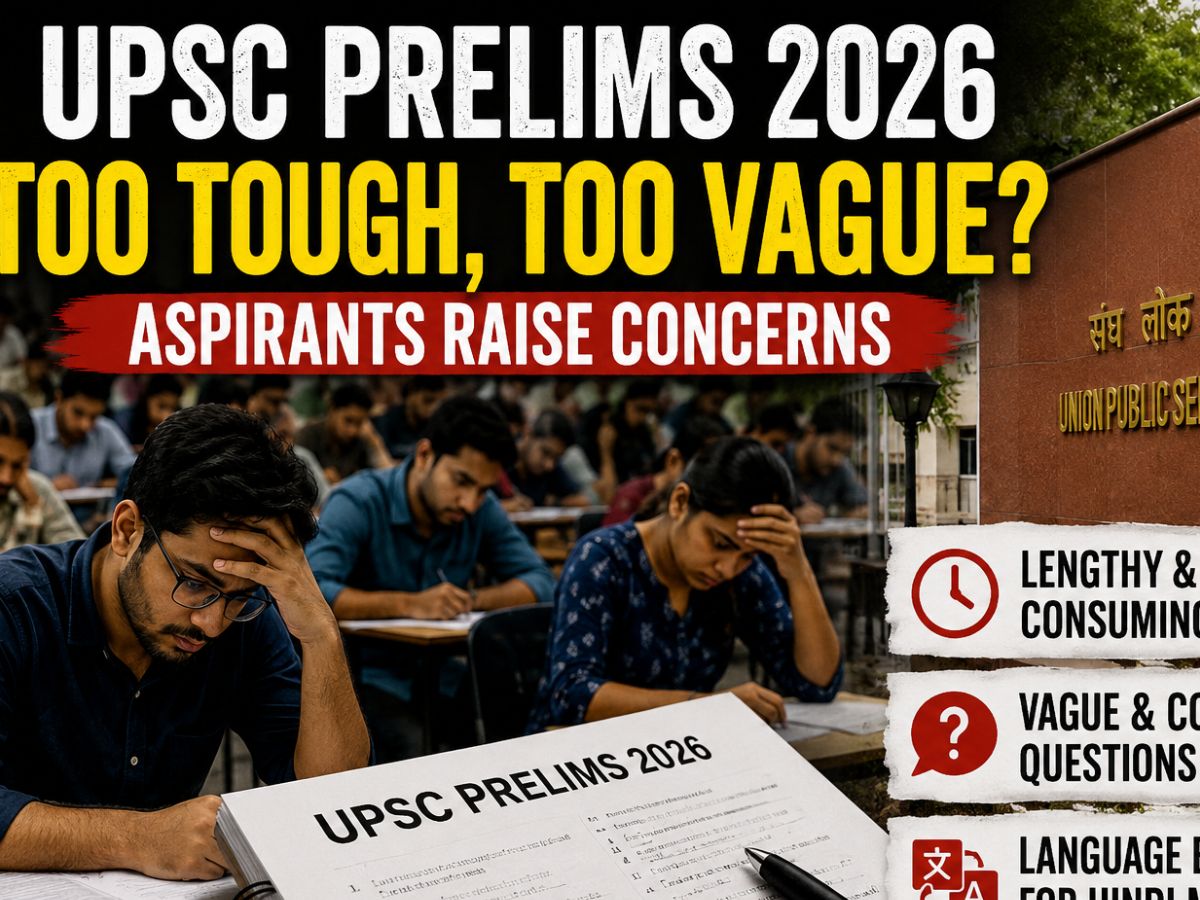
The UPSC Civil Services Prelims 2026 exam has sparked another debate regarding fairness and language and accessibility in Indian competitive examinations. Candidates who sat for the exam on May 24 found this year’s paper unusually difficult, time-consuming, and unpredictable. The preliminary exam, with 5.5 lakh candidates in total, has been held in two rounds, General Studies (GS Paper 1) and the Civil Services Aptitude Test (CSAT).
Questions received large amounts of criticism on social media just after the exam was conducted. Aspirants who appeared for the prelims exam questioned the UPSC exam pattern, the complexity of the language, and the UPSC’s approach regarding the exam itself.
Why are aspirants criticising UPSC Prelims 2026
The aspirants claimed that the exam was different from that of previous years, as it required more inferences rather than the answering of factual questions. The UPSC exam was criticised because of: The difficulty level and pattern of GS Paper 1, long and conceptually complicated questions, made it difficult for candidates to answer within the allotted time.
Even experienced academicians and coaching faculties were not able to answer the paper. Candidates also felt that direct questions related to subjects were fewer than those of the past years. Several candidates complained that the paper tested interpretation skills more than conceptual understanding, which made time management a difficult task.
Students in Mukherjee Nagar, one of the biggest hubs of civil services training centres in India, discussed the changing facets of the UPSC paper and the increasing unpredictability of the paper pattern.
What do Hindi aspirants say about the paper
One of the key issues was language accessibility after the exam. Several aspirants from the Hindi medium said some of the translated questions were difficult to understand and had to be read several times.
The question is the question! Candidates also complained that the translations were not framed properly and added more time to analyse the questions, disadvantaging the aspirants. ‘Equality of opportunity’ had to be translated into ‘equality of clarity’ of both the language versions of the paper, they added.
The debate was again focused on the issues of linguistics in national-level competitive examinations, which are taken by candidates from a multitude of backgrounds and regions with varying education. Having pointed out the problems with the translations, a few aspirants also said that the complex sentence structures add to the challenge in a time-crunched exam.
Why did candidates find the CSAT paper difficult
Apart from GS Paper 1, candidates also had concerns about the CSAT paper. Candidates found many math questions to be long and involved multiple stages of calculation, which reportedly added pressure during the test.
Some candidates also said the comprehension passages were heavily packed and academically phrased, which made them difficult to interpret quickly. Many students reported that a paper of this length takes a lot of time to read, leaving little time to revise and process carefully.
Candidates said UPSC exams are expected to be difficult, but unpredictability and overly complex patterns can undermine fairness and an accurate assessment of candidates’ performance. This is also contributing to renewed debate over whether a competitive exam cycle should be more balanced and less surprise-based in difficulty.
What larger debate has the UPSC controversy triggered
The reaction to UPSC Prelims 2026 comes on a day when India’s exam system has already come under fire over controversies linked to competitive exams such as NEET-UG and criticism of the evaluation process in other boards as well as recruitment exams. Education experts and aspirants are increasingly demanding more transparency, accessibility and standardisation in national-level exams. Fairness, many candidates say, should be a combination of clear language, balanced difficulty and predictable evaluation criteria.
So far, the UPSC has remained tight-lipped over the concerns raised by aspirants. However, this year’s preliminary exam discussion, marred by candid comments, has once again drawn a broader conversation into the exam system’s trustworthiness and inclusivity in India.
Radhika is a journalist with two years of experience covering education, competitive exams, and student-focused developments. She reports on exam notifications, results, admissions, scholarships, and academic policies, helping students stay updated with important information.
Known for her clear and reader-friendly writing, she simplifies complex education updates into accessible stories that guide aspirants, students, and parents. She is also interested in highlighting inspiring student journeys and grassroots education initiatives.
For queries or story tips, you can reach out to her on X (formerly Twitter): https://x.com/Hitkariradz





