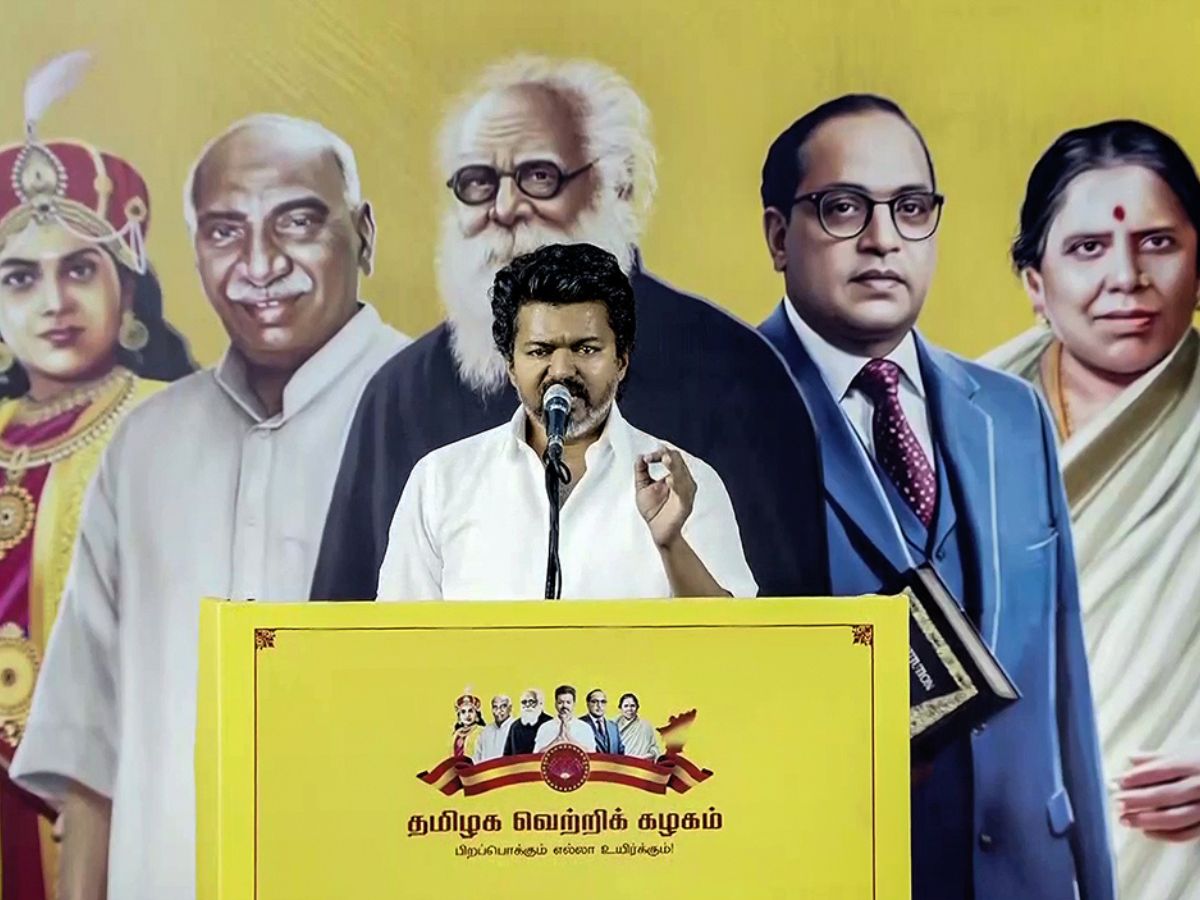

Tamil Nadu’s Dravidian battle ground is all set to witness the interesting final countdown. In the middle of this wait for the Assembly election results on May 4, a jarring contrast has sprouted out between the campaigning styles of the major players in Tamil Nadu. While the leaders of the Dravida Munnetra Kazhagam and All India Anna Dravida Munnetra Kazhagam have been seen in the media, responding to questions, dealing with controversies and influencing narratives, Thalapathy Vijay has been conspicuous by his absence from press conferences and question and answer sessions. Yet, the Tamilaga Vettri Kazhagam chief still mobilises crowds, leading many to wonder if a carefully planned absence can be as effective as direct political engagement. But how does his crowd pulling strategy work? Is it just because of his mass hero appeal?
What’s behind Vijay’s silence?
Vijay was missing a step on press conferences for years mainly on politics. The actor has avoided interviews for over a decade, citing lack of trust on his statements being reported correctly.
During a past incident, he had recalled how a magazine interview went wrong, where he was quoted as arrogant and even his close ones and family couldn’t believe that he had said what he was quoted as saying. With this happening in front of a large audience, Vijay decided to remain silent until he can clear the confusion, which was years ago.
The experience has evidently influenced his current style of communicating with the press. The actor has avoided press conferences in order to avoid any confusion, controversies or being questioned, which is a strategy that matches his long-term approach to media interaction.
Is Silence Vijay’s Political Strategy?
There are many politicians who speak to the press regularly. MK Stalin, Edappadi K. Palaniswami, they do. Vijay prefers controlled messaging to spontaneous press interactions. His statements, public appearances, manifesto launch are all carefully scripted to avoid the possibility of speaking to supporters in between.
This is definitely helpful in maintaining a consistent message of “honest administration” and attacks on established parties without the possibility of live questions. It’s also indicative of a shift towards leader-centric communication, where rallies and social media are a substitute for press engagement.
Can Star Power Replace Media Accountability?
Thalapathy’s ability to draw crowds is no one’s secret. His decades of stardom in cinema translates to political visibility. However, lack of press interaction is a cause for concern. Media Q&As provide an opportunity for leaders to be questioned on policy detail, government contradictions, and future plans. By avoiding this, Vijay avoids immediate pressure, but also stops an opportunity to explain complex issues and answer criticism. This could be a significant trade-off in a competitive political environment.
How Does TVK’s Manifesto Fit Into This?
Instead, Vijay has relied on his policy announcements. TVK manifesto promises a broad array of welfare measures ranging from Rs 2,500 monthly assistance for women heads of households to education loans, youth stipends, and improved healthcare coverage.
These announcements, however, decorates headlines and public interest, but are more often than not communicated in a one-way format. Without press conferences, there is little opportunity for follow-up questions about feasibility, cost, and implementation areas where rival parties often face intense media scrutiny.
Will This affect Election Results?
The real question is whether this no-press and no-Q&A approach works to extend the political momentum beyond campaign period. While Vijay’s silence hasn’t hurt his crowd-pulling ability so far, all that’s required for governance is rather different.
If TVK aspires to become a credible political party beyond a personality cult, it may have to consider more open communication formats at some point. For now, Vijay’s strategy is clearly working in terms of momentum and mass hero appeal, but whether it translates into election results will be known when the results are declared.
Sofia Babu Chacko is a journalist with over five years of experience reporting on Indian politics, crime, human rights, gender issues, and stories about marginalized communities. She believes journalism plays a crucial role in amplifying unheard voices and bringing attention to issues that truly matter. Sofia has contributed articles to The New Indian Express, Youth Ki Awaaz, and Maktoob Media. She is also a recipient of the 2025 Laadli Media Awards for gender sensitivity. Beyond the newsroom, she is a music enthusiast who enjoys singing. Connect with Sofia on X: https://x.com/SBCism