
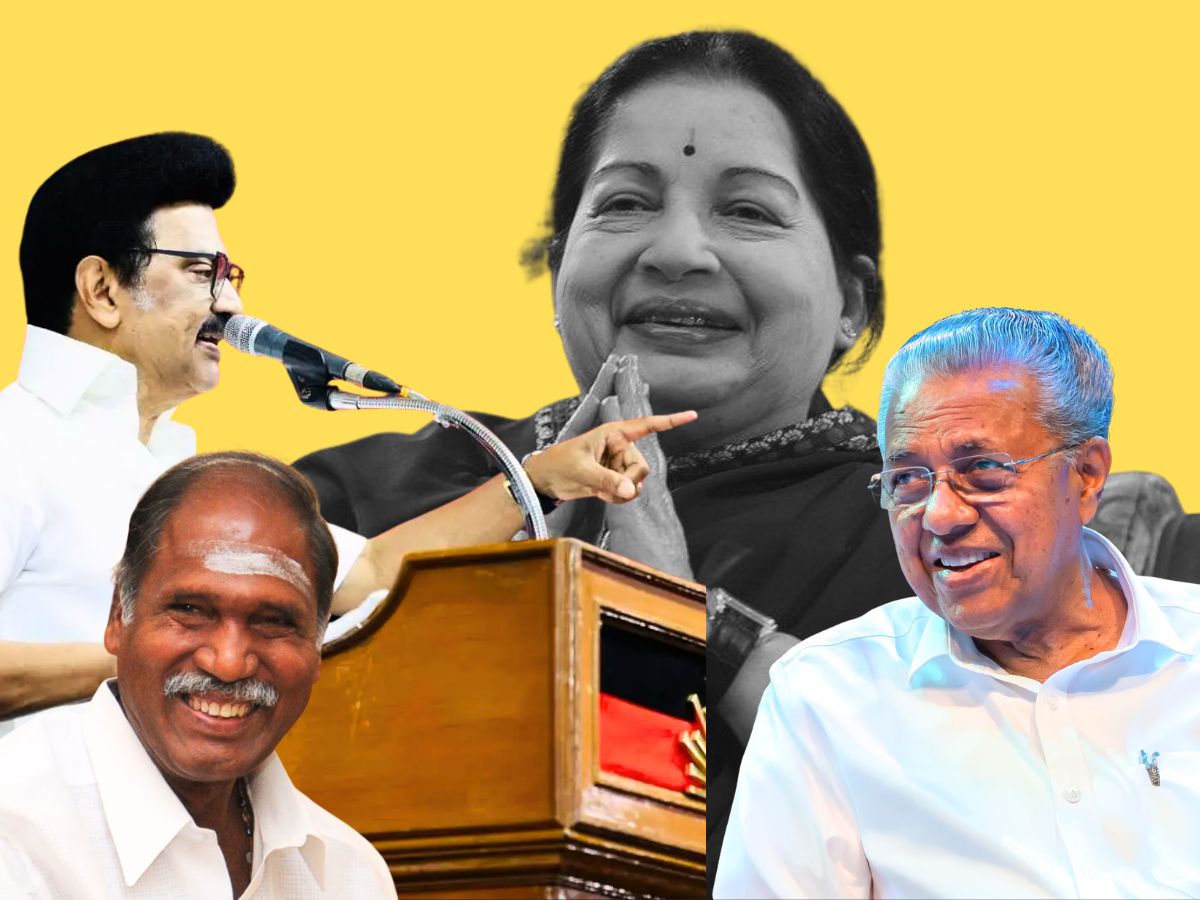

As southern India heads into a crucial election season with Kerala and Puducherry going to the polls on April 9 and Tamil Nadu following on April 23 the focus is, as always, on alliances, big leaders, and high voltage power battles.
But amid all the campaign noise, there’s a silence that’s hard to ignore: not one of these states has a clear woman Chief Ministerial face. Why So?
Despite high literacy, strong political participation, and a long history of social reform, both Kerala and Tamil Nadu continue to resist women at the very top of their power structures.
In Tamil Nadu, this contradiction feels even sharper when you look at the legacy of E V Ramasamy, who led a powerful movement challenging patriarchy and pushing for women’s rights. The Dravidian parties that grew out of his ideas still speak the language of social justice and equality.
And yet, when it comes to leadership, that promise seems to fall short. After J Jayalalithaa, there hasn’t been a serious woman Chief Ministerial face in the state. It reveals an uncomfortable truth: politics may claim progress, but when it comes to sharing real power, the system still seems reluctant to fully accept a woman at the top.
Kerala’s Gender Gap: A Majority Without Representation
Kerala’s electoral math tells a powerful story, one that political parties continue to ignore.
With over 1.39 crore women voters, women outnumber men in the electorate. Yet, in the upcoming elections, only around 40 women candidates are contesting across 140 constituencies.
Party-wise numbers reflect the imbalance: CPI(M) has fielded 12 women, Congress 9, BJP 14, CPI 5, and IUML just 2 marking its first-ever inclusion of women candidates.
This is despite the passage of the Nari Shakti Vandan Adhiniyam, which raised expectations of greater representation. But with its implementation tied to delimitation, parties have used the delay as an excuse to avoid internal reform.
Historically, the pattern is even more darker, women’s representation in Kerala’s Assembly has never crossed 10% since 1957. The result is a democracy where women vote in large numbers but remain excluded from power.
Sexism Still Shapes Kerala’s Political Culture
The structural exclusion is reinforced by everyday sexism in political discourse.
A recent controversy saw IUML leader Irshad Chakkalassery reducing CPI(M) MLA U Prathibha to her “physical beauty,” triggering widespread backlash.
Chief Minister Pinarayi Vijayan called it “heinous character assassination,” while Prathibha herself stated that such remarks reflect a mindset that evaluates women not by their work, but by their bodies.
This incident shows a deeper reality: women in Kerala politics are not just underrepresented they are often undermined.
“Left and Right Block Women”: A Structural Critique
EU Eswara Prasad, Former ABVP Kerala state secretary, speaking to NewsX, offers a blunt assessment of the system:
“The Left and Right parties have always shown a tendency to block women’s advancement. Neither the Congress nor the Left has seriously tried to bring a woman to such a position. Even when women rise, like Indira Gandhi, it is often through political families.”
He further pointed out how even strong leaders are sidelined:
“We have seen leaders like K R Gowriamma and even Shailaja teacher being overlooked. Parties speak of women empowerment, but their actions show otherwise.”
His critique highlights a bipartisan failure where ideology does not necessarily translate into gender inclusion.
The Rise and Disappearance of a Woman CM Face in Kerala
For a brief moment, Kerala seemed close to change.
K K Shailaja celebrated for her leadership during the Nipah outbreak and COVID-19 was widely seen as a potential Chief Ministerial face.
Recently, Shailaja herself expressed hope that Kerala will eventually have a woman Chief Minister, noting that women are increasingly active within party structures from branch to area leadership.
Yet, that momentum has not translated into top-level power.
Her case illustrates a key issue: visibility does not equal succession. Even widely respected women leaders are rarely positioned as the final choice for leadership.
Tamil Nadu: Jayalalithaa’s Legacy, But No Successors
Tamil Nadu’s political history includes one of India’s most powerful women leaders J Jayalalithaa.
Her journey was marked by extraordinary resilience in the face of intense misogyny from being labelled a “temptress” early in her career to facing physical humiliation during the 1989 Assembly attack.
Backed initially by M G Ramachandran, she rose to dominate the state’s political arena, even breaking its alternating power cycle by winning consecutive terms.
But her success remained an exception not a structural shift.
“Jayalalithaa Was an Exception, Not a Systemic Change”
Dr. Narmatha, former DMK student union leader, explains this gap clearly:
“Though many mention Jayalalithaa, she was an exception and not a systemic change. Her rise was extraordinary, but it did not create a pipeline of women leaders.”
She adds:
“Tamil Nadu still has male-dominated party hierarchies, informal power networks controlled by men, cultural biases questioning women’s authority, and limited access to political resources.”
Even in a socially progressive state, power remains concentrated within male networks.
“Real Power Lies in Money and Manpower”: Inside View from DMK
A young DMK leader, requesting anonymity, provides a candid, ground-level perspective:
“In our country, women in politics usually do not rise naturally on their own. They often need support from men or their community.”
He adds a more structural critique:
“Real political power lies in fieldwork with strong community backing, money, and manpower. Those kinds of power-driven politicians are mostly men.”
He also points to dynastic patterns:
“Even within political families, male successors are more likely to be groomed. Women are rarely positioned as primary heirs to power.”
This insight reveals the deeper mechanics of exclusion politics is not just about popularity, but about access to power structures that women are often denied.
Puducherry: More Women Voters, Fewer Women Leaders
The paradox extends to Puducherry, where women voters (over 5 lakh) outnumber men, yet representation remains minimal.
Women ministers are rare, and the Assembly typically has just one or two women MLAs. A woman Chief Ministerial face is virtually absent.
2 women candidates in a 30 candidate list is women’s representation ? Beautiful ! https://t.co/7GAKzRfQEo
— Prashanth Rangaswamy (@itisprashanth) March 23, 2026
VCK spokesperson Vadhanur Sivachandiran puts it bluntly:
“Patriarchal, male-dominated politics… women are not given proper space. Even though women voters are high, politics here is controlled by men.”
He adds:
“Less women participate in politics, and the system itself excludes them. Parties are not giving adequate space for women.”
His remarks underline a key issue: the problem is both participation and systemic exclusion.
The Illusion of Progress
Kerala and Tamil Nadu are often celebrated as progressive states. But when it comes to political leadership, progress remains superficial.
Women are mobilised as voters, showcased as symbols, and occasionally elevated as exceptions but rarely nurtured as leaders.
Even the hope of a woman Chief Minister in Kerala, as voiced by K K Shailaja, remains aspirational rather than imminent.
Across Kerala, Tamil Nadu, and Puducherry, the resistance to women rising as Chief Ministerial faces is neither accidental nor temporary, it is deeply structural. At its core lies a political culture shaped by patriarchal norms, where leadership continues to be subconsciously associated with masculinity. Even in states celebrated for social progress, the idea of women in ultimate authority still encounters hesitation, both within parties and among sections of the electorate.
This is further reinforced by male-dominated party hierarchies, where decision-making power remains concentrated in tightly controlled networks. These informal circles often built over decades determine candidate selection, resource allocation, and leadership projection, leaving little room for women to organically rise. As a result, women are frequently confined to symbolic or supporting roles rather than being groomed for top leadership.
Compounding this is the issue of limited access to financial and political resources. Electoral politics in India is resource-intensive, requiring not just funding but also grassroots networks, cadre strength, and sustained field presence. These structures are historically controlled by men, making it significantly harder for women to build the kind of political capital required to emerge as Chief Ministerial contenders.
Is dynastic politics sidelining women leaders?
In states like Tamil Nadu, where dynastic politics plays a major role, the bias becomes even more visible. Political legacies are overwhelmingly passed down to male heirs, while women within the same families are rarely positioned as primary successors. This reflects a broader assumption often unspoken that men are more “acceptable” as leaders, despite evidence to the contrary.
Overlaying all of this are cultural biases that continue to question women’s authority. Women politicians are judged more harshly, scrutinised for their appearance and personal lives, and often subjected to sexist rhetoric that undermines their credibility. Such an environment not only discourages participation but also limits the projection of women as serious contenders for top roles.
Ultimately, what persists is a system of token representation rather than structural inclusion. Women are fielded in limited numbers, showcased in campaigns, and occasionally elevated as exceptions but the pathways to real power remain restricted.
Until these systemic barriers are dismantled, the absence of women Chief Ministerial faces will continue to reflect not a lack of capability, but a lack of opportunity.
A Democratic Gap That Cannot Be Ignored
As elections approach, the absence of women Chief Ministerial faces is more than a political oversight; it is a democratic contradiction.
In states where women form a decisive voting bloc, their exclusion from top leadership raises a fundamental question:
Can a democracy truly be representative if half its population is missing from its highest positions of power?
Until political parties move beyond rhetoric and actively create space for women not as exceptions, but as leaders the answer, for now, remains no.
Sofia Babu Chacko is a journalist with over five years of experience reporting on Indian politics, crime, human rights, gender issues, and stories about marginalized communities. She believes journalism plays a crucial role in amplifying unheard voices and bringing attention to issues that truly matter. Sofia has contributed articles to The New Indian Express, Youth Ki Awaaz, and Maktoob Media. She is also a recipient of the 2025 Laadli Media Awards for gender sensitivity. Beyond the newsroom, she is a music enthusiast who enjoys singing. Connect with Sofia on X: https://x.com/SBCism




