
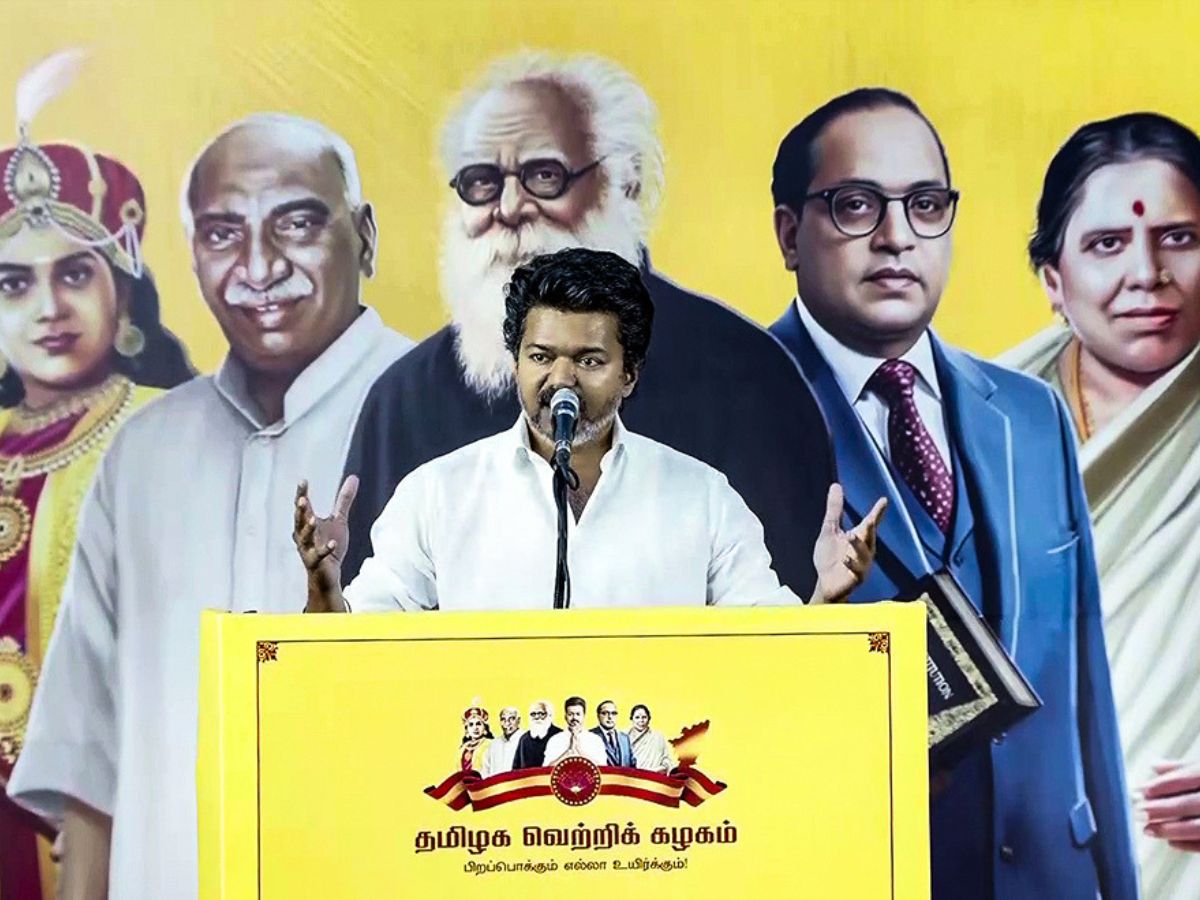

Actor-turned-politician, Thalapathy Joseph Vijay has made a calculated political entry by choosing to contest from two key constituencies Perambur in Chennai and Tiruchirappalli East (Trichy East) for the upcoming Tamil Nadu Assembly Elections on April 23.
Announcing the candidates of his party, Tamilaga Vettri Kazhagam (TVK), Vijay positioned his debut as a direct challenge to the ruling Dravida Munnetra Kazhagam (DMK), led by Chief Minister M. K. Stalin.
A Two-Seat Strategy to Maximise Entry Success
Vijay’s decision to contest from both Trichy East and Perambur is widely seen as a strategic move to secure a legislative foothold in his first electoral battle.
Both constituencies are currently held by the DMK, making his choice a high-risk, high-reward gamble.
By contesting from two seats, Vijay increases his chances of winning at least one, a tactic often used by first-time candidates to ensure political entry. At the same time, it signals his willingness to take on established strongholds rather than opt for safer constituencies.
Why is Trichy East in focus?
Trichy East is a politically significant and semi-urban constituency with over 2 lakh voters. It falls under the Tiruchirappalli Lok Sabha segment and has a diverse electorate, including a sizeable minority population.
The seat is currently represented by DMK’s Inigo S Irudayaraj, who won convincingly in 2021 with a margin of over 53,000 votes. His strong base, particularly among Christian voters, makes the constituency a challenging battleground.
However, Trichy East has shown electoral swings in the past, with the All India Anna Dravida Munnetra Kazhagam (AIADMK) previously winning the seat. For Vijay, this mix of strong incumbency and shifting voter patterns offers both risk and opportunity.
Perambur: A High-Profile Urban Battleground
Perambur, part of North Chennai, is another crucial seat in Vijay’s electoral strategy. With over 2.2 lakh voters, it is one of the largest assembly constituencies in Chennai and is known for its working-class demographic and social diversity.
The constituency is currently held by DMK’s R. D. Sekar, who secured a comfortable victory in 2021. Though historically contested by both DMK and AIADMK, Perambur has leaned towards the DMK in recent years.
The presence of a sizeable Dalit and Anglo-Indian population, along with urban voters, makes Perambur a politically dynamic seat. Vijay’s entry here is expected to intensify the contest and test his appeal among urban and grassroots voters alike.
Direct Face-Off With DMK
By choosing two DMK-held seats, Vijay has clearly positioned his campaign as a direct challenge to the ruling party. Calling the election a “two-sided fight” between his “people’s team” and M. K. Stalin’s camp, Vijay is attempting to frame the narrative as a straight contest.
This approach could help TVK consolidate anti-incumbency votes while projecting itself as a serious alternative in Tamil Nadu politics.
A Broader Party Strategy at Play
Vijay’s constituency choices are part of a larger strategy by TVK to make an impact in its debut election. Key party leaders, including General Secretary Bussy Anand, are contesting from constituencies in Chennai, particularly where the DMK is traditionally strong.
By fielding candidates in challenging seats rather than safe zones, TVK appears to be focusing on visibility, vote share expansion, and long-term positioning rather than short-term gains.
Lessons From 2021 and the Road Ahead
In the 2021 Assembly elections, the DMK returned to power with a decisive victory, winning 133 seats on its own and 159 with allies. The scale of that win underlines the challenge Vijay faces in his political debut.
However, his choice of Trichy East and Perambur suggests a carefully thought-out plan targeting high-visibility constituencies, tapping into diverse voter bases, and directly confronting the ruling party. As Tamil Nadu heads into a multi-cornered contest, Vijay’s electoral gamble could shape not just his political future but also the evolving dynamics of the state’s politics.
Sofia Babu Chacko is a journalist with over five years of experience reporting on Indian politics, crime, human rights, gender issues, and stories about marginalized communities. She believes journalism plays a crucial role in amplifying unheard voices and bringing attention to issues that truly matter. Sofia has contributed articles to The New Indian Express, Youth Ki Awaaz, and Maktoob Media. She is also a recipient of the 2025 Laadli Media Awards for gender sensitivity. Beyond the newsroom, she is a music enthusiast who enjoys singing. Connect with Sofia on X: https://x.com/SBCism




