
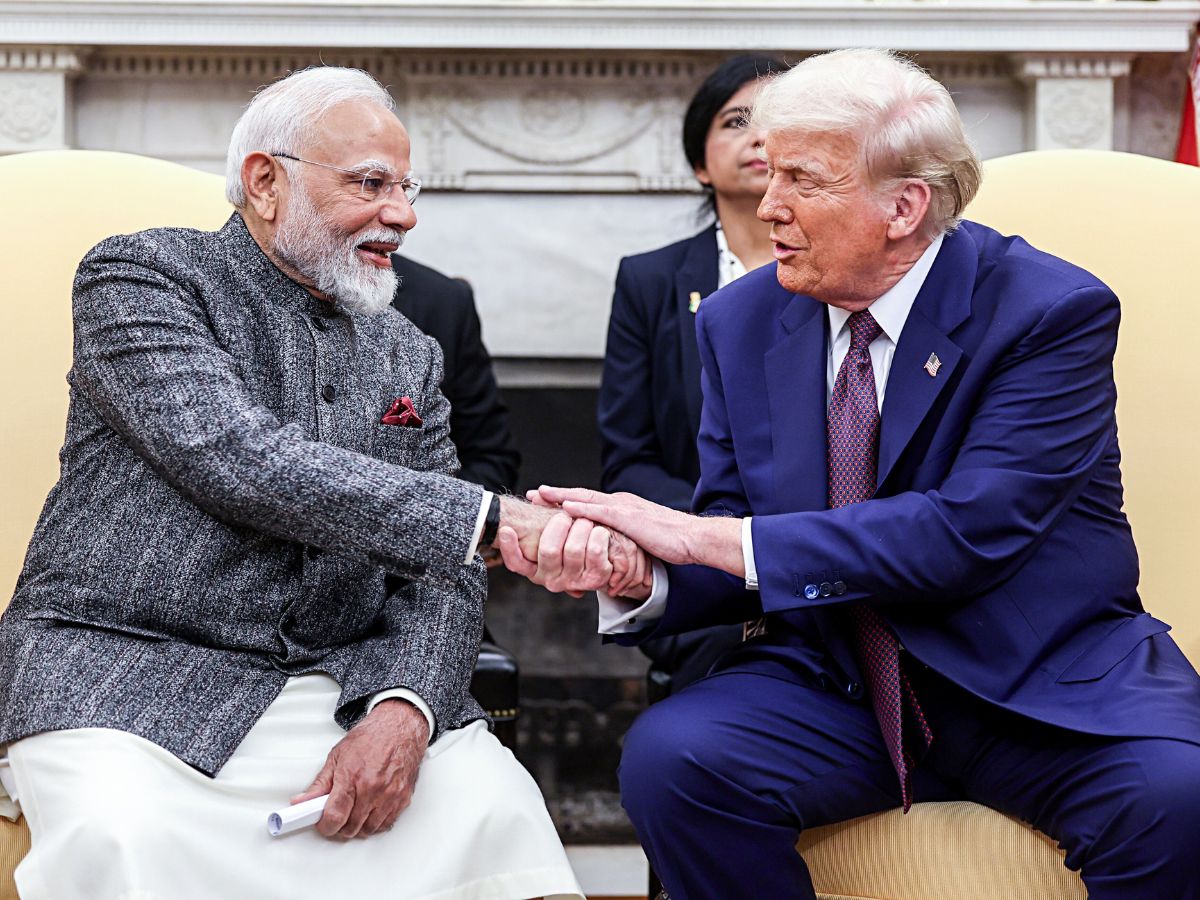

India Trade Deal: After nearly a year of tariff escalation, sharp rhetoric, and visible strain in ties, India and the United States have now announced a breakthrough trade understanding that brings reciprocal tariffs on Indian goods down to 18% from a punishing 50%.
The announcement followed a phone conversation between US President Donald Trump and Indian Prime Minister Narendra Modi, and was quickly amplified through social media posts from both leaders.
On the surface, this appears to be a straightforward trade reset that benefits Indian exporters in sectors such as textiles, gems and jewellery, leather, seafood, and engineering goods.
But Trump’s own explanation for the timing of the deal points to something much bigger than trade. He publicly claimed that PM Modi had agreed to stop buying Russian oil and would instead increase purchases from the United States and, potentially, Venezuela.
Donald Trump went a step further and suggested that this shift could “help end the war in Ukraine.”
That statement reveals the deeper geopolitical layer behind the tariff rollback.
India Trade Deal:Tariff War to Trade Reset
The past year had seen India-US trade relations deteriorate at an unprecedented pace.
In April 2025, the US imposed a 26% reciprocal tariff on Indian imports. Within months, this was raised to 25%, accompanied by warnings that India’s continued purchase of discounted Russian crude would invite penalties.
By August, tariffs had been pushed to 50%, the highest imposed on any US trade partner at the time.
This week’s decision to reduce tariffs to 18% marks a dramatic reversal.
Trump described the move as one made “out of friendship and respect” for PM Modi and claimed that India would cut tariffs and non-tariff barriers to zero for American goods while committing to purchase over $500 billion worth of US products over time.
PM Modi’s response, however, was notably crucial. He thanked Trump for the tariff reduction and spoke of cooperation between two major democracies, but made no mention of Russian oil, Venezuela, or any massive purchase commitments.
The difference in tone suggests that while a tariff reset is real, the political narratives around it are still evolving.
India Trade Deal : Why Now? The Energy Politics Behind the Deal
Trump’s remarks provide the clearest clue about the timing. For months, Washington had been pressuring New Delhi to reduce its dependence on cheap Russian oil, that surged after the Ukraine war began.
India benefited from discounted prices, while the US viewed the purchases as indirectly sustaining Moscow’s war economy.
By linking tariff relief to India’s oil sourcing decisions, Trump effectively turned trade into a tool of energy geopolitics.
Venezuela’s mention is equally important. The US has cautiously reopened engagement with Caracas amid global oil supply concerns. If India begins sourcing more crude from the US and Venezuela instead of Russia, it fits squarely into Washington’s larger strategy of isolating Moscow while stabilising global energy flows.
In this context, the trade deal becomes less about import duties and more about oil diplomacy.
Modi’s Approach: Silence Over Spectacle
Throughout the tariff escalation, New Delhi avoided public confrontation. Even as Trump criticised India sharply and tariffs touched 50%, PM Modi and External Affairs Minister S Jaishankar refrained from escalating rhetoric. Instead, India quietly strengthened trade relations elsewhere.
Over the past year, India concluded trade agreements with the UK, New Zealand, Oman, and most significantly, the European Union. The India-EU deal in particular enhanced India’s negotiating leverage and reduced the urgency to concede to US pressure.
At the same time, India’s visible engagement with Russia and China, including Modi’s meeting with Xi Jinping at the SCO and the grand state visit hosted for Vladimir Putin, sent a clear geopolitical message that India had multiple strategic options.
This strategy of diversification appears to have shifted the balance in negotiations.
The Optics That Unsettled Washington
Images of Modi alongside Xi and Putin, combined with India’s continued Russian oil purchases, reportedly irritated Trump. A report by Jefferies earlier suggested that “personal pique” may have influenced the earlier tariff escalation.
While Pakistan publicly credited Trump for diplomatic initiatives and reset its optics with Washington, India chose not to play into the theatre of personal diplomacy. Modi did not rush to publicly engage or flatter the US President during tense moments. Instead, back-channel talks continued quietly.
Over time, the pressure created by tariffs appeared to lose effectiveness as India expanded trade with other partners.
India Trade Deal: What the Tariff Cut Means for Trade
An 18% tariff does not restore pre-2025 conditions, but it significantly improves competitiveness for several Indian export sectors that depend heavily on the US market. However, the relief is not universal.
Products that fall under Section 232 of the US Trade Expansion Act, imposed on national security grounds, remain outside the scope of this tariff reduction. This includes automobiles, steel, aluminium, timber, copper, trucks, and ships.
These categories account for more than $8 billion worth of Indian exports that may continue to face higher duties despite the broader trade understanding.
A Deal Shaped by Geopolitics
While Trump framed the move as a gesture toward a “great friend,” the sequence of events suggests a more complex reality. India’s expanding trade partnerships, its refusal to engage in public sparring, and its strategic geopolitical balancing reduced the impact of tariff pressure.
At the same time, Washington’s need to recalibrate energy flows away from Russia gave India additional leverage.
In the end, tariffs dropped sharply without India publicly committing to the sweeping concessions that Trump highlighted in his statements. The full contours of the agreement may take time to become clear, but the path to this trade reset clearly ran through Moscow and Caracas as much as through Washington and New Delhi.
This was not just a trade negotiation. It was a diplomatic chess game where energy politics, patience, and strategic signalling shaped the outcome.
Sofia Babu Chacko is a journalist with over five years of experience covering Indian politics, crime, human rights, gender issues, and stories about marginalized communities. She believes that every voice matters, and journalism has a vital role to play in amplifying those voices. Sofia is committed to creating impact and shedding light on stories that truly matter. Beyond her work in the newsroom, she is also a music enthusiast who enjoys singing.




