
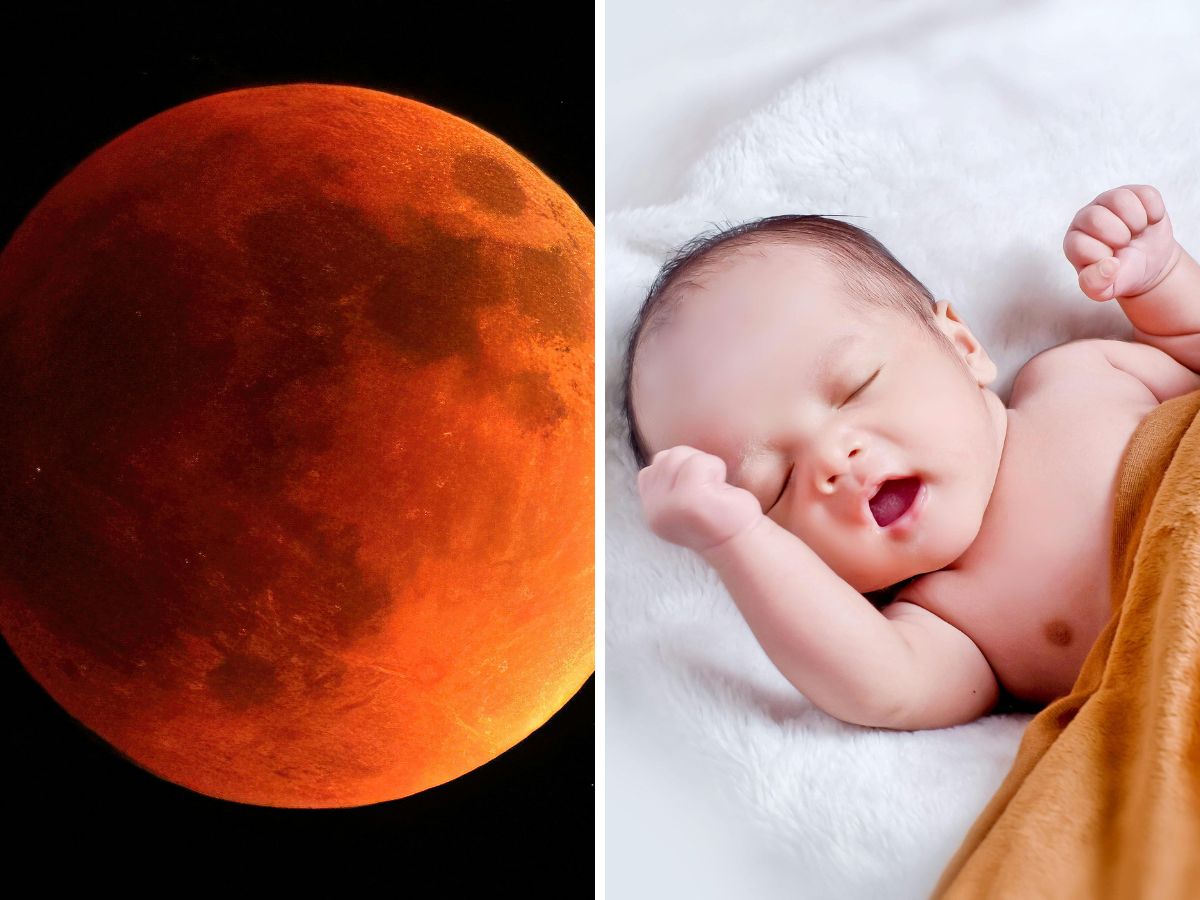

Chandra Grahan, or lunar eclipse, has a very fascinating culture believes across the world for centuries. In numerous societies, eclipse has been related with numerous theories and superstitions, specifically when it comes to childbirth.
But how science sees these claims is a different story, and is there any impact on babies born during this celestial happening? Let’s discover the facts and show up the myths surrounding this matter.
Lunar Eclipse: The Science Behind Lunar Eclipses
A lunar eclipse happens when the Earth positioned in between the Sun and the Moon, creating a shadow over the Moon. Scientifically, this phenomenon doesn’t have any straight forward effect on human health or the birth of a child.
Astronomical and medicinal specialists have clearly stated that the situation of the lunar eclipse in the sky and the Earth’s shadow have no physical impact on a baby’s development or the birthing process.
The myth of lunar eclipses disturbing babies probably stems from ancient views. In many cultural believes, it was thought that lunar eclipses carried bad luck or inclined the health of the newborn.
Though, modern scientific studies and medical professionals confirm that these are unsupported claims. There is no reliable evidence to support any impact on the baby’s health or upcoming life when born during a lunar eclipse.
Lunar Eclipse or Chandra Grahan: Cultural Beliefs and Superstitions Around the World
Although there is no scientific basis for these entitlements, cultural superstitions close to lunar eclipses continue to persevere in various parts of the world. In some cultures, it is believed that babies born in a lunar eclipse may be cursed or will be unlucky.
Whereas, some societies assess it as a sign of a superior or powerful destiny. These traditions are extremely rooted in history and continue to shape social views on childbirth, in spite of the lack of scientific support.
What Experts Say about Lunar Eclipse or Chandra Grahan
Healthcare specialists and astronomers believes that there is no danger to the baby or mother during a lunar eclipse. The birth time with respect to the eclipse embraces no significance. As with any other birth, medical professionals emphasis on the security of both the mother and child, depend on on established healthcare practices and technology.
As per the study by the American Pregnancy Association, there is no sign that the moon’s phases, together with lunar eclipses, have any behavioral impact on human pregnancy.
Therefore, despite the fact lunar eclipses continue a source of fascination and myth, the birth of a child through such an event embraces no distinct significance or effect on the health of the newborn. As with any other celestial variations, it is important to distinct fact from fiction, depend on on medical science to guide healthcare choices.
Also Read: Blood Moon 2025: Lunar Eclipse Secrets Revealed, Here’s Why Some Are Different From Others?
Ankur Mishra is a journalist who covers an extensive range of news, from business, stock markets, IPOs to geopolitics, world affairs, international crises, and general news. With over a decade of experience in the business domain, Ankur has been associated with some of the reputed media brands. Through a sharp eye on global marketplaces along with deep insights and analysis of business strategies, Ankur brings simplicity to the complex economic matrix to decode market trends and empower people.
He is committed to entrenched data, facts, research, solutions, and a dedication to value-based journalism. He has covered trade tariff wars, international alliances, corporate policies, government initiatives, regulatory developments, along with micro- and macroeconomic shifts impacting global fiscal dynamics.




