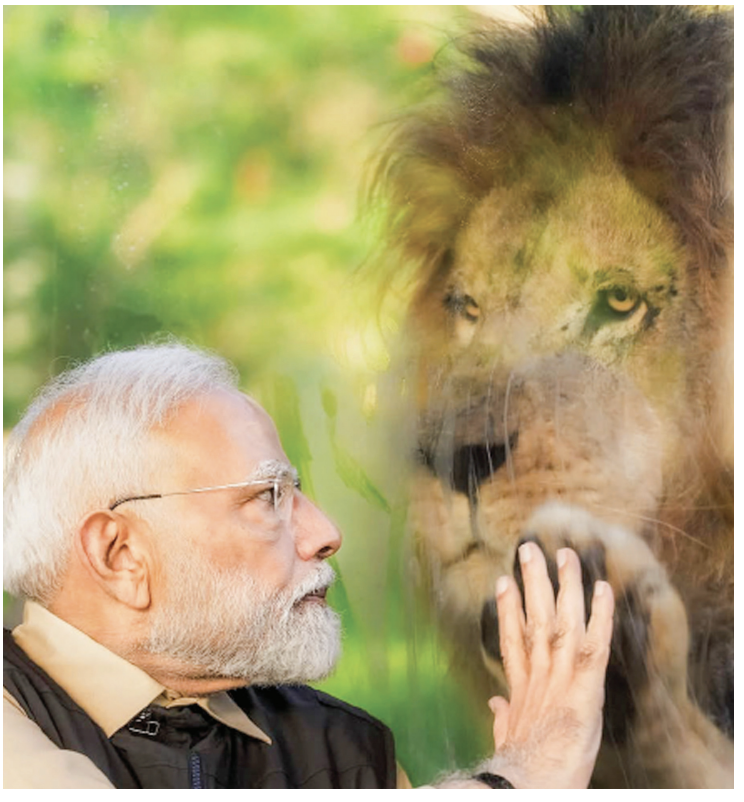

The Atharva Veda declares, “The Earth is our Mother and we are her children.” This timeless ethos of coexistence with nature has been at the heart of India’s civilisational journey. Over the last elev- en years, Prime Minister Narendra Modi’s govern- ment has sought to align national development with this philosophy, turning India into a global leader in environmental protection, renewable energy, and sus- tainable growth. From har- nessing the power of the sun to reviving the Ganga, from pioneering the Green Hy- drogen Mission to reintro- ducing cheetahs on Indian soil, the vision has been one of balance between progress and preservation.
Renewable Energy: Powering Growth, Protecting Nature When PM Modi assumed office in 2014, India was seen as a reluctant partici- pant in climate negotiations. Today, it is recognised as a global pioneer in renew- able energy adoption. The country has nearly tripled its renewable energy capac- ity since 2014, with solar en- ergy capacity alone growing by over 3,600%. India has achieved its COP21 target of 40% installed electricity capacity from non-fossil fuel sources nine years ahead of schedule, demonstrating its commitment to climate ac- tion. Landmark initiatives like the International Solar Al- liance (ISA), co-founded by India, aim to mobilise over $1 trillion in solar invest- ments by 2030, bringing clean energy within reach of developing nations. On the domestic front, the UJALA programme has distributed more than 36.8 crore LED bulbs, significantly reduc- ing carbon emissions while saving households thou- sands of crores in energy costs. In addition, over 49 lakh agricultural pumps are be- ing solarised under PM-KU- SUM, reducing dependence on conventional energy sources while empowering farmers with clean energy solutions.
Green Hydrogen Mission: FuelLing the Future A cornerstone of India’s clean energy vision is the National Green Hydrogen Mission, launched to make the country a hub for the production and export of green hydrogen. This initia- tive aims not only to achieve energy independence but also to place India at the forefront of the global en- ergy transition. By tapping into abundant renewable resources like so- lar and wind, India seeks to replace fossil fuels in indus- tries such as steel, chemi- cals, and transport. This will reduce dependence on imports, cut emissions, and create a new ecosystem of innovation and green jobs.
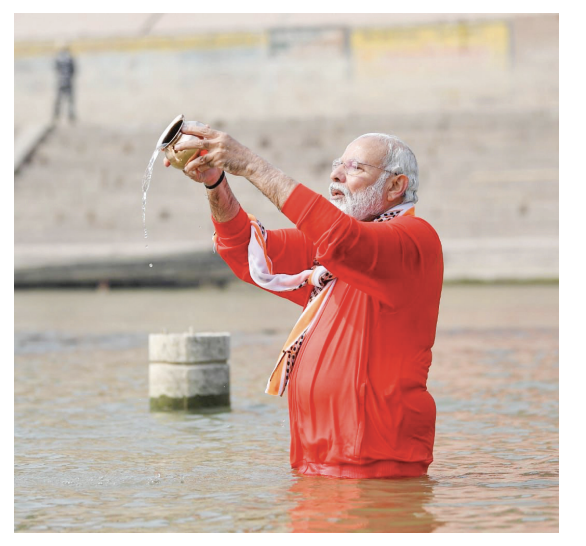
Namami Gange: Reviving the Lifeline of India The Ganga is not just a river—it is a lifeline for mil- lions and a symbol of India’s spiritual heritage. Launched in 2014, the Namami Gange programme has been one of the most ambitious river rejuvenation projects in the world. It has successfully curbed pollution, improved water quality at several stretches, and restored the ecological health of the river. What sets this initiative apart is the emotional con- nect of the Prime Minister with the river—he even donated proceeds from the auction of gifts received by him to Namami Gange, un- derlining his personal com- mitment. Today, the pro- gramme stands as a global model for integrated river basin management.
Life to Lifestyle for Environment At the COP26 Summit in Glasgow, PM Modi intro- duced a simple yet power- ful idea: LiFE – Lifestyle for Environment. The phi- losophy emphasises that climate action begins at the individual level, with con- scious choices in consump- tion and lifestyle. From promoting energy- efficient appliances to en- couraging the end of sin- gle-use plastics, LiFE has been positioned as a global movement. It shifts the dis- course from government- led policies to citizen-led action, transforming envi- ronmental con- sciousness into a mass movement. Linked initiatives such as GOBARdhan (Galvanising Organic Bio- Agro Resources Dhan) embody the circular econ- omy by converting cattle dung and agricultural waste into biogas and com- post. This not only ensures village cleanliness but also provides farmers with ad- ditional income streams.
Project Cheetah:Restoring Ecological Heritage After 70 years, India wit- nessed the return of the cheetah with the world’s first inter-continental large wild carnivore transloca- tion project. Under Project Cheetah, African cheetahs were relocated to Kuno National Park, Madhya Pradesh, marking a historic moment in global wild- life conservation. In 2023, cheetah cubs were born in the wild in India, signal- ling a successful revival of a species once declared ex- tinct in the country. This effort complements India’s broader focus on biodiversity, symbolising both ecological responsibil- ity and national pride.
Forest AND Tiger Conservation: Guardians of the Green India has made remarkable strides in forest and wild- life conservation. As per the 2022 census, the coun- try’s tiger population has reached a record 3,682 in- dividuals, more than dou- bling in the past decade. India now hosts 75% of the world’s tiger population, reinforcing its role as the planet’s tiger capital. At the same time, forest cover has expanded signifi- cantly, re- flecting India’s commit- ment to balance economic growth with ecological preservation. More than 142 crore trees have been planted under campaigns like Ek Ped Maa Ke Naam, ensuring that environmen- tal action becomes a par- ticipatory, people-driven effort. India has also expanded its network of Ramsar sites, increasing the count from 26 in 2014 to 85 in 2025, thereby safeguarding wet- lands crucial for migratory birds and aquatic biodiversity.
Global Leadership in Climate Action India’s transformation un- der PM Modi is not limited to domestic policies. Inter- nationally, the country has emerged as a champion of climate justice, ensuring that equity remains central to global negotiations. At COP26, PM Modi’s Panchamrit commitments set clear goals: achieving 500 GW of non-fossil fuel energy capacity by 2030, reducing emissions inten- sity by 45%, and achieving net-zero by 2070. These targets reflect ambition tempered with realism, aligning growth with sus- tainability. Moreover, India’s proac- tive disaster readiness— strengthened by a Rs 46,000 crore fund, 16 NDRF battal- ions, and resilient infra- structure systems—shows its focus on both adapta- tion and mitigation.
Citizens as Partners in Change From the Swachh Bharat Abhiyan to the ban on single-use plastics, PM Modi has consistently transformed environ- mental goals into mass movements. By involving citizensbe it through tree-planting drives, clean energy adoption, or waste- to-wealth projectsIndia has demonstrated that large-scale change is possi- ble only when governance and grassroots work hand- in-hand. Over the past eleven years, India’s environ- mental journey under PM Modi has been marked by ambition, innovation, and inclusivity. The coun- try has tripled renewable energy capacity, launched the world’s most ambi- tious green hydrogen pro- gramme, revived the Gan- ga, reintroduced cheetahs, and doubled its tiger popu- lation. At the same time, initiatives like LiFE and GOBARdhan have ensured that sustainability is not an abstract policy goal but a lived reality for millions. India’s story is one of confidence and conviction: growth without compro- mising the environment, development that heals rather than harms. As PM Modi has often said, “There should not only be climate change, but a change in lifestyle for climate.” In the Amrit Kaal, India’s commitment to environment and sustainability is shaping a greener, cleaner, and more resilient future for generations to come.