
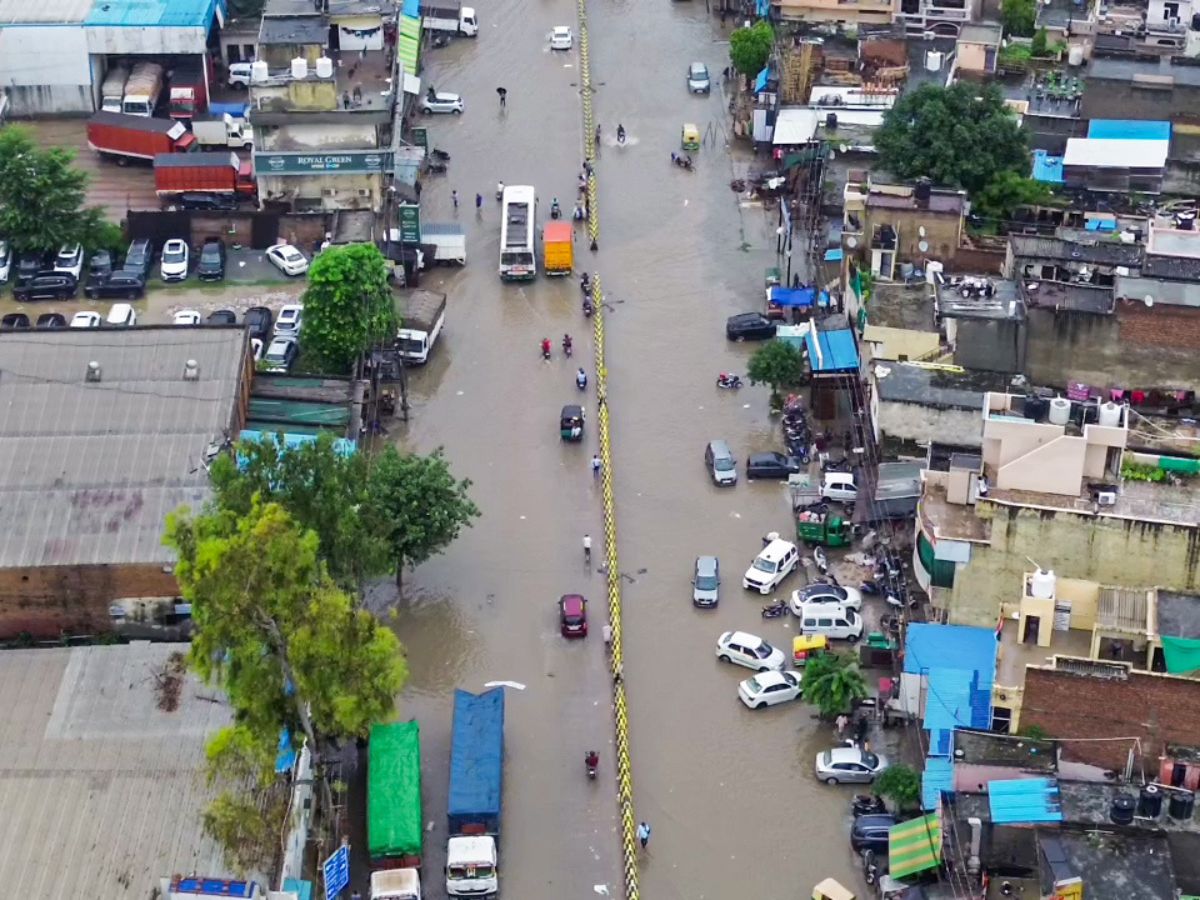

A short but strong bout of rain 100 mm in a mere four hours was sufficient to bring the ‘Millennium City’ to grinding halt this week. Roads were converted into streams, NH-48 saw huge jams, and office-goers were left stranded for hours. For the residents, this is no new thing. Gurugram is flooded every monsoon. Anger goes viral on social media, promises from the government are made, and yet the same thing happens again and again until the next cloudburst.
Why Gurugram Floods Every Year?
Experts attribute numerous reasons behind Gurugram’s annual monsoon sufferings. Poorly planned flyovers that disregard drainage patterns, blocked stormwater drains filled with plastic trash, and uncontrolled urbanization have all decreased the city’s capacity for water absorption. Earlier well-endowed recharge areas of the Aravalli hills and their sandy foot slopes, or bhood, have been cleared to make way for real estate and highways. These natural sponges previously soaked up surplus rainwater and refilled groundwater. Without them, runoffs have nowhere to go saturating the city with water within hours of a downpour.
Governance and Planning Failures
Adding to Gurugram’s misery is the absence of long-term planning. Although Gurugram is India’s corporate center, infrastructure in Gurugram has not been able to match its expansion. The Central Ground Water Board has already rated it a “dark zone,” where groundwater extraction is much more than recharge. “During monsoon, waterlogging turns the commute to hell. MG Road, which is one of the busiest and major roads between Delhi and Gurgaon, turns into a nightmare everyday during monsoon. What government can do is, to improve the drainage system as soon as possible” a resident told NewsX. Most people contend that stopgap solutions like work-from-home permits during rains are only pointing to the city’s structural deficiencies.
The Larger Picture: India’s Urban Flooding
Urban flooding has been a reality in India. When the rainfall is too much for a city’s drainage capacity, colonies, roads, and business districts are inundated. From Punjab to Himachal Pradesh, uncontrolled growth on delicate ecosystems increases the effects of heavy rain. Gurugram is an egregious case of how climate change and poor planning intersect, transforming a smart city vision into a civic nightmare.
Can Gurugram Still Be Saved?
Urban planners caution that Gurugram is heading to an irreversible calamity unless all the players involved take certain actions. Urban planners relate not only to restoring some of the Aravalli hills, preserving natural recharge areas for tanks, updating drainage, and controlling unregulated building. Without integrated planning, Gurugram will become uninhabitable during monsoons soon. The decision is simple: either plug the gaps in planning now, or let India’s business capital drown annually in its own complacency.
ALSO READ: ‘We Are Stuck With The Same Problem’: Why Gurugram Can’t Escape Urban Flooding Every Year?
Sofia Babu Chacko is a journalist with over five years of experience reporting on Indian politics, crime, human rights, gender issues, and stories about marginalized communities. She believes journalism plays a crucial role in amplifying unheard voices and bringing attention to issues that truly matter. Sofia has contributed articles to The New Indian Express, Youth Ki Awaaz, and Maktoob Media. She is also a recipient of the 2025 Laadli Media Awards for gender sensitivity. Beyond the newsroom, she is a music enthusiast who enjoys singing. Connect with Sofia on X: https://x.com/SBCism




