
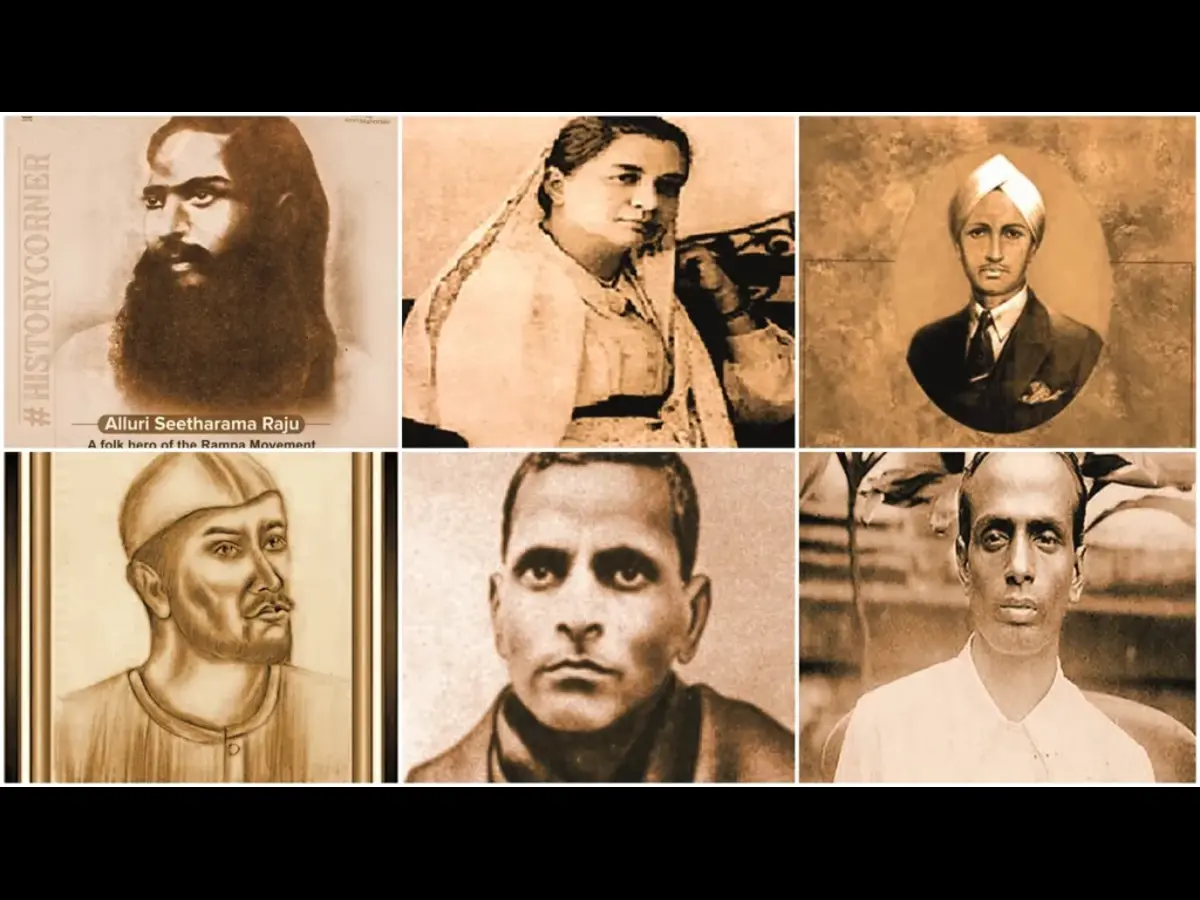

When India awoke to freedom at the stroke of midnight on August 15, 1947, the world witnessed the triumph of a nation that had endured centuries of colonial rule. While names like Mahatma Gandhi, Jawaharlal Nehru, and Subhas Chandra Bose are rightfully celebrated for their leadership, the history of India’s independence is equally shaped by countless unsung heroes, ordinary individuals who risked everything for a dream of sovereignty, yet faded into the margins of history.
The Revolutionaries
India’s freedom struggle was not confined to the speeches of leaders or the halls of political meetings; it was fought in villages, forests, printing presses, and battlefields by people whose courage often went unrecorded. These individuals, spread across regions and communities, embodied the spirit of resistance in their own unique ways.
One such figure was Matangini Hazra, a 73-year-old woman from West Bengal who became an active participant in the Quit India Movement. Despite her age, she led processions against British rule, waving the Indian flag until she was shot by colonial police. Her dying moments chanting “Vande Mataram” with the tricolour in her hands remain etched as a symbol of resilience.
Similarly, Peer Ali Khan, a revolutionary from Bihar, played a vital role in the 1857 uprising. Arrested for distributing anti-British pamphlets, he was tortured and executed. His defiance reflected the spirit of countless nameless rebels who resisted British rule long before the national movement gained momentum.
Tribal and Rural Resistance
The struggle for independence was also carried on the shoulders of tribal communities, often overlooked in mainstream narratives. Leaders like Birsa Munda in Jharkhand spearheaded movements against exploitative British forest laws and land policies in the late 19th century. He inspired tribal generations across the region, blending the fight for cultural survival with the demand for freedom.
In the forests of Odisha, Laxman Naik, a Gond tribal leader, mobilized his people during the Quit India Movement. His execution in 1943 for protesting against colonial policies is a reminder that the fight for independence was not limited to cities but was deeply rooted in rural and tribal struggles.
The Silent Foot Soldiers
Freedom also owed its success to those who worked quietly behind the scenes couriers, underground publishers, and local organizers who risked imprisonment to keep the resistance alive. The story of Bhikaji Cama is a striking example. Living in exile, she raised the first version of the Indian national flag in Stuttgart, Germany, in 1907, drawing global attention to India’s plight. Her work in mobilizing support abroad ensured the independence movement was not an isolated cause.
Similarly, Tirupur Kumaran, a young activist from Tamil Nadu, died in 1932 holding the banned national flag after being assaulted by British police during a protest march. He was only 27 years old, yet his determination became a rallying cry for Tamil Nadu’s youth.
Women Beyond the Known Names
While Sarojini Naidu and Kasturba Gandhi are well remembered, there were many women whose sacrifices went unnoticed. Kanaklata Barua, an 18-year-old from Assam, led a procession to hoist the national flag at a police station during the Quit India Movement. She was shot dead before she could reach the building, yet her courage inspired generations in Northeast India.
Another remarkable figure was Aruna Asaf Ali, who defied arrest during the Quit India Movement by hoisting the Congress flag at Mumbai’s Gowalia Tank Maidan in 1942. Her leadership in underground resistance activities earned her the title “Grand Old Lady of the Independence Movement,” though her contributions are still less celebrated compared to her male contemporaries.
Forgotten Martyrs of Armed Resistance
India’s freedom movement was not solely non-violent. Many took up arms against the British, embracing the path of revolution. Jatin Mukherjee, known as Bagha Jatin, organized daring raids against British forces and inspired a network of revolutionaries across Bengal. His death in a gun battle with British police in 1915 marked him as a martyr for the cause.
In Punjab, Udham Singh avenged the Jallianwala Bagh massacre by assassinating Michael O’Dwyer in London in 1940. Though his act was condemned by colonial authorities, for millions of Indians, it symbolized justice for one of the darkest days in British India.
Why Their Stories Matter Today
The freedom we celebrate today was built on the sacrifices of both celebrated leaders and countless unsung warriors. Many of these individuals were not part of grand political strategies; they acted from sheer conviction, guided by a love for their land and its people. Their stories reveal that independence was a collective achievement, woven from the bravery of people from every region, caste, class, and gender.
Remembering these forgotten heroes is not only a matter of historical justice but also a source of inspiration. In a time when patriotism risks being reduced to mere symbolism, their lives remind us that true service to the nation often demands personal sacrifice, unwavering integrity, and quiet courage.
Honouring the Legacy
Efforts are now being made to bring these lesser-known figures into the mainstream narrative. Museums, local history projects, and academic research are uncovering forgotten documents, oral histories, and personal letters that shed light on their contributions. Schools and universities are gradually including them in curricula, ensuring that future generations understand the depth and diversity of India’s freedom struggle.
As India moves towards the centenary of its independence in 2047, acknowledging these hidden stories becomes all the more important. They are not mere footnotes to history, they are its backbone. By telling their stories, we enrich our understanding of the past and strengthen the values of courage, unity, and sacrifice that continue to shape the nation’s journey forward.
India’s independence was not a gift; it was earned through the blood, sweat, and dreams of millions, many of whom remain nameless in history books. Honouring these unsung heroes is a tribute not just to their memory but to the very spirit of freedom itself.
Also Read: India Marks 79th Independence Day, Celebrating Freedom, Unity, and a Vision for “Naya Bharat”




