
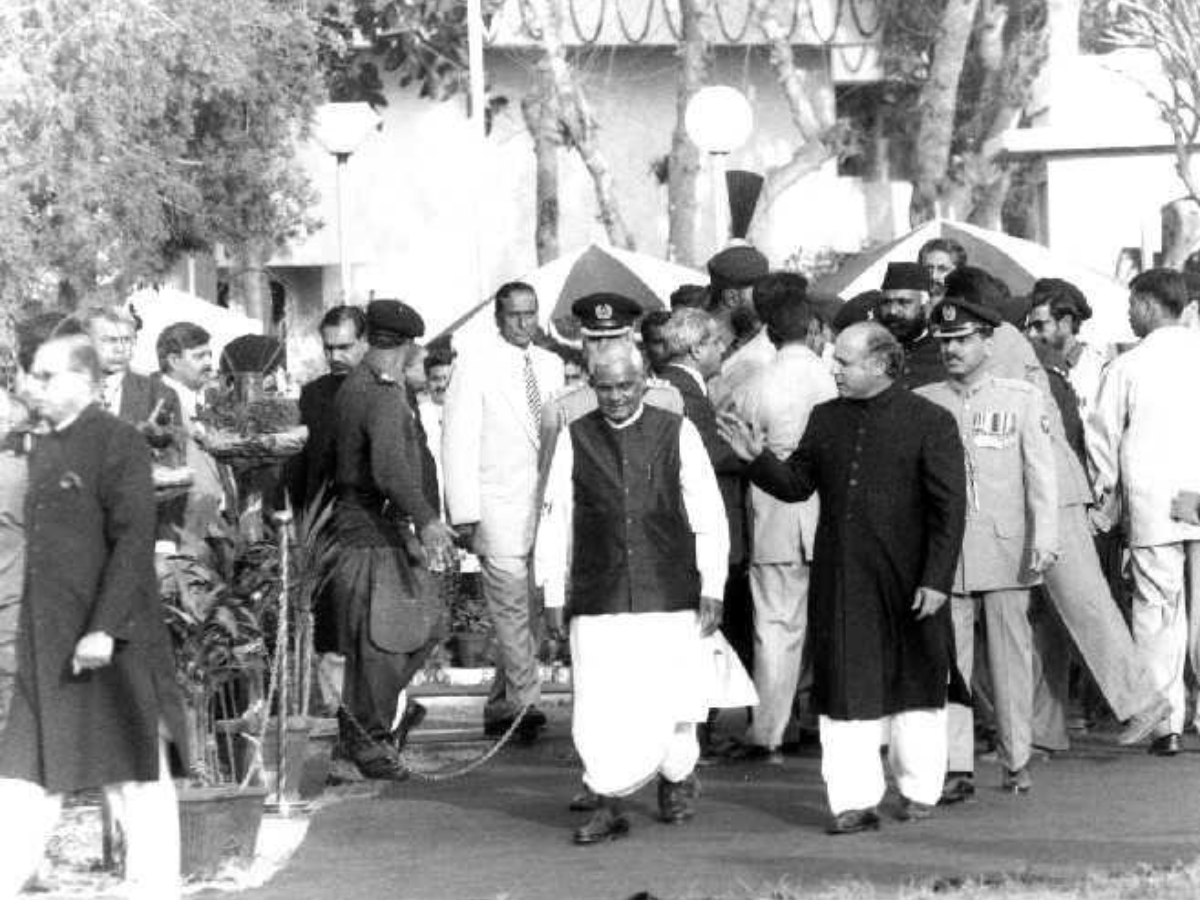

Atal Bihari Vajpayee, former Prime Minister of India, led with unmatched strength and courage. He always stood firm for India’s interests and never let political differences stop him from defending the nation. Known for his powerful speeches, Vajpayee inspired generations with his voice and vision.
He showed courage beyond expectations when he gave the green signal for Pokhran-II nuclear tests in 1998. By doing this, he officially ended India’s self-imposed freeze on nuclear testing. Speaking to the world with confidence, Vajpayee said, “India is now a nuclear weapon state,” marking a turning point in India’s defence and global standing.
Vajpayee’s Warning to Pakistan During the Kargil War
During the 1999 Kargil War, Vajpayee sent a confidential message to then-US President Bill Clinton. Since Clinton was in Geneva, National Security Adviser Sandy Berger received the letter. Vajpayee clearly warned that India might attack inside Pakistan if it did not withdraw troops that had occupied Indian military posts.
The United States later informed India that Pakistan’s General Pervez Musharraf had threatened a nuclear strike. Vajpayee firmly responded, “Pakistan sena ke parmaṇu hamle se Bharat ka toh kuch nahin bigṛega, lekin kal ka Suraj nahi dekhega, Pakistan.” His words sent a strong and clear message of India’s resolve.
Support for India in the 1971 War with Pakistan
Atal Bihari Vajpayee never let politics interfere with national unity. During the 1971 war with Pakistan, he strongly supported Prime Minister Indira Gandhi. Though he led the Jan Sanghthen the largest opposition party -he stood by the government in a time of national crisis. In Parliament, Vajpayee said, “Today, I am not ready to speak on behalf of any political party. Right now, the entire nation is one party.” He called on all Indians to stand united and to make whatever sacrifices the war demanded. His words reflected his belief in national unity during the most difficult times.
In a memorable speech delivered during the 1971 conflict, Vajpayee addressed Parliament with emotion and clarity. He said, “We are going through a trial by fire. There is no reason why we should not emerge from this fire purified like gold.” Vajpayee reminded everyone that defending India’s borders remained the nation’s highest duty. He added, “We must teach the rulers of Pakistan a lesson they will never forget.”
Praise for Indira Gandhi After Pakistan’s Surrender
After Pakistan’s surrender in December 1971, Atal Bihari Vajpayee stood in Parliament and applauded Prime Minister Indira Gandhi for leading India to victory. He joined the entire House in a standing ovation. Vajpayee said, “The Prime Minister must now lead the country to total victory over the enemy.” He assured the government that his party would fully support any steps needed to strengthen India.
This act of cooperation highlighted how Vajpayee placed the country above all political boundaries. Even as an opposition leader, he chose unity and national interest when the country faced threats from outside forces.
Atal Bihari Vajpayee led not just with authority, but with vision. He believed in a united and strong India and showed that leadership means putting the country first. His actions during the Kargil War, the Pokhran-II nuclear tests, and the 1971 India-Pakistan conflict reflect his deep commitment to national security and unity.
Must Read: Miyan Sahab Ne Joote Khane Akele Bhej Diya’: When Pakistan DGMO Came Alone To End The Kargil War
Swastika Sruti is a Senior Sub Editor at NewsX Digital with 5 years of experience shaping stories that matter. She loves tracking politics- national and global trends, and never misses a chance to dig deeper into policies and developments. Passionate about what’s happening around us, she brings sharp insight and clarity to every piece she works on. When not curating news, she’s busy exploring what’s next in the world of public interest. You can reach her at [swastika.newsx@gmail.com]




