
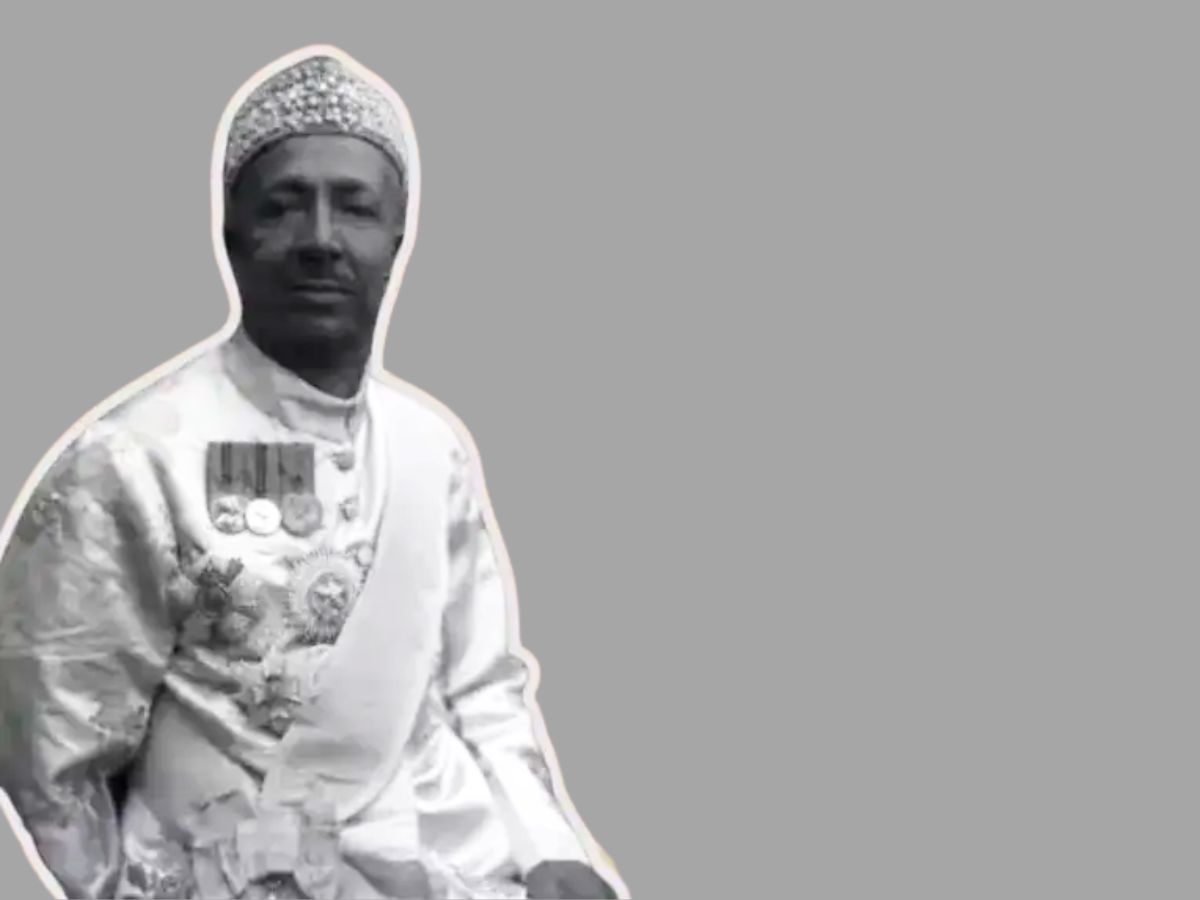

In a country where millions depend on crowded platforms and overbooked cabins, the idea of a railway station built exclusively for a single man sounds almost mythical. Yet, in the heart of Uttar Pradesh, history quietly preserves one of India’s most extravagant tales the story of Nawab Hamid Ali Khan, a ruler whose imagination and wealth ran on their own track, quite literally.
A Railway Station Fit for Royalty
At a time when the British Raj had just begun to lace the subcontinent with steel tracks, the Nawab of Rampur envisioned something far grander. He didn’t want a train that stopped near his palace he wanted one that entered it. What rose from this desire was a private railway line and station inside the sprawling Rampur Palace, a marvel of engineering and royal indulgence now estimated to be worth Rs 113 crore.
The station was not merely functional. It was a jewel box of Indo-Islamic and colonial architecture marble-inlaid floors, ornamental jaali work, and iron pillars engraved with the Rampur crest. When the Nawab travelled, guards sounded trumpets and velvet carpets were unfurled on the platform. For his subjects, the railway was a lifeline. For him, it was a red-carpet entrance draped in steam and authority.
The Saloon: A Palace on Wheels
In 1925, Nawab Hamid Ali Khan commissioned Baroda State Rail Builders to create his own four-coach royal train, famously known as The Saloon. Each coach was a masterpiece: Persian carpets, gleaming chandeliers, carved teakwood interiors, and silk drapes that barely moved even when the train swayed.
The Saloon wasn’t just a mode of travel it was a self-contained world. It featured a bedroom, dining hall, kitchen, and a recreation room. Additional coaches carried guards, cooks, and attendants. While ordinary Indians waited in long queues for third-class tickets, the Nawab travelled like a king in motion.
A Royal Gesture During Partition
Beyond its grandeur, the Nawab’s train also became a vessel of hope in one of South Asia’s darkest chapters. After the Partition in 1947, Hamid Ali Khan used his private rail line to safely transport families migrating to Pakistan. It remains one of the lesser-known stories of humanitarian action by an Indian royal during widespread turmoil.
In 1954, he handed over two of his train coaches to the Government of India, where they remained in service until 1966, the year of his death. It marked the end of an era where aristocracy, modernity, and compassion travelled hand in hand.
Decline of a Royal Legacy
After the Nawab’s passing, the private station’s grandeur began to fade. His successor, Nawab Raza Ali Khan, could not maintain the extensive costs required to run a personal rail system. The abolition of the privy purse the government stipend given to former royals was the final blow.
By the late 1960s, the once-thundering tracks fell silent. Dust gathered where locomotives once glided, and the station that symbolised unmatched royal ambition slipped into memory.
A Symbol of India’s Forgotten Opulence
Today, the story of Nawab Hamid Ali Khan stands as a striking reminder of an India where imagination was limitless and extravagance was a form of statecraft. In an age now defined by skyscrapers, private jets, and luxury cars, the Nawab’s vision seems almost poetic a ruler who brought the railway to his doorstep, not to flaunt power alone, but to redefine what comfort and mobility could mean.
As one historian put it, “The Nawab didn’t merely travel by train he transformed the train into a royal experience.”
A century later, the station still whispers that story, its silent tracks echoing the rumble of a bygone world where royalty lived life on rails and lived it grandly.
Sofia Babu Chacko is a journalist with over five years of experience reporting on Indian politics, crime, human rights, gender issues, and stories about marginalized communities. She believes journalism plays a crucial role in amplifying unheard voices and bringing attention to issues that truly matter. Sofia has contributed articles to The New Indian Express, Youth Ki Awaaz, and Maktoob Media. She is also a recipient of the 2025 Laadli Media Awards for gender sensitivity. Beyond the newsroom, she is a music enthusiast who enjoys singing. Connect with Sofia on X: https://x.com/SBCism




