
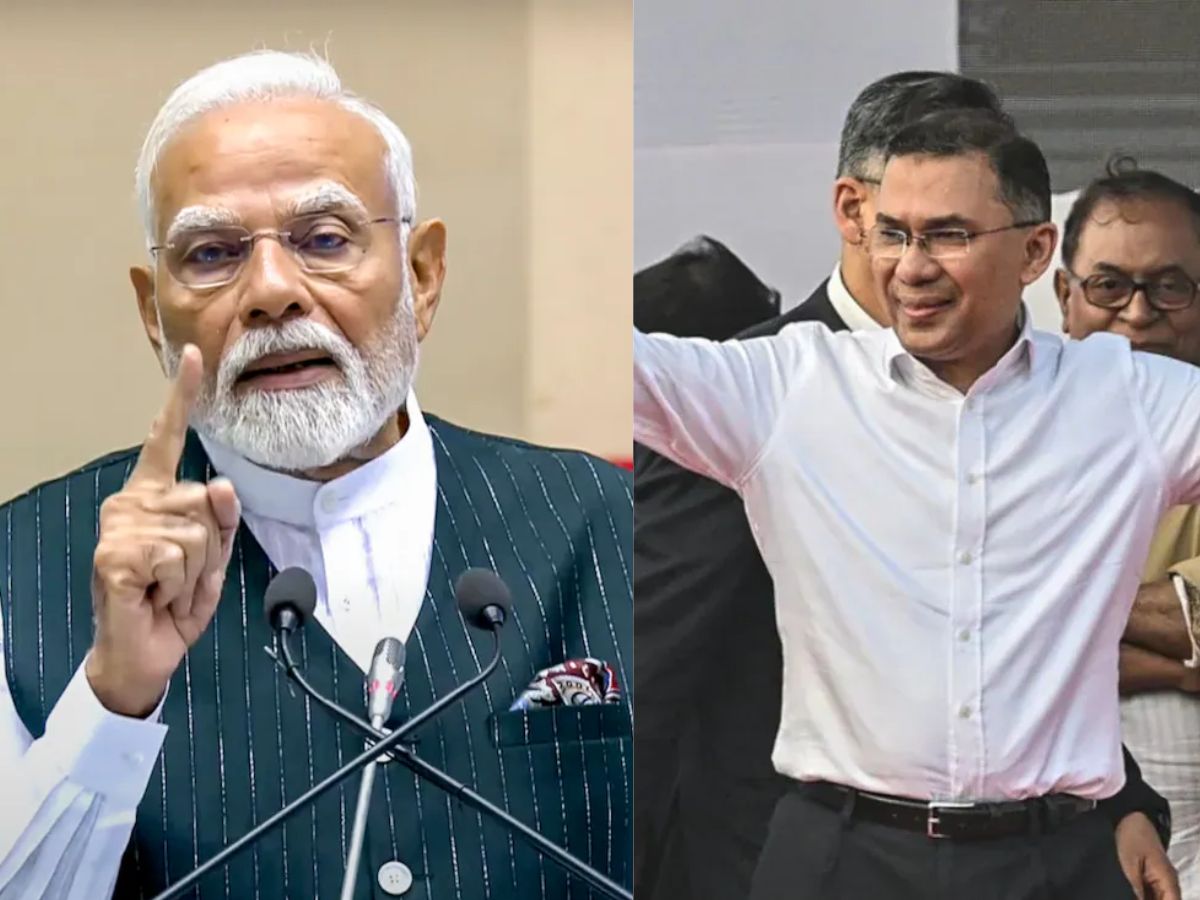

Bangladesh’s Prime Minister-elect Tarique Rahman on Saturday made his position clear on relations with India, asserting that the country’s foreign policy will be guided solely by national interest. Addressing his first press conference after the Bangladesh Nationalist Party’s (BNP) sweeping electoral victory, Rahman said, “The interests of Bangladesh and its people will determine our foreign policy.”
His remarks come amid heightened regional attention on Dhaka’s future engagement with New Delhi following a dramatic political transition.
BNP Secures Two-Thirds Majority After Political Upheaval
The Bangladesh Nationalist Party (BNP) secured a decisive two-thirds majority in the February 12 national elections, marking its return to power after nearly two decades. The party won 212 of the 297 seats in Parliament, decisively defeating rivals including Jamaat-e-Islami.
The election followed months of instability after the ouster of former Prime Minister Sheikh Hasina in a Gen Z-led uprising in 2024. Rahman, who recently returned from a 17-year exile, led the BNP campaign on a “Bangladesh First” plank, promising economic recovery, improved governance, and restored law and order.
‘No Country Will Be Treated as Master’
Speaking specifically about India, Rahman emphasized that Dhaka would pursue a balanced foreign policy.
“The interests of Bangladesh and its people will determine our foreign policy,” he reiterated when asked about ties with neighbouring India.
He added that a BNP-led government would maintain balanced relations with regional powers including India, China, and Pakistan, and would not treat any country as its “master.” The statement signals a recalibration of Dhaka’s diplomatic approach after years of close ties with New Delhi under Hasina’s leadership.
BNP Signals Outreach to India
Rahman’s adviser, Humayun Kabir, echoed the call for balanced engagement, saying the new government seeks to build stronger people-to-people ties with India.
“Obviously there are certain domestic priorities and then international engagements. Of course India will be one of the countries that we will visit among other countries in the region,” Kabir said in media interactions.
For India, the BNP has often been viewed as a more moderate alternative to Jamaat-e-Islami, despite historically complex ties between New Delhi and the BNP.
India Responds Swiftly to Election Outcome
India moved quickly to engage with the incoming leadership. Prime Minister Narendra Modi was among the first global leaders to congratulate Rahman publicly. In a post on X, Modi said India would continue to support a “democratic, progressive and inclusive Bangladesh” and expressed his desire to strengthen bilateral cooperation.
The two leaders also spoke over the phone shortly after the results were declared, underscoring New Delhi’s intent to reset ties following strain under the interim administration led by Muhammad Yunus.
Sources indicate that Dhaka may invite Modi to Rahman’s swearing-in ceremony, signaling a potential thaw and fresh beginning in India-Bangladesh relations.
Regional Stakes High Amid Minority Concerns
Bangladesh’s ties with India have remained under scrutiny in recent months, particularly amid concerns raised by New Delhi over reported attacks on the minority Hindu community in Bangladesh. Additionally, the presence of Sheikh Hasina in New Delhi after her ouster added a diplomatic layer to bilateral tensions.
With the BNP now set to form the government, both sides appear keen to stabilise and redefine the relationship on mutually beneficial terms.
As Rahman prepares to take oath as Bangladesh’s next Prime Minister, his early messaging suggests that while India remains a key regional partner, Dhaka’s diplomacy will be firmly anchored in what he calls the “interests of Bangladesh and its people.”
Sofia Babu Chacko is a journalist with over five years of experience covering Indian politics, crime, human rights, gender issues, and stories about marginalized communities. She believes that every voice matters, and journalism has a vital role to play in amplifying those voices. Sofia is committed to creating impact and shedding light on stories that truly matter. Beyond her work in the newsroom, she is also a music enthusiast who enjoys singing.




