

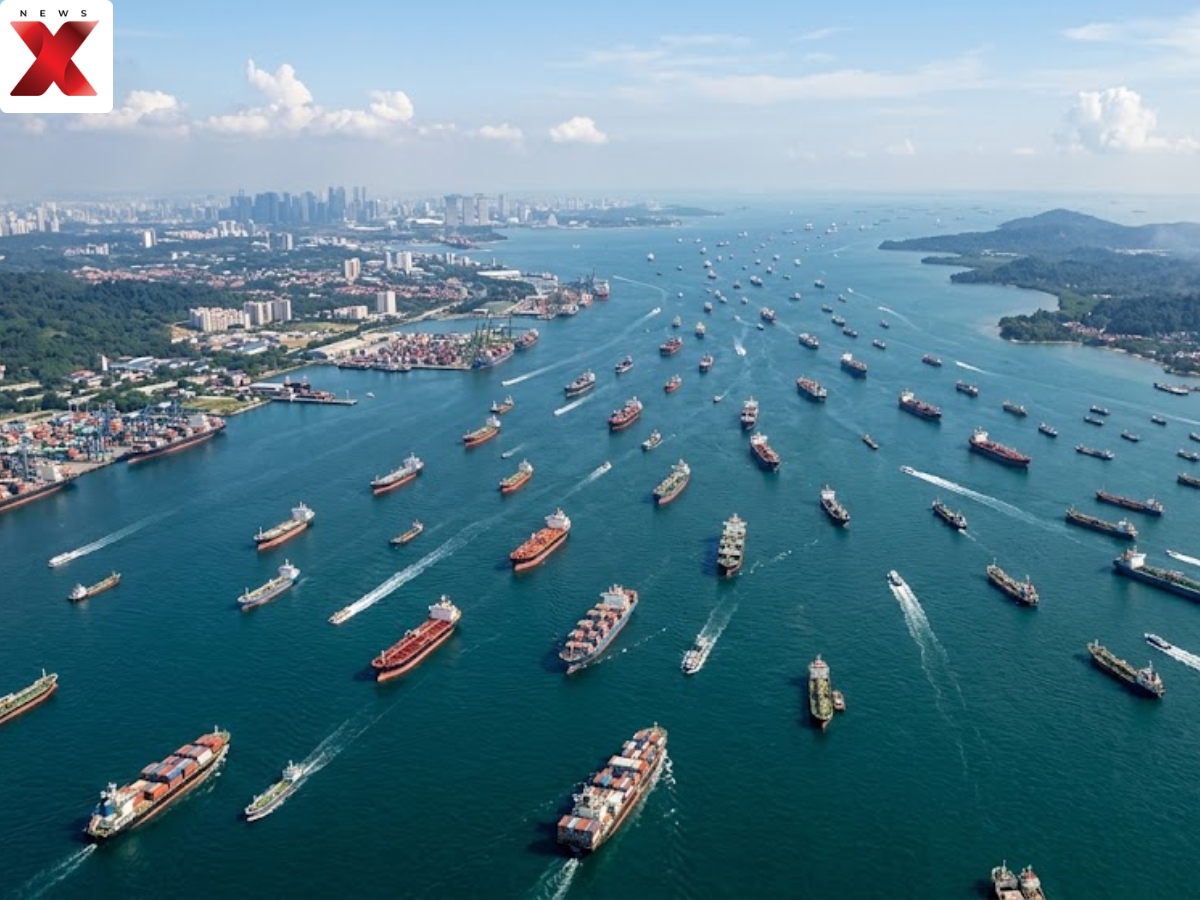
As Iran and the US continue to fight over the control of the Strait of Hormuz in the Persian Gulf, a new deal between the US and Indonesia is raising eyebrows in Southeast Asia. The two countries have inked a new defence deal, raising questions if US President Donald Trump is looking to control another strategic choke point – the Strait of Malacca. The strategic maritime corridor connects India Ocean with East and Southeast Asia. According to the reports, Jakarta has given full access to Washington to operate in its Airspace. Analysts have questioned the timing of the deal as US is currently enforcing a naval blockade in the Strait of Hormuz. Nearly 40% of the global trade passes through this busy maritime strait, which is jointly managed by Indonesia, Singapore and Malaysia. At Phillip Channel, it is only 3 km wide. Around 30% of the global oil is transported through. While the Hormuz Strait is a vital oil strait, the Malacca is known for more than oil. It is the commercial lifeline known for the transport of huge volumes and a variety of goods.
Why is Trump Eyeing Strait of Malacca as Hormuz Remains Under Blockade?
Observers claim that US may be looking to increase its presence in the Indo-Pacific to challenge China. The unlimited access to Indonesia’s airspace will help US keep an eye on the Malacca Strait. The observers say Trump is focused on controlling the world trade choke points.
Also Read: India To Join Pakistan-Hosted US-Iran Peace Talks? US Envoy Drops Big Hint, Says ‘Decision Is…’
“President Trump remains laser-focused on securing the world’s choke points. The Strait of Malacca is unequivocally more important than Hormuz,” writes US defence strategist John Konrad.
Jacob Creech, a US Army veteran, claims that global oil shipping chokepoints are being secured by the US military and their partners.
US Eyeing Strait of Malacca: What This Means For China, India
The Malacca Strait is central to the economy of China. According to reports, China and Japan import majority of their oil and LPG through this waterway. Reports reveal that China receives almost 80% of its oil through the Malacca. Chinese industries are also heavily dependent on the strait. Most of the raw materials and final goods pass through Malacca. Describing the importance of Malacca for China, analysts call it ‘Achilles heel’ for Beijing.
China is not the only country vulnerable to the chokepoint. India is also in the firing range, depending hugely on the strait. It lies close to India’s Andaman and Nicobar Islands. From Port Blair, it is only at a distance that can be travelled in 24 hours. To oversee the strait, India has stationed INS Baaz at Campbell Bay.
India also does a huge amount of trade through the Malacca. To increase trade with Southeast countries through Malacca, India has developed several infrastructure projects, including the Great Nicobar Project.
A report recently claimed that China is collecting data from the naval experts to increase it submarine warfare. The report claimed that Beijing is mapping oceans, including the Pacific, Arctic and Indian oceans. To increase its military capabilities against the US and its allies, China is reportedly using several research vessels and underwater sensors. Experts are viewing this Chinese naval push as an effort to control the Strait of Malacca.
Zubair Amin is a Senior Journalist at NewsX with over seven years of experience in reporting and editorial work. He has written for leading national and international publications, including Foreign Policy Magazine, Al Jazeera, The Economic Times, The Indian Express, The Wire, Article 14, Mongabay, News9, among others. His primary focus is on international affairs, with a strong interest in US politics and policy. He also writes on West Asia, Indian polity, and constitutional issues. Zubair tweets at zubaiyr.amin