
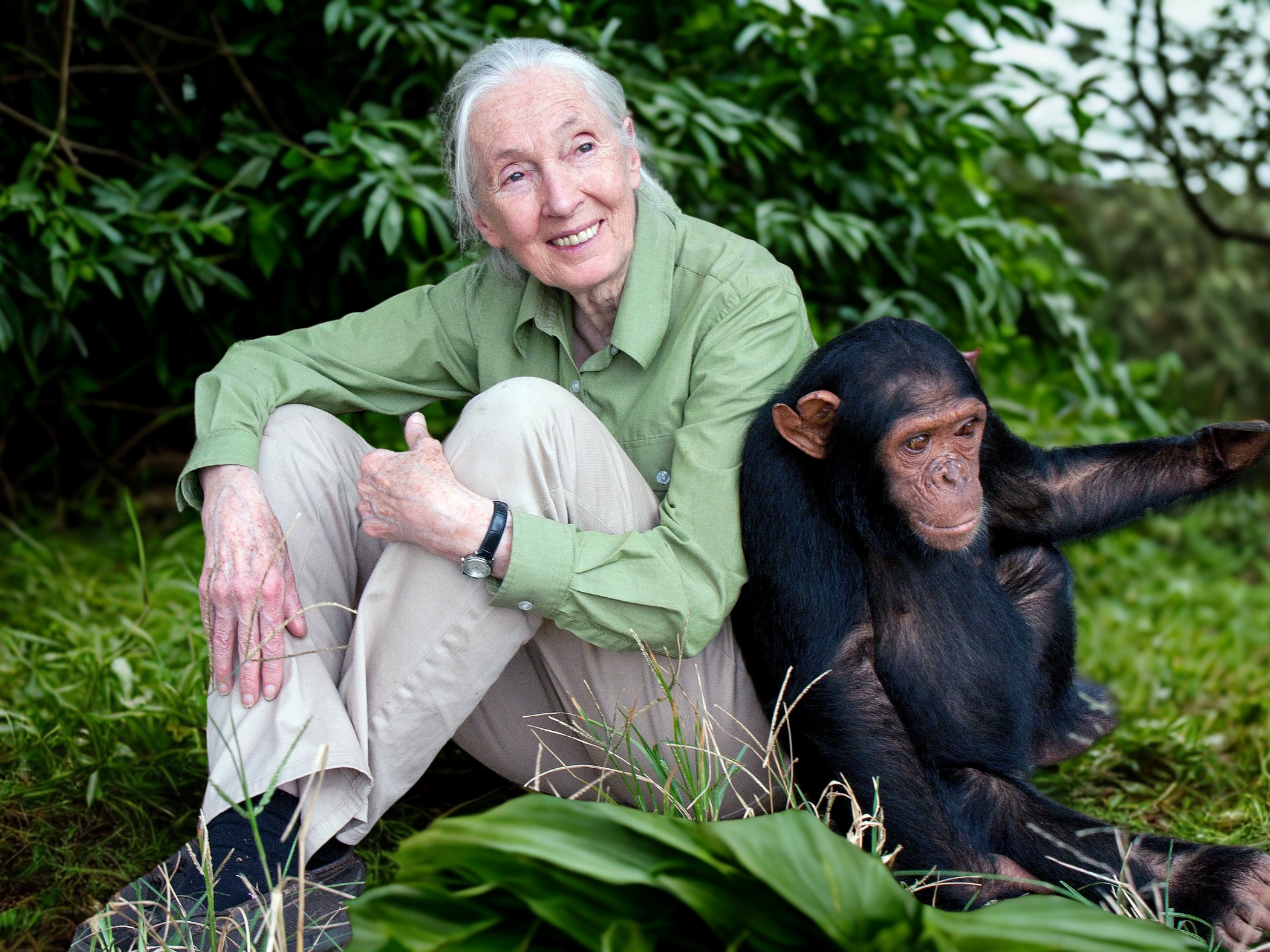

Dr. Jane Goodall, the pioneering chimpanzee researcher and founder of the Jane Goodall Institute, has passed away at the age of 91, the institute confirmed on Wednesday.
“The Jane Goodall Institute has learned this morning, Wednesday, October 1, 2025, that Dr. Jane Goodall DBE, UN Messenger of Peace and Founder of the Jane Goodall Institute has passed away due to natural causes. She was in California as part of her speaking tour in the United States. Dr. Goodall’s discoveries as an ethologist revolutionized science, and she was a tireless advocate for the protection and restoration of our natural world,” the statement read.
Who Was Jane Goodall?
Born Valerie Jane Morris-Goodall on April 3, 1934, in London, Goodall became world-renowned for her groundbreaking six-decade study of chimpanzees at Gombe Stream National Park in Tanzania, beginning in 1960.
At just 26, Goodall made a discovery that redefined humanity’s understanding of the animal kingdom. She observed that chimpanzees make and use tools – previously believed to be a uniquely human trait.
Today, the UN family mourns the loss of Dr. Jane Goodall.
The scientist, conservationist and UN Messenger of Peace worked tirelessly for our planet and all its inhabitants, leaving an extraordinary legacy for humanity and nature. pic.twitter.com/C0VMRdKufF
— United Nations (@UN) October 1, 2025
Her mentor, Dr. Louis Leakey, famously remarked, “We must now redefine man, redefine tool, or accept chimpanzees as human.”
Goodall documented chimpanzees engaging in warfare with neighboring communities, showing altruism, and even hunting for meat – challenging assumptions about animal behavior.
Jane Goodall’s Fascination With Animals
Goodall’s connection with chimpanzees began as a child. At age one, her father gifted her a toy chimpanzee named Jubilee, which remained on her dresser throughout her life.
Heartbroken to hear of Dr. Jane Goodall’s passing. She was a pioneer whose research and advocacy reshaped our understanding of the natural world. Her wisdom and compassion will live on in every act of conservation. All of us who were so greatly inspired by her will miss her… pic.twitter.com/NM5HEyftzJ
— Justin Trudeau (@JustinTrudeau) October 1, 2025
She also developed a love for African wildlife and the Tarzan stories by Edgar Rice Burroughs. “I had read Tarzan and fallen in love, although he married the wrong Jane, the wretched man,” she joked.
Her passion for observing animals began even earlier. At four years old, she hid in a henhouse for nearly four hours to watch how a chicken lays an egg.
“I was oblivious of the fact that no one had known where I was, and the whole household had been searching for me,” she recalled. “They had even called the police to report me missing.”
Research Work By Jane Goodall
When Goodall first traveled to Tanzania in 1960 to study wild chimpanzees, it was considered inappropriate for a young woman to travel alone. Authorities required her to be accompanied, so her mother joined the expedition.
Remarkably, Goodall undertook her research with no formal scientific training. This lack of conventional background allowed her to develop unique observational methods that led to groundbreaking discoveries.
She was only the second researcher in history to attempt studying chimpanzees in the wild. Unlike her predecessor, who traveled with 22 porters, Goodall’s expedition consisted solely of her mother and a single assistant.
A PhD Without An Undergraduate Degree
In 1962, Goodall entered Cambridge University as a PhD candidate despite lacking an undergraduate degree – a rare honor, as she was only the eighth person accepted under such circumstances. She reflected, “I never went to university after school because we couldn’t afford it. We didn’t have any money.”
Her unconventional approach occasionally drew criticism. Fellow scientists objected to her practice of naming chimpanzees, which was seen as compromising objectivity in research.
Jane Goodall was one of a few people to earn a PhD without an undergraduate degree.
It was thought that her lack of formal academic training would allow her to remain unbiased by traditional thought and study the chimps with an open mind.
It worked. ❤️ pic.twitter.com/3eCi2oDTJ8
— Encyclopaedia Britannica (@Britannica) October 1, 2025
Why Jane Goodall Is Known As A ‘Trimate’
Jane Goodall is recognized as one of the world’s leading primatologists, earning the distinction of being a ‘Trimate’ alongside Dian Fossey, who studied gorillas, and Birute Galdikas, who studied orangutans. All three were personally selected by Louis Leakey to observe hominids in their natural environments.
Also Read: Jane Goodall Dies: Cause Of Death, Who She Was, Her Legacy & Groundbreaking Work
Zubair Amin is a Senior Journalist at NewsX with over seven years of experience in reporting and editorial work. He has written for leading national and international publications, including Foreign Policy Magazine, Al Jazeera, The Economic Times, The Indian Express, The Wire, Article 14, Mongabay, News9, among others. His primary focus is on international affairs, with a strong interest in US politics and policy. He also writes on West Asia, Indian polity, and constitutional issues. Zubair tweets at zubaiyr.amin




