
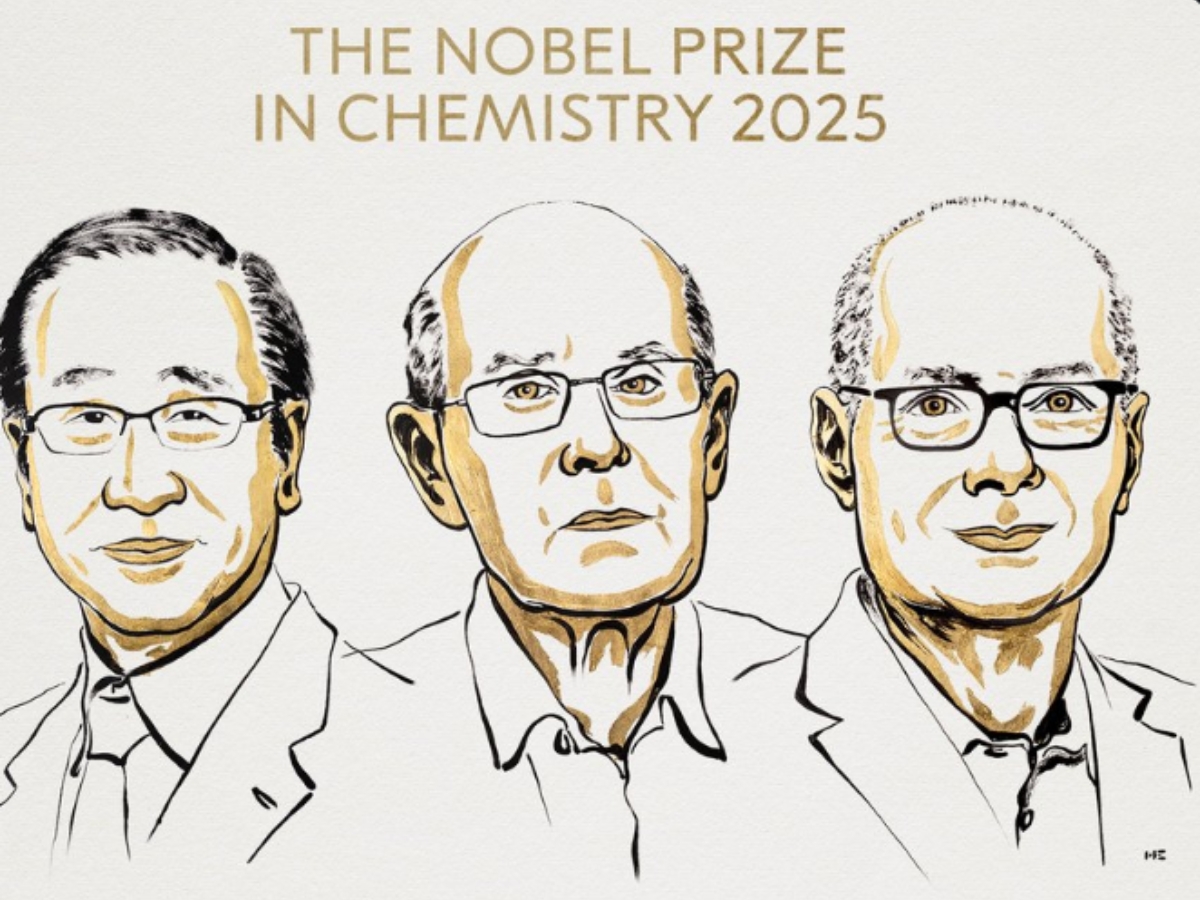

Susumu Kitagawa, Richard Robson and Omar M Yaghi have won th Nobel Prize in Chemistry for 2025. The three chemists will share the 11 million Swedish crowns prize money – approximately Rs 10 crore in Indian currency – alongside the global prestige associated with the Nobel Prize.
“The Royal Swedish Academy of Sciences has decided to award the 2025 #NobelPrize in Chemistry to Susumu Kitagawa, Richard Robson and Omar M Yaghi ‘for the development of metal-organic frameworks,’ the post on X announced.
BREAKING NEWS
The Royal Swedish Academy of Sciences has decided to award the 2025 #NobelPrize in Chemistry to Susumu Kitagawa, Richard Robson and Omar M. Yaghi “for the development of metal–organic frameworks.” pic.twitter.com/IRrV57ObD6— The Nobel Prize (@NobelPrize) October 8, 2025
Who Are The Nobel Prize in Chemistry 2025 Winners?
Susumu Kitagawa, who earned his PhD in hydrocarbon chemistry from Kyoto University, Japan, has previously received the Humboldt Research Prize (2008) and the De Gennes Prize. He is currently a faculty member at Kyoto University.
“I tell my students that challenge is very important in chemistry, in science.”
New chemistry laureate Susumu Kitagawa shared an inspiring message for young researchers at this morning’s press conference for the 2025 Nobel Prize in Chemistry.#NobelPrize pic.twitter.com/bLmWpHHwmB
— The Nobel Prize (@NobelPrize) October 8, 2025
Richard Robson, born in the United Kingdom, studied chemistry at the University of Oxford and now teaches at the University of Melbourne, Australia.
Omar M. Yaghi, born in Amman, Jordan, completed his PhD at the University of Illinois Urbana-Champaign, USA, and currently serves as a professor at the University of California, Berkeley, USA.
Susumu Kitagawa, Richard Robson and Omar M. Yaghi have been awarded the 2025 #NobelPrize in Chemistry for the development of a new type of molecular architecture.
In 1989, chemistry laureate Richard Robson tested utilising the inherent properties of atoms in a new way. He… pic.twitter.com/cX6VCmkQID
— The Nobel Prize (@NobelPrize) October 8, 2025
Nobel Prize in Chemistry 2025 Winners’ Work
The Nobel Committee highlighted the practical applications of MOFs, “These constructions, metal-organic frameworks, can be used to harvest water from desert air, capture carbon dioxide, store toxic gases, or catalyse chemical reactions,” the jury said.
Heiner Linke, chair of the Nobel Committee for Chemistry, praised the innovation, “Metal-organic frameworks have enormous potential, bringing previously unforeseen opportunities for custom-made materials with new functions.”
Last year, the Nobel Prize in Chemistry was awarded to David Baker, John Jumper, and Demis Hassabis for breakthroughs in determining protein structures through computing and artificial intelligence.
Also Read: Nobel Prize In Physics 2025: John Clarke, Michel H. Devoret & John M. Martinis Awarded For Work On…
Zubair Amin is a Senior Journalist at NewsX with over seven years of experience in reporting and editorial work. He has written for leading national and international publications, including Foreign Policy Magazine, Al Jazeera, The Economic Times, The Indian Express, The Wire, Article 14, Mongabay, News9, among others. His primary focus is on international affairs, with a strong interest in US politics and policy. He also writes on West Asia, Indian polity, and constitutional issues. Zubair tweets at zubaiyr.amin




