
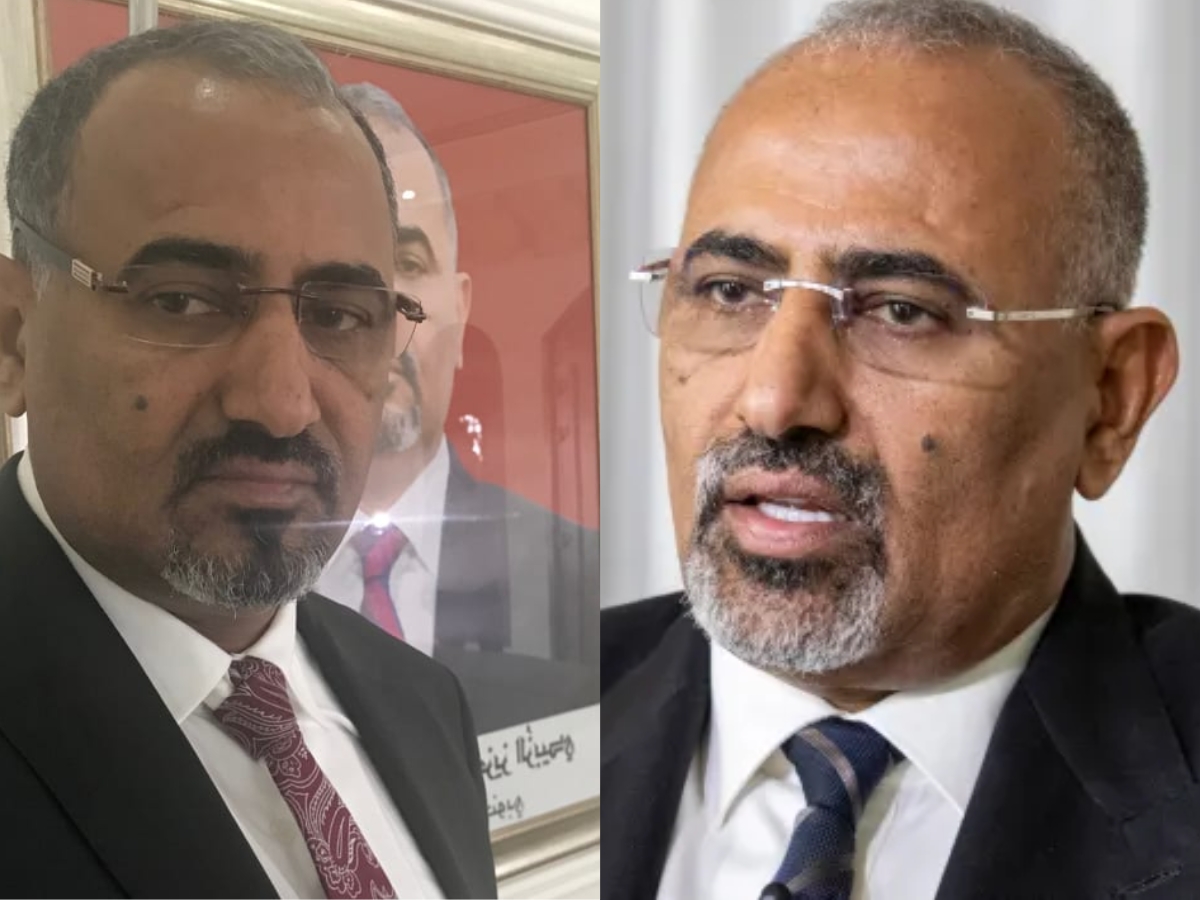

The leader of Yemen’s southern separatists, Aidarous al-Zubaidi, was in the port city of Aden on Wednesday, the group said, after he skipped a flight to Riyadh for talks on a crisis that caused a major feud between Saudi Arabia and the United Arab Emirates, the most powerful countries in the oil-rich Gulf.
Hours after its leader’s unexplained absence, the Southern Transitional Council (STC) said he was in Aden overseeing military and security operations, while it had lost contact with its delegation in Riyadh, the Saudi Arabian capital.
An STC official told Reuters Zubaidi had not fled but was in Aden in a safe location and that it was inappropriate for him to go to Riyadh under the current security situation, adding that the safety of the political delegation in Riyadh was now in Saudi hands.
Reuters could not independently verify Zubaidi’s whereabouts.
The dramatic developments dashed hopes for swift resolution of the recent turmoil in Yemen’s south that exposed a deep rift between the Gulf powers, fracturing a coalition to battle the Iran-aligned Houthis in a civil war more than a decade old.
Major oil producers Saudi Arabia and the UAE, both close allies of the United States, have differed for years on a range of volatile geopolitical issues from Sudan to energy policy, sharp rifts exposed by the latest crisis in Yemen, where they now back opposing sides.
The United Arab Emirates has pursued an assertive foreign policy and carved its own sphere of influence across the Middle East and Africa, a strategy in the spotlight after its rare military escalation with Saudi Arabia in Yemen.
The country, a regional business and trade hub, has used alliances with states or proxies and financial support mainly to counter what it views as the destabilising, existential threat of political Islam.
Earlier, Turki al-Maliki, the spokesperson of the Saudi-backed coalition, had flagged the disappearance of the UAE-backed Zubaidi in a statement.
A flight carrying a large number of senior leaders of the separatist group had departed after a more than three-hour delay without him, Maliki said at the time, adding that there was no information on his whereabouts.
During the delay there were indications that Zubaidi had moved large forces, Maliki said.
He accused Zubaidi of having distributed weapons and ammunition to dozens of elements in Aden, in a bid to stir unrest.
Maliki added that the coalition had asked the vice president of the STC, Abdulrahman al-Mahrami, known as Abu Zara’a, to impose security, prevent clashes, protect civilians and property.
In a statement carried by state news agency SABA, Yemen’s Presidential Leadership Council, the Saudi-backed ruling authority, said it had dismissed Transport Minister Abdul Salam Humaid and Planning Minister Waed Badhieb.
It had also ordered an investigation and the arrest of those who distributed weapons and threatened civil peace, the statement said.
Zubaidi’s deputy, Abu Zara’a, met the Saudi defence minister in Riyadh on Jan. 5. His appointment on Wednesday to take charge of security in Aden indicates warming ties with the Saudis.
HIGH TREASON
Maliki’s statement came amid efforts to end fighting that erupted last month between the STC, backed by the United Arab Emirates, and Yemen’s Saudi-backed internationally recognised government.
Zubaidi had been set to travel to Saudi Arabia days after Yemen’s government said it had asked Riyadh to host a forum on the southern issue.
The status of those talks is now unclear.
The Saudi-backed presidential council also stripped Zubaidi of his membership on Wednesday and referred him to the public prosecutor on charges including high treason, state news agency SABA said.
The decision, issued by presidential council chairman Rashad al-Alimi, accused Zubaidi of inciting armed rebellion, attacking constitutional authorities and committing abuses against civilians in southern Yemen.
Saudi Arabia and the UAE first intervened in Yemen more than a decade ago after the Houthis seized the Yemeni capital of Sanaa in 2014.
The UAE joined a Saudi-backed coalition the following year in support of the internationally recognised government.
The Southern Transitional Council, set up in 2017 with UAE backing, ultimately joined the government coalition.
For years, it has been part of that administration, which controls southern and eastern Yemen and is backed by Gulf states.
But last month STC forces suddenly seized swathes of territory, shifting the delicate balance of power and pitting Saudi Arabia against the UAE.
The UAE pulled its forces out of Yemen last month under pressure from Saudi Arabia, which saw the southern advance on its borders as a threat to its national security. The UAE has called for de-escalation in Yemen since.
On Wednesday, the Saudi coalition also said it carried out limited pre-emptive airstrikes in the southern province of al-Dhalea, Zubaidi’s birthplace, after monitoring the movements of armed forces that had left their camps.
Local sources and sources within the STC reported more than 15 strikes in the province.
(With inputs from ANI)
Zubair Amin is a Senior Journalist at NewsX with over seven years of experience in reporting and editorial work. He has written for leading national and international publications, including Foreign Policy Magazine, Al Jazeera, The Economic Times, The Indian Express, The Wire, Article 14, Mongabay, News9, among others. His primary focus is on international affairs, with a strong interest in US politics and policy. He also writes on West Asia, Indian polity, and constitutional issues. Zubair tweets at zubaiyr.amin




