
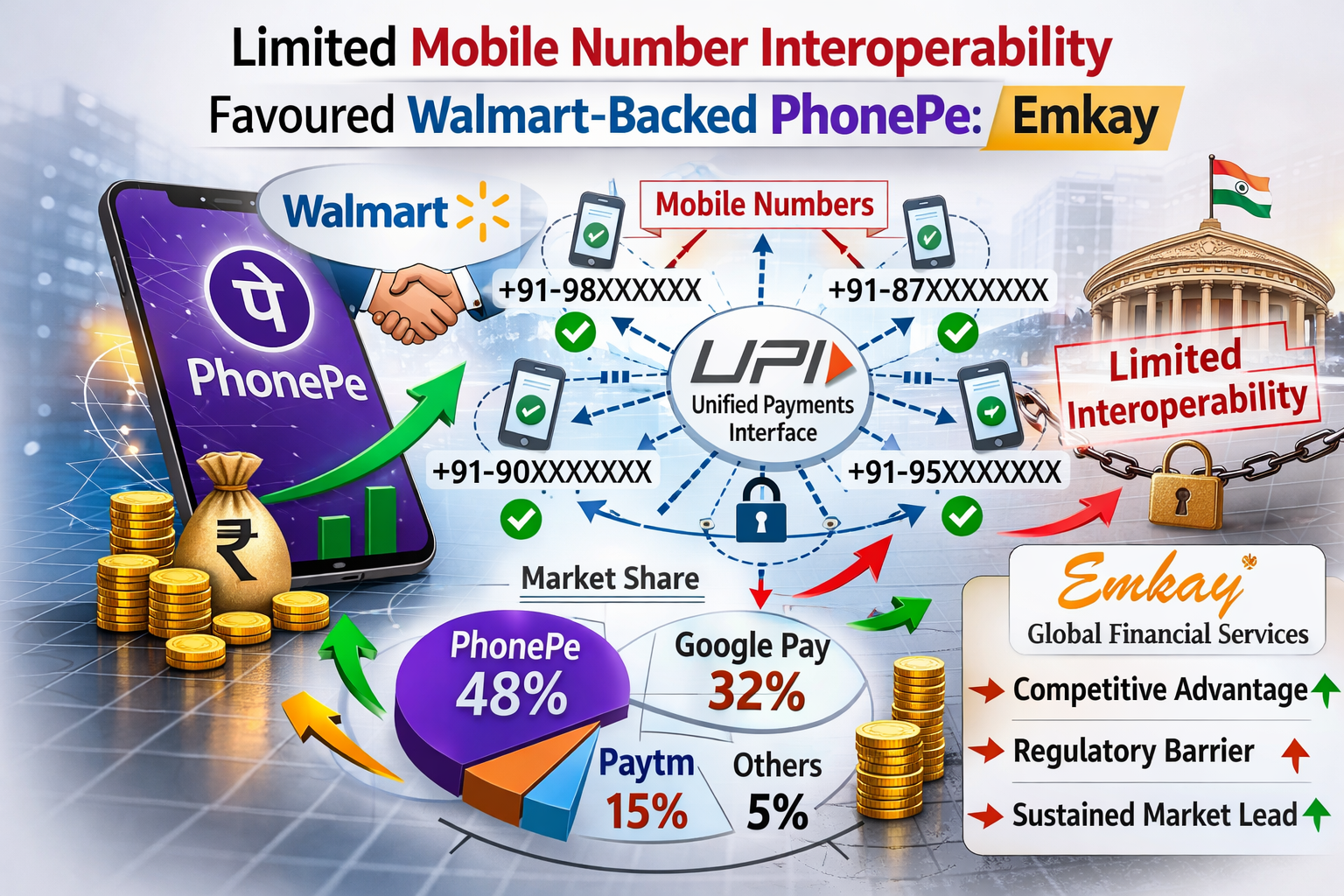

When UPI was launched in CY16, interoperability for payments made directly to a mobile number was limited across different apps, according to the Emkay Research Internet Sector Report dated February 25, 2026. While UPI supported cross app transfers using a full virtual payment address, mobile number based payments relied on each app’s local database to map the number to a UPI ID.
As the report explains, a user “could only send money to a mobile number if the recipient was registered on the same app as the sender otherwise, the app was not able to resolve the mapping, thus making the transfer impossible without the full VPA.” In effect, discoverability across apps through mobile numbers was constrained during the early years of UPI adoption.
How Early UPI Interoperability Limits Created Network Effects for PhonePe & Google Pay?
Emkay notes that this “resulted in network effects in early UPI adoption, which benefitted players like PhonePe and Google Pay, who had the resources to fund the payments app without any monetization potential.” Before the introduction of the centralized UPI mapper system managed by NPCI, these structural limits meant that scale within an app became a powerful advantage.
The report’s observations gain significance in the context of NPCI’s role as the operator of UPI infrastructure and the later introduction of the centralized UPI mapper system, which removed the earlier mobile number interoperability constraint. As the ecosystem evolves and large platforms tap public markets, such structural factors may also intersect with SEBI’s oversight on disclosures, particularly where market share concentration and competitive positioning are relevant to investors.
NPCI’s Centralised UPI Mapper: What Changed for Mobile Number–Based Payments
Even after the centralized mapper was introduced and “such benefits were missing,” the report states that these players “have managed to retain their consumer market share for a sticky product like payments, by ensuring a sleek payment app with high uptime.” The early network effects, according to Emkay’s assessment, shaped competitive outcomes in the UPI ecosystem.
Exhibit 12 of the report shows PhonePe leading UPI volume market share consistently from CY22 to CY25, with shares of 46.3 percent in CY22, 46.7 percent in CY23, 48.5 percent in CY24 and 47.0 percent in CY25, based on NPCI data cited by Emkay. Exhibit 13 shows a similar trend in value market share, with PhonePe at 49.1 percent in CY23, 50.4 percent in CY24 and 49.8 percent in CY25. The report characterizes PhonePe as having a “strong hold on consumer UPI business,” consistently holding over 45 percent share in both volume and value terms.
PhonePe’s Sustained Lead in UPI Volume and Value Share
The report also highlights that PhonePe has 300 million monthly active users, describing it as “one of the largest internet platforms in India.” At the same time, it observes that “the scale of engagement has not yet translated into revenues, with PhonePe and Paytm reporting similar revenue and H1’26 PAT levels,” even as PhonePe commands “much higher consumer engagement.”
In its Draft Red Herring Prospectus, PhonePe has also disclosed that its market capitalization post listing could be subject to risks, including factors linked to regulatory changes, market dynamics and business concentration. The DRHP lists market related volatility and regulatory developments as risk factors that may impact valuation, a disclosure that assumes relevance in light of Emkay’s observations on early structural advantages and sustained market share leadership.
UPI Infrastructure, Regulation and Investor Risk Factors
Taken together, Emkay’s analysis and the disclosures in the DRHP point to how early structural features of UPI, particularly limited mobile number interoperability and app specific mapping, created network effects that benefitted well funded players. The market share data presented in the report indicates that the advantage built during those formative years continues to reflect in sustained leadership in both transaction volume and value, even as regulatory frameworks and investor scrutiny evolve.




