
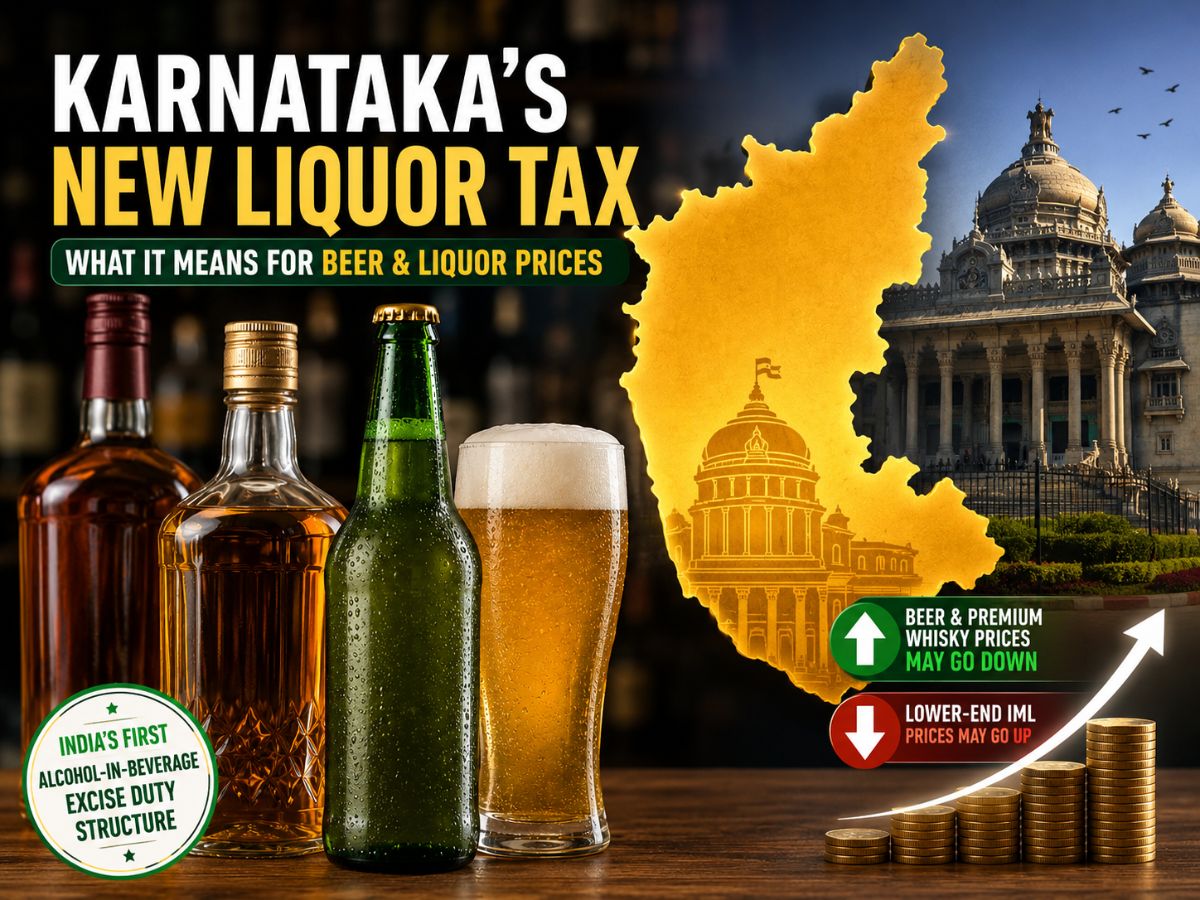
Karnataka becomes the first Indian state to link liquor tax directly to alcohol strength, changing beer and whisky prices across the market. If you buy alcoholic beverages in Karnataka, your liquor store bill might look very different now. Karnataka has officially rolled out a new excise duty structure based on Alcohol-in-Beverage (AIB) from May 11, 2026, ending the bulk-litre taxation model that has been in place for decades.
The move makes Karnataka the first state in India to have a taxation system where alcohol duty is directly proportional to the actual alcohol percentage, or ABV (Alcohol by Volume), in a drink.
Announcing the rollout, the Karnataka Excise Department said, “For the first time in India, the AIB-based excise duty structure has been implemented in Karnataka from May 11, 2026. It is globally recognised as the gold standard for alcohol taxation.”
The proposal for the reform was first made by the Resource Mobilisation Committee, headed by KP Krishnan, in its recommendations on Karnataka excise reforms and was then announced by Chief Minister Siddaramaiah during the presentation of the 2026-27 budget.
The state has also set an ambitious target of Rs 45,000 crore in excise revenues for FY27.
But what exactly has changed in Karnataka’s liquor market?
Earlier, liquor in Karnataka was taxed using multiple price-based slabs. In simple terms, products were categorised into arbitrary pricing buckets instead of being taxed according to their actual alcohol strength.
Industry players and experts have often criticised the older system for creating pricing distortions and unintentionally encouraging the consumption of stronger alcohol products.
Now, under the revised Karnataka Excise (Excise Duties and Fees) Rules, 1968, the taxation system will work differently.
Instead of taxing liquor based on bulk litres and rigid pricing categories, the government will now calculate excise duty based on the alcohol percentage present in beverages.
The government has also deregulated price fixation under the new framework.
That means producers and liquor companies now have greater flexibility to place their products within specified pricing slabs depending on market demand, positioning and alcohol content.
IML slabs reduced from 16 to 8
One of the biggest structural changes under the new excise policy is the rationalisation of Indian Made Liquor (IML) slabs.
According to the government notification:
- IML pricing slabs have been reduced from 16 categories to eight
- Product placement within slabs will now be decided by producers
- Pricing flexibility has increased significantly for manufacturers
- Revised Maximum Retail Prices (MRPs) now apply to products manufactured after May 11, 2026
The Karnataka State Excise Department has also asked companies to publish the revised MRPs of spirits and beer in leading Kannada and English newspapers across the state.
Which alcohols are becoming less expensive in Karnataka?
The new AIB-based excise duty structure should be of benefit to certain categories, particularly low-alcohol beverages.
According to official estimates:
| Category | Expected Price Impact |
|---|---|
| Mild and lager beers (5% alcohol) | Prices down by 20–25% |
| Premium Scotch whiskies | Prices down by nearly 20% |
This means consumers buying lighter beers or imported premium whisky brands may actually pay less than before under the revised structure.
Officials believe the change could gradually encourage consumption of beverages with relatively lower alcohol content rather than stronger spirits.
What may become costlier in Karnataka’s liquor market?
Not everything is getting cheaper.
The first five excise slabs of Indian Made Liquor (IML) are expected to see price increases under the new taxation model.
According to estimates:
| Category | Expected Price Impact |
|---|---|
| Lower-end IML categories | Prices up by 20–25% |
So while premium alcohol and lighter beer categories may benefit, several mass-market liquor products could become pricier for consumers.
Why is Karnataka calling this a ‘global standard’?
Globally, many countries already follow taxation systems linked to alcohol content rather than arbitrary pricing slabs.
The Karnataka government says the AIB structure improves transparency, simplifies taxation and creates a more rational pricing mechanism for the liquor industry.
Chief Minister Siddaramaiah had earlier said in the budget speech that Karnataka would move toward being globally recognised as the gold standard for alcohol taxation.
The government also believes the reform could reduce market distortions and improve long-term excise revenue efficiency.
Check new liquor and beer prices in Karnataka
| Alcohol Category | Alcohol Content / Type | Expected Price Change Under New AIB Policy |
|---|---|---|
| Mild Beer | Around 5% alcohol | Cheaper by 20–25% |
| Lager Beer | Around 5% alcohol | Cheaper by 20–25% |
| Premium Scotch Whisky | Imported premium whisky | Cheaper by nearly 20% |
| Lower-End Indian Made Liquor (IML) | First five excise slabs | Costlier by 20–25% |
| Premium IML Products | Higher pricing slabs | Limited impact / market-linked pricing |
Karnataka’s new liquor and beer duty structure may change prices
Karnataka’s new alcohol taxation framework marks one of the biggest reforms in India’s liquor industry in recent years.
For consumers, the immediate impact may be visible at retail counters — with some beer and premium whisky brands becoming cheaper, while several lower-end liquor categories become more expensive.
For the industry, however, the shift is even bigger. The move gives manufacturers greater pricing freedom, changes how products are positioned in the market and aligns Karnataka’s taxation model more closely with global alcohol taxation practices.
Priyanka Roshan is a business writer and chief sub-editor at the NewsX website who tracks everything from stock market swings and corporate earnings to personal finance trends and policy shifts. Known for turning fast-moving business developments into sharp, reader-friendly stories, she combines speed, accuracy, and a data-driven approach to break down complex financial news for everyday audiences.
With over 9.5 years of newsroom experience, Priyanka has worked with leading media organisations, including Moneycontrol, Times Now, and Ping Digital, covering diverse beats such as business, politics, technology, auto, travel, sports, and the world. From live breaking news desks to SEO-led digital storytelling, she specialises in creating engaging content that keeps readers informed without overwhelming them.





