

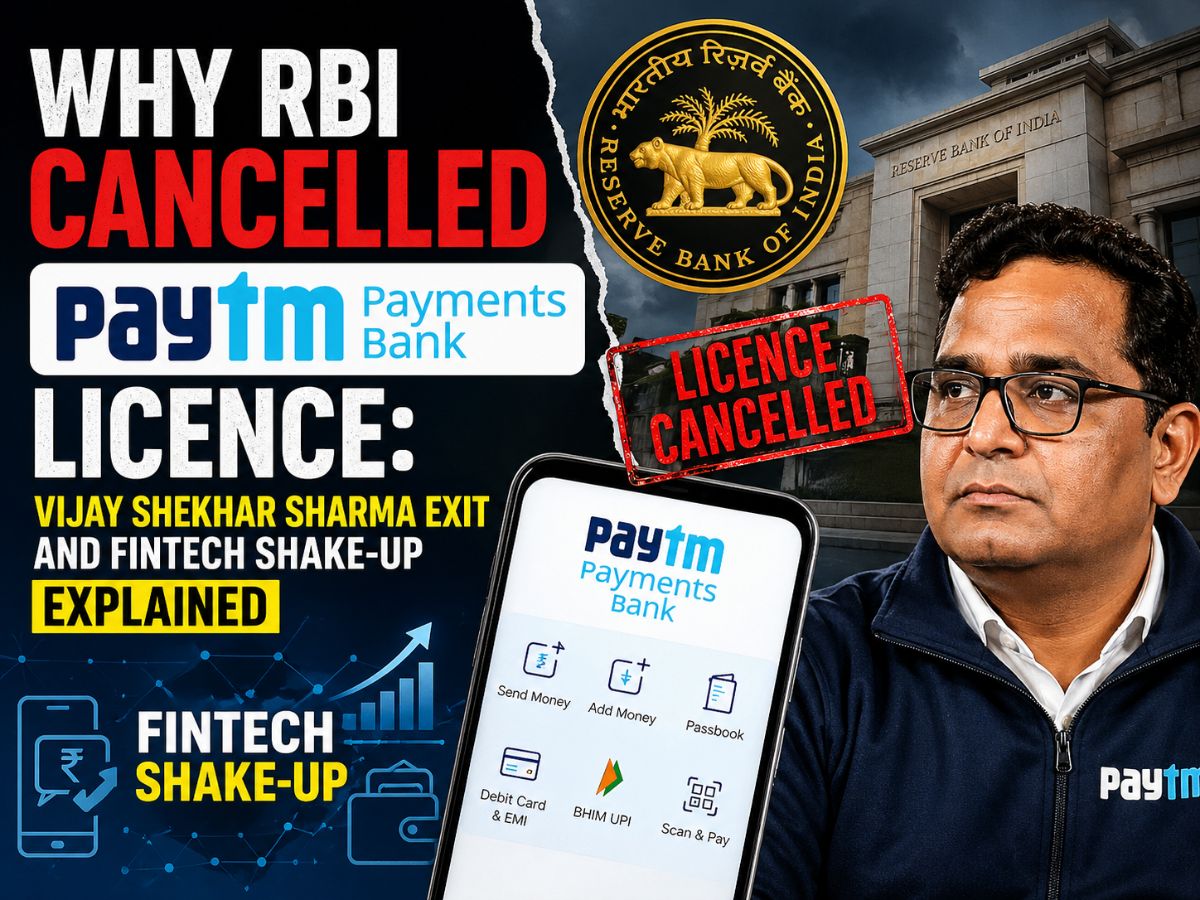
The Reserve Bank of India (RBI) shutting down Paytm Payments Bank Limited (PPBL) marks one of the most significant regulatory interventions in India’s fast-evolving digital payments ecosystem. What might look like a sudden withdrawal of licence, however, is the end point of a long process of compliance issues, repeated warnings and tightening restrictions that spanned several years.
In India’s fintech industry, where innovation frequently outstrips regulation, this case has become a textbook example of how regulatory patience eventually gives way to enforcement.
RBI Cancels Paytm Payments Bank Licence, Why?
On April 24, 2026, the RBI cancelled the banking licence of PPBL with immediate effect under the Banking Regulation Act, 1949, citing serious regulatory lapses, governance concerns and risks to depositors’ interests.
The central bank said the bank’s operations were carried out in a manner “detrimental” to the interests of depositors and its governance practices were “prejudicial” to public interest.
The court also found that the bank’s continued operation would serve “no useful public purpose,” effectively closing the door on the bank’s operations.
Significantly, the RBI also clarified that PPBL had sufficient liquidity to repay all depositors and initiated action to wind up the entity through the appropriate High Court.
Was this a sudden shutdown or part of a long-term RBI investigation?
The shutdown wasn’t a snap decision, even though it had a headline impact. In fact, it was the result of almost four years of increasing regulatory scrutiny.
The RBI had been watching PPBL closely since at least 2022, when it had issued its first major warning. The bank was advised to suspend the onboarding of new clients and undertake a thorough system audit of its IT infrastructure in light of supervisory concerns.
This was the start of a slow tightening of operational freedoms.
What were the first warning signs that the RBI raised in 2022?
In March 2022, the RBI’s directive effectively froze the bank’s expansion. Existing customers could continue using services, but PPBL was barred from adding new users.
The regulator also mandated a full IT audit, signalling concerns not only about compliance but also about operational systems and governance control.
It was an early sign the regulator was unhappy with how the payments bank met its licence commitments.
Why did RBI impose further restrictions in 2024?
By January 2024, the situation was worse. After reviewing the audit findings, the RBI concluded that PPBL continued to show “persistent non-compliances,” meaning that it had not adequately addressed the issues flagged earlier.
Therefore, the central bank introduced stricter limitations:
No new deposits allowed
No FASTags or wallet top-ups
Restrictions effective February 29, 2024.
At this stage, PPBL was mostly in “pause mode,” allowing customers to withdraw only existing funds.
At that time, the then RBI governor Shaktikanta Das had underlined the regulator’s approach and said adequate time was given for compliance, but corrective action was not taken.
Why did the RBI extend deadlines for customers?
Later in February 2024, the RBI granted a short extension, acknowledging the magnitude of customer exposure. This was not a relaxation of restrictions, but a measure to protect customers and ensure a smooth transition of funds and services.
The bank was directed to:
Facilitate easy withdrawal of deposits
Support automatic sweep-in/sweep-out transfers
Don’t let recurring payments and linked services break off
The aim was to make it less friction for users to move to other banks and payment systems.
What Were the Final Grounds for Licence Cancellation?
The last RBI order in April 2026 formally cancelled PPBL’s licence under the Banking Regulation Act. The principal causes were the following:
- Conducting banking business in a manner detrimental to depositors
- Weak governance frameworks
- Failure to meet licensing conditions for payments banks
- Continued non-compliance with regulations despite repeated warnings
RBI said PPBL was no longer serving any meaningful public or financial stability purpose in continuing operations.
What Happens to Customer Deposits When a Bank Fails?
In such cases depositor safety is a primary concern.
The Reserve Bank of India (RBI) clarified that PPBL has enough liquidity to return all the deposits. This means that customers’ money is safe and accessible.
Customers can expect the following:
- Take money out of their accounts.
- Transfer money to other banks
- Close or restrict wallets and payment instruments
The Reserve Bank of India (RBI) also clarified that the winding-up process would be through the process of the High Court, implying a structured resolution rather than an abrupt disruption.
Did corporate governance changes help to prevent a shutdown?
Over the years, PPBL has attempted various governance reforms, such as Vijay Shekhar Sharma quitting key board positions, independent director appointments, and reorganisation of oversight functions internally.
These actions, however, did not convince the regulator that all compliance risks had been mitigated. The RBI’s move indicates that structural governance changes alone failed to address the systemic issues flagged during audits.
Why Does Paytm Say Its Core Business Is Unaffected?
Following the RBI’s decision, One 97 Communications Ltd (Paytm’s parent company) quickly clarified that there will be no financial or operational impact on its listed entity.
The company emphasised that Paytm Payments Bank is a separate associate entity. There is no shared board or management control, and PPBL has already impaired investments.
More importantly, Paytm has already decoupled its core fintech operations from the payments bank.
Is Paytm Still Operating UPI, Wallets, and Merchant Payments?
Yes, this is where the picture gets more complicated than it seems. Paytm had already moved its payments ecosystem to partner banks before the shutdown, as per earlier restrictions by the RBI.
Currently, Paytm’s UPI services operate on a multi-bank model led by Yes Bank, and the acquiring banks continue to process all merchant payments.
Soundbox devices, payment gateways and QR codes are excellent. Paytm is licensed to act as a payment aggregator, which allows us to process digital transactions efficiently and in accordance with regulations.
This separation ensured that Paytm’s core digital payments infrastructure continued to work even after the PPBL restrictions.
What does this separation mean for Paytm users? What does it mean for India’s fintech sector?
The shutdown of PPBL sends a strong message across the larger fintech ecosystem in India. Three major themes for regulation are identified:
1. Compliance is non-negotiable: Large-scale digital adoption cannot override regulatory expectations.
2. Structural constraints for payments banks: Unlike full-service banks, payments banks operate under restricted models, and, therefore, compliance discipline becomes even more important.
3. Regulators have only so much patience: The RBI took the final step after a gradual escalation path, first issuing warnings, then carrying out audits and finally imposing restrictions.
The case is a reminder for investors and fintech players on the importance of governance, audit readiness and regulatory alignment.
What to expect from the market and Paytm?
The shutdown of Paytm Payments Bank is a big regulatory moment but doesn’t tear apart Paytm’s core business. Rather, it signifies a different structural transition:
- The payments bank model has been effectively phased out for Paytm
- The company has repositioned itself as a bank rather than a multi-bank fintech platform
- Regulatory clarity has brought about a clearer division of banking and payment infrastructure
It is less a case of sudden disruption than a long-awaited correction in the structure of business.
The Bottom Line
The story of Paytm Payments Bank is not just about a license cancellation; it is about the evolution of regulatory oversight in response to systemic risks in a rapidly digitising financial system.
Warnings, audits and restrictions had gradually over the years curtailed the bank’s scope until closure was the last step. But for Paytm’s bigger ecosystem, the impact remains contained because it structurally separated from its banking arm early on.
The message is now clear in India’s fintech ecosystem: innovation can be rapid, but compliance defines the boundaries.
Priyanka Roshan is a business writer and assistant editor at the NewsX website who tracks everything from stock market swings and corporate earnings to personal finance trends and policy shifts. Known for turning fast-moving business developments into sharp, reader-friendly stories, she combines speed, accuracy, and a data-driven approach to break down complex financial news for everyday audiences.
With over 9.5 years of newsroom experience, Priyanka has worked with leading media organisations, including Moneycontrol, Times Now, and Ping Digital, covering diverse beats such as business, politics, technology, auto, travel, sports, and the world. From live breaking news desks to SEO-led digital storytelling, she specialises in creating engaging content that keeps readers informed without overwhelming them.





