
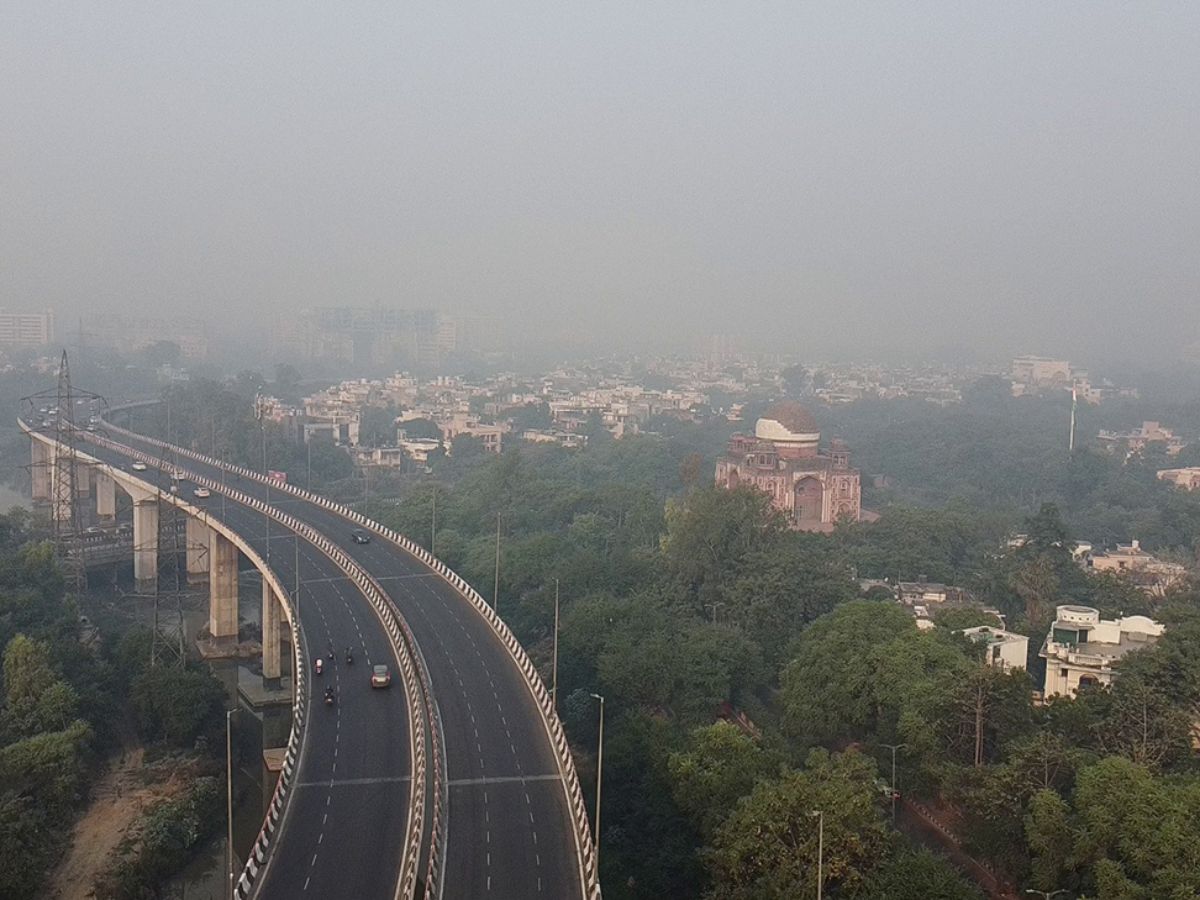

Delhi’s air quality worsened on Saturday, with pollution levels crossing the 400 threshold in multiple parts of the city, placing the national capital among the most polluted urban centers in the country.
Delhi AQI Climbs Throughout the Day
The 24-hour average Air Quality Index (AQI), compiled daily at 4 pm, stood at 361, according to the Central Pollution Control Board (CPCB). By 6 pm, the index had further increased to 372, indicating a continued decline in air quality.
Real-time data from the CPCB’s Sameer app, which tracks readings from 39 monitoring stations across the city, showed that at least 15 locations recorded AQI levels at or above the 400 mark by early evening.
Several Delhi Areas in ‘Severe’ AQI Category
The stations registering severe air quality included Alipur (417), ITO (408), Punjabi Bagh (404), Nehru Nagar (407), Patparganj (403), Ashok Vihar (402), Sonia Vihar (401), Jahangirpuri (409), Rohini (408), Vivek Vihar (415), Narela (412), Wazirpur (424), Bawana (424), Chandni Chowk (400) and Burari Crossing (420).
In the adjoining National Capital Region (NCR), Noida recorded an AQI of 354, Greater Noida 336, and Ghaziabad 339, placing all three in the ‘very poor’ category, PTI reported citing CPCB data.
Earlier in the day, at 8 am, Delhi’s overall AQI stood at 355, also in the ‘very poor’ category.
Persistent Pollutants and Forecast
On Friday, the city had logged an AQI of 322 and was ranked the most polluted city in the country for the day. The concentrations of PM2.5 and PM10 remained elevated on Saturday and continued to be the dominant pollutants.
According to the Air Quality Early Warning System for Delhi, the air quality is expected to stay in the ‘very poor’ range for the coming days.
AQI Classification
Under CPCB guidelines:
0–50 is ‘good’
51–100 ‘satisfactory’
101–200 ‘moderate’
201–300 ‘poor’
301–400 ‘very poor’
401–500 ‘severe’
Also Read: Delhi Air Crisis: Govt Takes Drastic Measures Amid ‘Very Poor’ AQI Levels
Zubair Amin is a Senior Journalist at NewsX with over seven years of experience in reporting and editorial work. He has written for leading national and international publications, including Foreign Policy Magazine, Al Jazeera, The Economic Times, The Indian Express, The Wire, Article 14, Mongabay, News9, among others. His primary focus is on international affairs, with a strong interest in US politics and policy. He also writes on West Asia, Indian polity, and constitutional issues. Zubair tweets at zubaiyr.amin




