
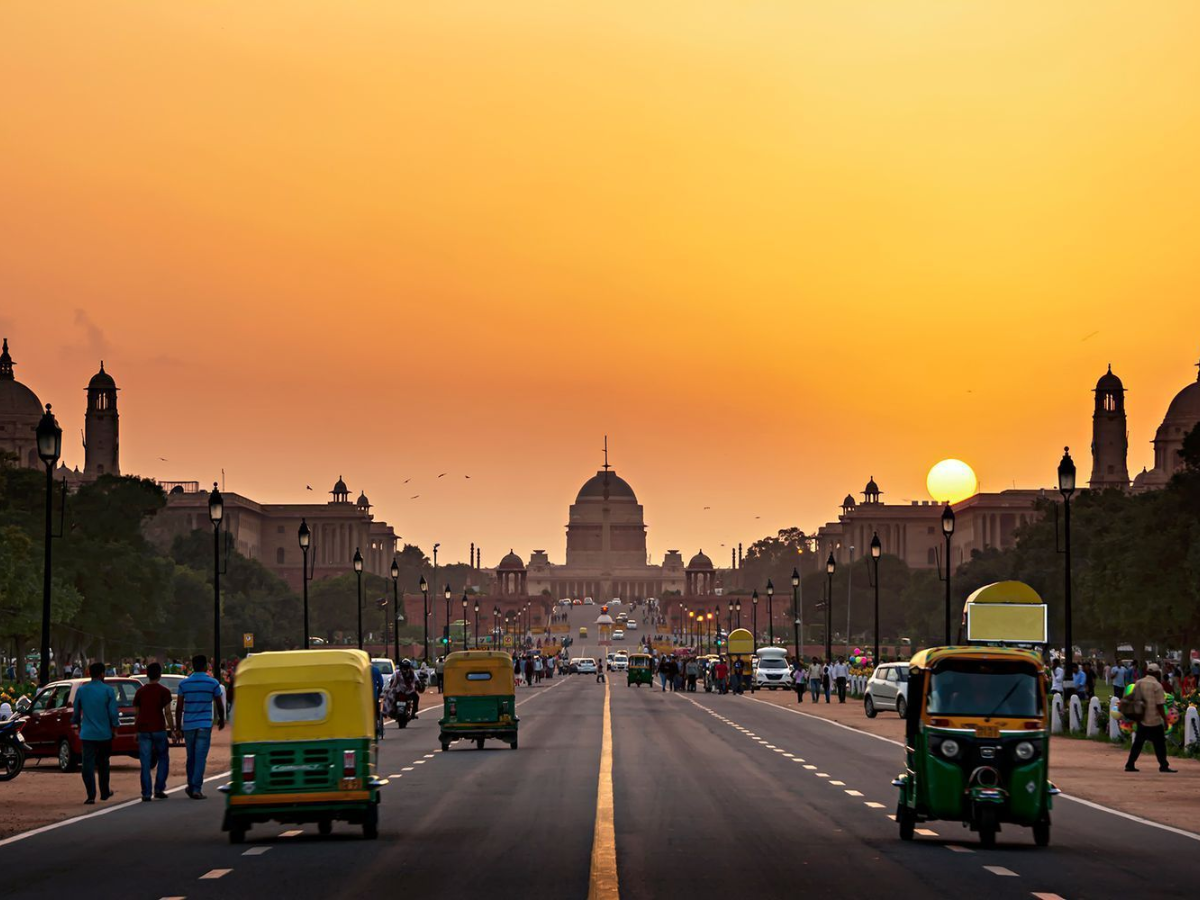

In the latest development, Delhi’s air quality improved on Sunday after nearly slipping into the “poor” category a day earlier. The average Air Quality Index (AQI) dropped to 167, which falls under the “moderate” category, compared to 199 recorded on Saturday.
The improvement came due to consistent winds blowing at speeds between 10 and 15 km per hour, dispersing pollutants across the National Capital Region. However, environmental officials have warned that the relief may be short-lived, with pollution levels likely to rise again in the coming days.
Stubble Burning Share Slightly Rises
Despite the overall improvement in AQI, the share of stubble burning in Delhi’s total pollution slightly rose to 0.8% on Sunday from 0.4% a day earlier, according to the Centre’s Decision Support System (DSS).
The Early Warning System (EWS) under the Ministry of Earth Sciences predicted that Delhi’s air quality would remain in the “moderate” range between October 13 and 14 but could deteriorate to “poor” by October 15. Officials further added that this “poor” phase may continue for nearly a week due to meteorological conditions and regional emissions.
Delhi Records 123 Days Of Cleaner Air
According to the Central Pollution Control Board (CPCB), the city last recorded “poor” air on June 11, with an AQI of 245. Since then, Delhi has experienced 123 consecutive days of cleaner air, which included 77 “satisfactory” and 46 “moderate” days.
The CPCB classifies air quality between 0–50 as “good,” 51–100 “satisfactory,” 101–200 “moderate,” 201–300 “poor,” 301–400 “very poor,” and 401–500 as “severe.” However, experts caution that air quality typically worsens in October due to the withdrawal of the monsoon, lower wind speeds, and the onset of stubble burning in nearby states.
Transport Major Contributor To Delhi’s PM 2.5
The Decision Support System (DSS) estimated that emissions from Delhi’s transport sector accounted for 19.8% of PM 2.5 pollution on Sunday, making it the highest contributor. This was followed by emissions from Sonipat (9.2%) and Jhajjar (5.1%). Stubble burning contributed 0.8% on Sunday, with a similar trend expected for Monday.
Data further revealed that the number of farm fires this year has been significantly lower compared to 2023. Between September 15 and October 11, Punjab recorded 116 farm fires against 533 during the same period last year, while Haryana recorded 11 against 280 in 2023.
Delhi’s maximum temperature on Sunday was 31.5°C, around three degrees below normal, while the minimum temperature stood at 19.6°C.
The India Meteorological Department (IMD) predicted that cool northwesterly winds would keep minimum temperatures between 18°C and 20°C until Tuesday, while the maximum may rise slightly by midweek, reaching around 34°C by Wednesday.
Government Highlights Progress On Air Quality
Delhi’s Environment Minister Manjinder Singh Sirsa shared CPCB data, highlighting that the Capital has already recorded 199 days of AQI below 200 this year. He stated that this figure is nearly double the 110 days recorded in 2016, indicating progress in pollution control efforts.
Must Read: Air India’s Dreamliners Face Fresh Safety Scrutiny After Repeated Technical Incidents
Swastika Sruti is a Senior Sub Editor at NewsX Digital with 5 years of experience shaping stories that matter. She loves tracking politics- national and global trends, and never misses a chance to dig deeper into policies and developments. Passionate about what’s happening around us, she brings sharp insight and clarity to every piece she works on. When not curating news, she’s busy exploring what’s next in the world of public interest. You can reach her at [swastika.newsx@gmail.com]




