
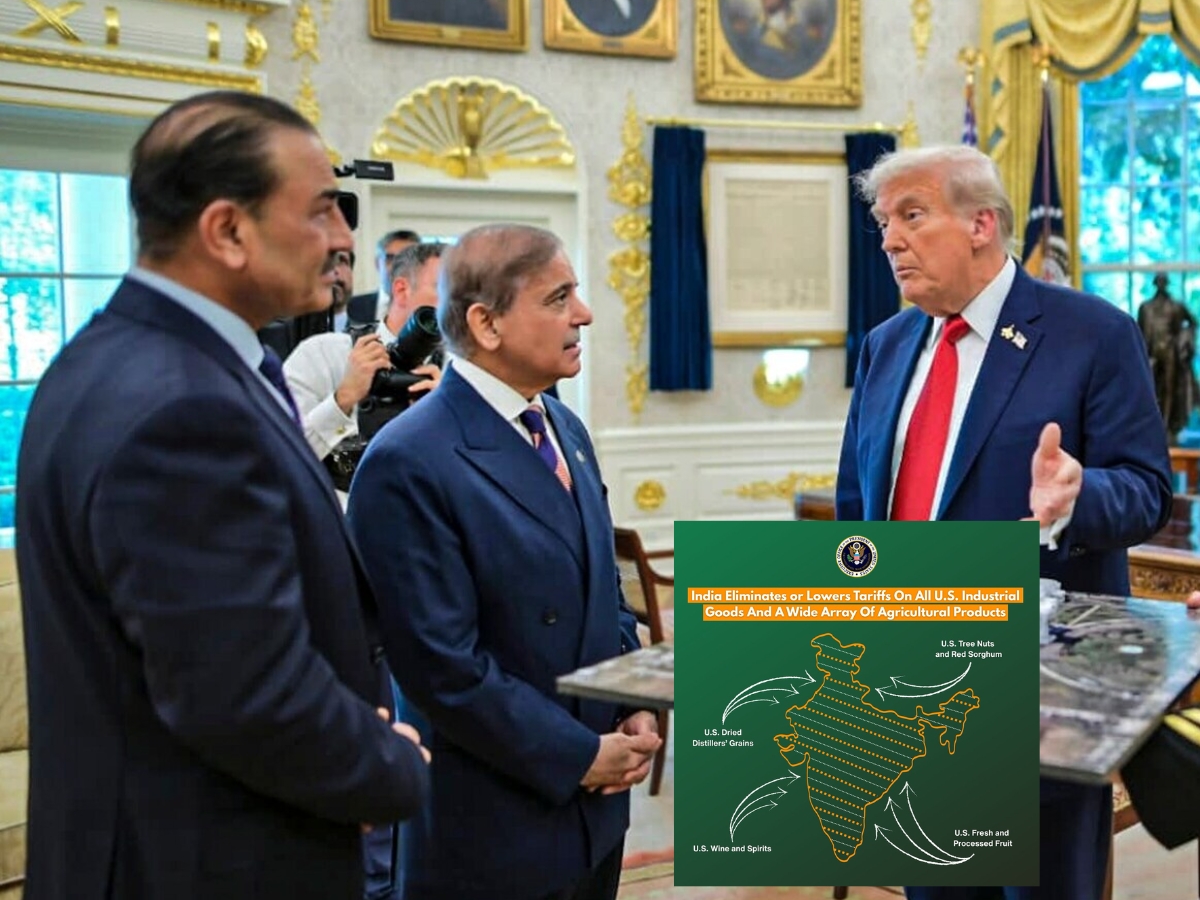

Over the past six months, Pakistan’s diplomatic engagement with the United States has intensified significantly, led largely by its military leadership. Army Chief General Asim Munir has visited the US three times during this period and has held two meetings with US President Donald Trump, including a widely publicised lunch in June. Notably, this marked the first instance of a US President meeting Pakistan’s army chief alone, without the presence of any civilian leadership from Islamabad.
The outreach was seen as part of Pakistan’s broader effort to reassert its relevance on the global stage and strengthen ties with Washington amid ongoing economic and geopolitical challenges.
India-US Trade Deal Comes With A Major Shocker For Asim Munir, Shehbaz Sharif
As New Delhi and Washington announced the framework for an interim trade agreement on Saturday, an unexpected element of the announcement drew sharp attention on social media. While releasing details of the trade deal, the office of the US Trade Representative shared a map of India that showed the entire Jammu and Kashmir region, including Pakistan-occupied Kashmir (PoK), as part of India.
The map also showed Aksai Chin as part of India. Aksai Chin, a high-altitude region in eastern Ladakh under Chinese control since 1962, has consistently been claimed by India as its sovereign territory.
From tree nuts and dried distillers’ grains to red sorghum and fresh and processed fruit, the U.S.-India Agreement will provide new market access for American products. pic.twitter.com/mqpP10LJp1
— United States Trade Representative (@USTradeRep) February 6, 2026
Why the US Showing PoK As A Part Of India Is Important
The US showing Aksai Chin and PoK as part of India marks a clear shift from earlier US representations. Traditionally, maps released by the US government or the State Department have included disclaimers or demarcations acknowledging competing territorial claims, particularly in regions such as Jammu and Kashmir and eastern Ladakh.
The absence of any qualifying note or dispute marker on the latest map represents a departure from long-standing US cartographic practice.
While India has never sought external validation of its territorial sovereignty, consistently maintaining that Jammu and Kashmir is an inalienable part of the country, the development remains diplomatically significant.
PoK Map Shows Reset in India-US Relations
The timing of the development is also notable. India and the US have been recalibrating their relationship under the unpredictable leadership of Donald Trump, following a turbulent phase marked by trade disputes. At one point, Trump imposed a steep 50% tariff on Indian goods, the highest among US allies.
Under the newly announced trade framework, that tariff has now been reduced to 18%, the lowest rate among Asian nations, underscoring a broader reset in bilateral ties.
Zubair Amin is a Senior Journalist at NewsX with over seven years of experience in reporting and editorial work. He has written for leading national and international publications, including Foreign Policy Magazine, Al Jazeera, The Economic Times, The Indian Express, The Wire, Article 14, Mongabay, News9, among others. His primary focus is on international affairs, with a strong interest in US politics and policy. He also writes on West Asia, Indian polity, and constitutional issues. Zubair tweets at zubaiyr.amin




