
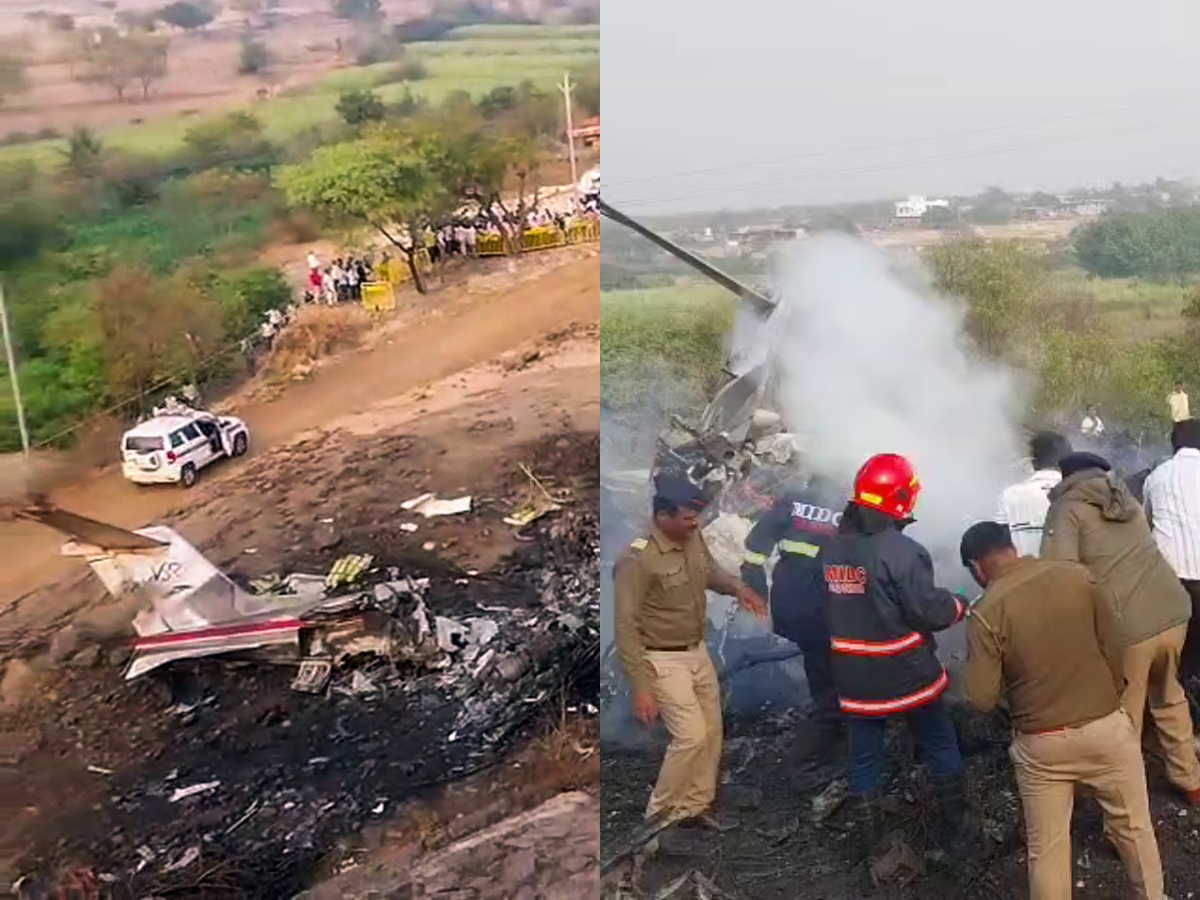

The Ministry of Civil Aviation on Wednesday revealed the reasons behind the plane crash in Baramati that killed Maharashtra Deputy Chief Minister Ajit Pawar and four others. According to the release from the ministry, the pilots flying the Learjet informed ground control that they were unable to locate the Baramati airstrip during their initial landing attempt.
Detailed Account of Ajit Pawar Plane Crash
The crew made a second approach and confirmed that the runway was finally in sight and received clearance to land. Seconds later, the aircraft went up in a ball of flames.
According to the ministry, Captains Sumit Kapoor and Shambhavi Pathak did not respond to the air traffic control’s landing clearance message and crashed soon after. The release provided a detailed account of aircraft VT-SSK’s final moments following a 33-minute flight from Mumbai.
Visibility Conditions At Baramati Airport
The air traffic control (ATC) transcript cited by the ministry raised questions about visibility conditions at Baramati and whether the pilots had an adequate view of the narrow runway. Aviation experts also pointed out that Baramati airport is categorised as an “uncontrolled” airfield, a term used for smaller airports that have only a basic runway and lack a full-fledged ATC tower or dedicated ATC frequency.
Ground control operations at Baramati are managed by pilot cadets from two private aviation academies based in the town, Redbird Aviation and Carver Aviation.
Ajit Pawar Plane Crash: Flight Path and Timeline
Flight-tracking data from FlightRadar24 shows that the eight-seater Learjet 45 took off from Mumbai airport at 8.10 am and headed southeast towards Baramati. The aircraft made its first contact with Baramati airport at 8.18 am, the ministry said.
The flight followed a largely linear path, climbing to a peak altitude of 19,000 metres above sea level and maintaining that height for about three minutes while crossing the Western Ghats. Over the next 20 minutes, the jet steadily descended as it approached Baramati.
Around 30 nautical miles short of the airport, the pilots contacted ATC again. This was the point at which the situation began to deteriorate.
Missed Runway and Go-Around Attempt Before Ajit Pawar Plane Crash
During the final approach, the pilots informed ATC that the runway was not in sight. At that stage, the crew appeared to have decided to abort the landing and go around for another attempt.
The aircraft returned to its initial position for the final approach. However, the crew once again reported that the runway was “currently not in sight.”
“Will call when runway is in sight,” the release quoted the pilots as saying.
Seconds later, the cockpit relayed that the runway was finally visible. ATC then cleared the aircraft for landing.
“The aircraft was cleared to land on runway 11 at 0843 IST. However, they did not give a readback of the landing clearance,” the civil aviation ministry said.
“It is a standard practice to readback to the ATC, which acts like a confirmation to the instructions given to the pilot,” the former AAI official cited earlier explained.
Soon after, the aircraft is believed to have smashed into the ground just short of the runway, veering to the left, before erupting into flames.
Ajit Pawar Plane Crash Last Words
“The last words heard from the crew were ‘oh s***’,” the person added.
The aircraft was largely destroyed, reduced to its skeletal frame, with only the tail fin remaining relatively intact. Debris from the jet was scattered several metres from the impact site.
The Aircraft Accident Investigation Bureau (AAIB) has taken over the probe into the crash.
Zubair Amin is a Senior Journalist at NewsX with over seven years of experience in reporting and editorial work. He has written for leading national and international publications, including Foreign Policy Magazine, Al Jazeera, The Economic Times, The Indian Express, The Wire, Article 14, Mongabay, News9, among others. His primary focus is on international affairs, with a strong interest in US politics and policy. He also writes on West Asia, Indian polity, and constitutional issues. Zubair tweets at zubaiyr.amin




