

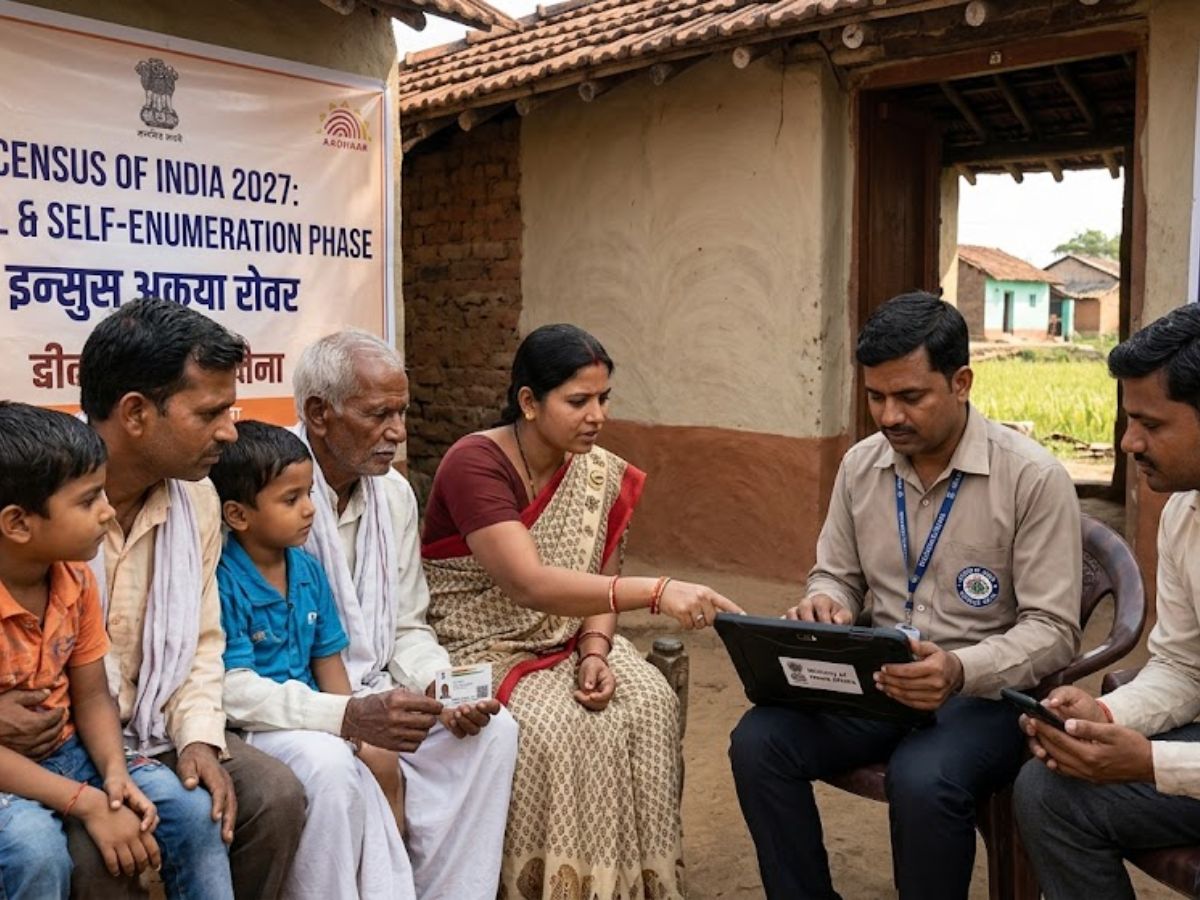
Self Enumeration Census 2027: India on April 1 formally kicked off the first phase of national Census, the world’s largest administrative and statistical exercise. The Census 2027 will be conducted using digital devices, replacing traditional paper-based methods. In another major change, citizens will have the option to self-enumerate online. Officials have clarified that door-to-door enumeration will also continue across all houselisting blocks, as has been the practice in previous Census exercises. The self-enumeration feature is intended to supplement, not replace, physical verification. A key feature of Census 2027 is the inclusion of caste enumeration, which has not been part of the decennial Census since 1931.
Census 2027: Two-Phase Exercise, Key Timeline
The Census will be conducted in two phases:
Phase 1: House Listing and Housing Census (HLO)
Scheduled from April 1 to September 30, with specific timelines determined by individual states and Union Territories.
Phase 2: Population Enumeration
To be conducted in early 2027.
The official reference date for population counting will be midnight of March 1, 2027.
However, in snow-bound and non-synchronous regions, including Ladakh and parts of Jammu and Kashmir, Himachal Pradesh, and Uttarakhand, enumeration will take place earlier in September 2026, with a reference date of October 1, 2026.
Census 2027: How Self-Enumeration Will Work
The government has outlined a process for citizens opting to self-enumerate:
Login the official portal using a mobile number
Mark the exact household location using the portal’s map tool
Fill in household details and Census schedule
Submit the completed form online
Receive a unique self-enumeration ID generated by the system
Share the ID with the visiting enumerator for validation
Once verified, the data will be formally included in the Census records.
Census 2027: State-Wise Self-Enumeration Schedule
The window for self-enumeration will vary across states and Union Territories:
April 1-15, 2026: Andaman and Nicobar Islands, Goa, Karnataka, Lakshadweep, Mizoram, Odisha, Sikkim, Delhi (NDMC and Cantonment Board)
April 5 -19, 2026: Gujarat, Dadra and Nagar Haveli, Daman and Diu
April 10 – 24, 2026: Uttarakhand
April 16 – 20, 2026: Andhra Pradesh, Arunachal Pradesh, Chandigarh, Chhattisgarh, Haryana, Madhya Pradesh
April 17 – May 1, 2026: Bihar
April 26 – May 10, 2026: Telangana
April 30– -May 14, 2026: Punjab
May 1 – 15, 2026: Delhi (MCD), Maharashtra, Meghalaya, Rajasthan, Jharkhand
May 7 -21, 2026: Uttar Pradesh
May 17 – 31, 2026: Jammu and Kashmir, Ladakh, Puducherry
June 1 – 15, 2026: Himachal Pradesh
June 16 – 30, 2026: Kerala, Nagaland
July 17 – 31, 2026: Tamil Nadu, Tripura
August 2 – 16, 2026: Assam
August 17–31, 2026: Manipur
West Bengal: Dates yet to be announced
Budget, Workforce, and Delay Explained
Census 2027 Budget
The Centre has allocated ₹11,718.24 crore for the exercise. Approximately three million field functionaries are expected to be deployed nationwide to carry out the enumeration.
India’s last Census was conducted in 2011. The 2021 round was postponed due to the COVID-19 pandemic, resulting in a 15-year gap.
In 2023, the UN Population Fund estimated that India’s population had likely surpassed China’s by nearly three million people by mid-year.
Zubair Amin is a Senior Journalist at NewsX with over seven years of experience in reporting and editorial work. He has written for leading national and international publications, including Foreign Policy Magazine, Al Jazeera, The Economic Times, The Indian Express, The Wire, Article 14, Mongabay, News9, among others. His primary focus is on international affairs, with a strong interest in US politics and policy. He also writes on West Asia, Indian polity, and constitutional issues. Zubair tweets at zubaiyr.amin





