
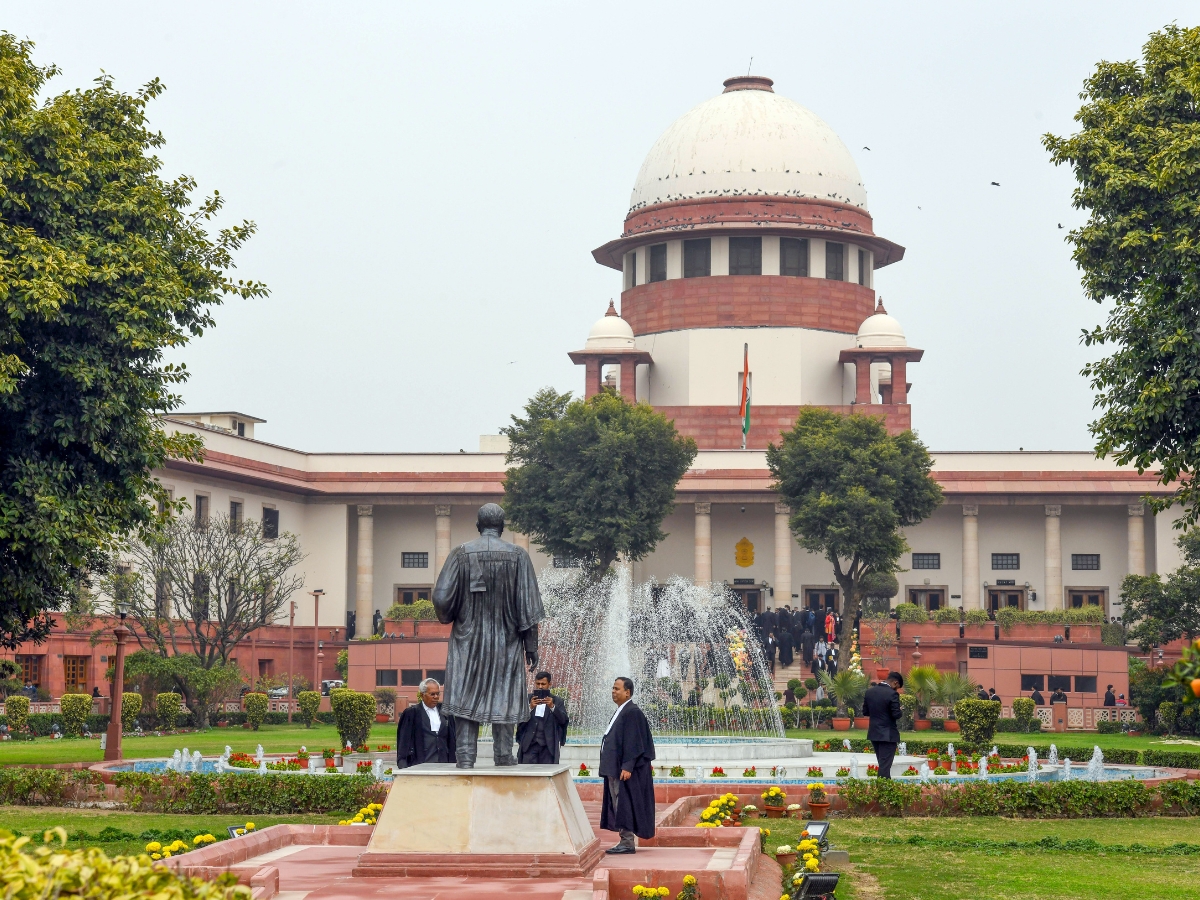

The Supreme Court on Thursday held that neither the President nor state Governors can be compelled to follow judicially imposed timelines when dealing with Bills passed by legislatures. A five-judge Constitution Bench ruled that their actions are “not justiciable” and may be subjected to judicial review only after a Bill becomes law.
The ruling came in response to a set of questions President Droupadi Murmu referred to the court under Article 143, following a two-judge bench verdict in the Tamil Nadu Governor case that effectively prescribed deadlines for constitutional heads to act on Bills.
What President Droupadi Murmu Asked The Top Court
President Murmu sought the court’s opinion on whether the judiciary could set time limits for Governors and the President under Articles 200 and 201.
Her letter asked, “In the absence of a constitutionally prescribed time limit, and the manner of exercise of powers by the Governor, can timelines be imposed and the manner of exercise be prescribed through judicial orders for the exercise of all powers under Article 200 of the Constitution of India by the Governor?”
Also Read: Bihar CM Nitish Kumar Oath Ceremony: PM Modi’s Gamcha Moment Grabs Spotlight Yet Again
She also asked whether the President’s constitutional discretion under Article 201 is justiciable, and further inquired, “Is the Governor bound by the aid and advice tendered by the Council of Ministers while exercising all the options available with him when a Bill is presented before him under Article 200 of the Constitution of India?”
Citing Article 361, the President stressed that constitutional heads “shall not be answerable to any court for the exercise of the powers and duties of office.”
What Supreme Court Ruled While Overturning Two Two-Judge Bench Interpretation
A Constitution Bench led by Chief Justice of India BR Gavai, and comprising Justices Surya Kant, Vikram Nath, PS Narasimha, and AS Chandurkar, said imposing timelines on constitutional authorities was “strictly contrary” to the Constitution.
The court also rejected the two-judge bench’s interpretation of “deemed assent,” concluding that, “Deemed consent of the Governor, or President, under Article 200 or 201 at the expiry of a judicially set timeline, is virtually a takeover, and substitution, of the executive functions by the Judiciary… which is impermissible within the contours of our written Constitution.”
The Tamil Nadu Case
The controversy began on April 8, when a bench of Justices JB Pardiwala and R Mahadevan ruled in The State of Tamil Nadu vs The Governor of Tamil Nadu that ten Bills withheld by Governor RN Ravi were to be treated as “deemed to have been assented on the date when they were presented to the Governor.” The bench invoked Article 142 to issue this direction.
The judgment emphasised, “We are in no way undermining the office of the Governor. All we say is that the Governor must act with due deference to the settled conventions of parliamentary democracy; respecting the will of the people being expressed through the legislature as well as the elected government responsible to the people.”
Zubair Amin is a Senior Journalist at NewsX with over seven years of experience in reporting and editorial work. He has written for leading national and international publications, including Foreign Policy Magazine, Al Jazeera, The Economic Times, The Indian Express, The Wire, Article 14, Mongabay, News9, among others. His primary focus is on international affairs, with a strong interest in US politics and policy. He also writes on West Asia, Indian polity, and constitutional issues. Zubair tweets at zubaiyr.amin




