
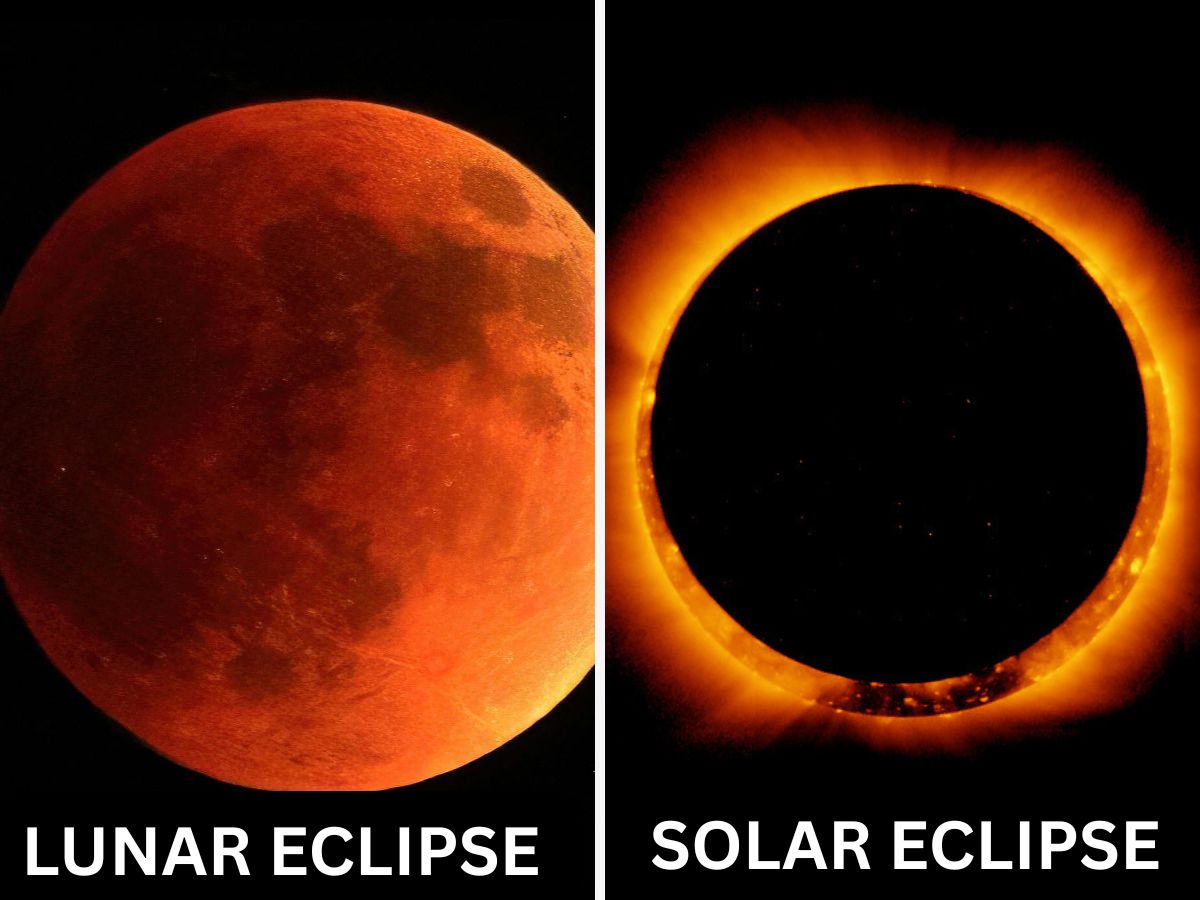

Solar and Lunar Eclipse have fascinated us for centuries, surrounded by myths, rituals, and pseudoscientific opinions. But outside cultural interpretations, what do these celestial events really do to Earth and to all of us? Scientific research illustrates that while eclipses do not have any direct effect om our health, they might affect Earth’s atmosphere, weather conditions, and even animal behavior in subtle but assessable manner.
Solar and Lunar Eclipse: Do Eclipses Affect the Human Body?
From the viewpoint of medical and physiology, solar and lunar eclipses do not have any direct physical impact on the human body. As per NASA and the World Health Organization (WHO), there is no indication that eclipses influence our health, emotions, or any body functions.
Though, eye safety is a key concern in any of the solar eclipses. Looking directly at the sun, even during a partial eclipse, with no proper solar filters or eyeglasses can cause enduring retinal damage or solar retinopathy.
There are also unreliable indications and ongoing psychological studies that recommend eclipses may affect the sleep patterns, primarily due to an unexpected change in light during solar eclipses or more night-time brightness during certain lunar eclipses. Though, the effects are temporary and not harmful.
Solar and Lunar Eclipse: How Eclipses Affect Earth’s Atmosphere?
Although human beings are mostly not affected physically, Earth’s atmosphere does react to eclipses, particularly solar eclipses cause decrease in surface temperature to some extent, atmospheric waves, ionospheric Changes, and animal Behavior.
Solar or Lunar Eclipse: Myths and Facts?
Lunar Eclipses happens when the Earth’s shadow falls on the moon, have far less atmospheric effect than Solar Eclipses because it happens at night and does not include direct solar radiation, the temperature doesn’t change, significantly. Their impacts are almost visual and cultural, providing a fabulous display to the skywatchers.
Misconceptions about eclipses continue, from warnings to avoid eating or that injuries heal slower. Yet, none of these are backed by science. Utmost rituals offer psychological relief rather than any physical benefit.
Also Read: Solar Eclipse 2025: How The September Eclipse Differs From The August Eclipse?
Ankur Mishra is a journalist who covers an extensive range of news, from business, stock markets, IPOs to geopolitics, world affairs, international crises, and general news. With over a decade of experience in the business domain, Ankur has been associated with some of the reputed media brands. Through a sharp eye on global marketplaces along with deep insights and analysis of business strategies, Ankur brings simplicity to the complex economic matrix to decode market trends and empower people.
He is committed to entrenched data, facts, research, solutions, and a dedication to value-based journalism. He has covered trade tariff wars, international alliances, corporate policies, government initiatives, regulatory developments, along with micro- and macroeconomic shifts impacting global fiscal dynamics.




