
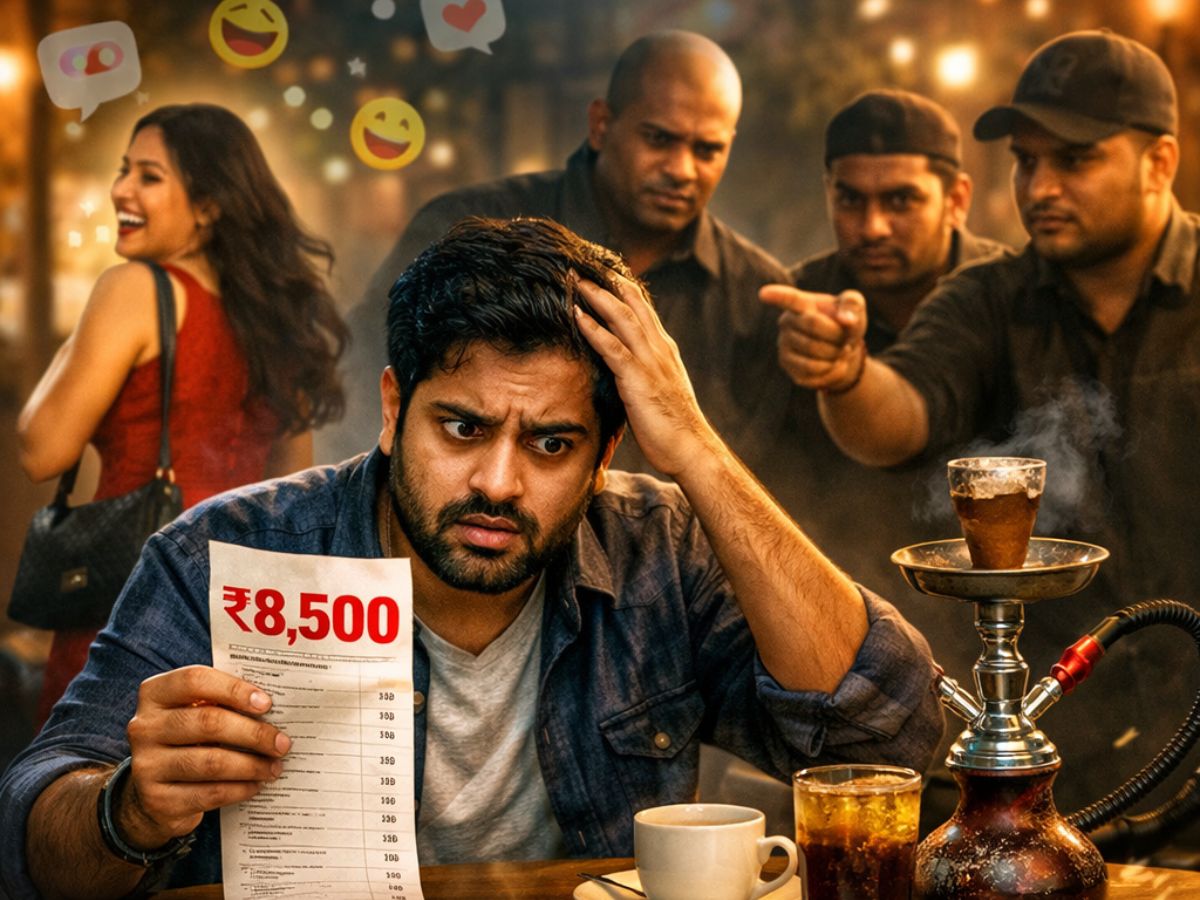

A bizarre incident that went viral from Kolkata has raised eyebrows, when a young man claimed that his first date was not only a costly but also a scary experience. According to social media posts, the man had paired up with a woman on the dating app Bumble. A simple chat began and eventually, a plan to meet in person was made. The woman allegedly requested to meet her date at a café near Ranikuthi in Kolkata. The date started positively as the two of them ordered hookah and coffee while chatting. The conversation was going on when the bill arrived.
The bill was an inflated ₹8,500. Before the man could raise his concerns, the café staff rushed to him and insisted that the bill be paid immediately. He turned to his date for support, but she had already left the café. She reportedly left, laughing, while the man was left to pay the bill. The incident went viral on social media as “₹8,500 ka chuna”.
A boy has a conversation with a girl on the Bumble dating app.
The girl calls him to meet at the Couple Cafe Zone near Ranikuthi in Kolkata.
Together, they ordered two coffees and a hookah, but later the boy was handed a huge bill of ₹8500.
The cafe staff surrounded the… pic.twitter.com/02Q7D4GPSB
— Bharat Mata ke Sewak (@CountryGulshan) April 10, 2026
What is honey trap billing fraud?
Honey trap billing fraud is an emerging scam pattern in urban India that mixes online deception with offline manipulation. In these cases, scammers use fake or deceptive profiles on social media or dating apps to attract people and lure them to meet in person.
Once the victim trusts the scammer, the victim is asked to meet at a particular café, lounge or restaurant (usually pre-chosen by the scam network). There, premium drinks, food and hookah are served at exorbitant prices, sometimes without a clear disclosure.
When the bill comes, it is often exorbitant. The victim then faces intimidation from the staff or their accomplices and may not be able to leave without paying or even argue the bill. At this stage, the “date” is usually gone.
How do such scams generally work?
Internet and cybercrime experts and netizens say such scams are usually organised and follow a pattern:The scammer gets in touch with the target through a dating portal like Bumble or via social media
The scammer asks the victim for an offline meeting at a particular venue
The staff is asked to order expensive or unnecessary items or add them to the bill
The prices are inflated beyond market value
The staff or their accomplices allegedly threaten the victim into paying immediately
Police in some of the metro cities have received complaints regarding similar scams. This suggests that the scam rings might be more common than one might think.
Why don’t more victims report the scam?
In spite of the financial loss and discomfort, most victims don’t file complaints. Experts say that fear of embarrassment and perceived social stigma are the main reasons.
Being scammed during a date can be quite a source of personal shame, which makes it difficult for victims to approach the police. Additionally, people feel judged when a dating app is involved, which further reduces the possibility of reporting. Hence, these scams go virtually unreported, which allows them to continue targeting new victims.
Users on social media reacting to the Kolkata case also pointed out that several “couple cafés” have long been accused of overbilling customers, but are not well-known to first-time visitors.
What has the social media reaction to the viral post been?
The case in Kolkata went viral in a matter of hours, and drew a range of responses on social media, from jokes to concern. While some users made jokes about the “expensive coffee date,” others called for seriousness over the matter.
Several posts stressed that the victim should not be blamed, noting that such scams can be very sophisticated, involving exploitation of trust, social norms and pressure. Others shared their experiences, suggesting that this might be a more common phenomenon.
The post going viral has also drawn attention to the offline risks associated with online dating platforms, and has prompted discussions on user safety.
How can you protect yourself against ‘honey trap billing fraud’?
As dating apps are gaining more popularity, ways to stay safe have been suggested by experts, especially when it comes to first meetings:
Select the place yourself or prefer popular, well-known places
Be wary of places suggested at the behest of a new match
Search for online rating of cafés or lounges before going there
If a pricey item is ordered without your consent, be careful
Tell a friend or a family member about your plans
If something feels wrong, trust your gut and walk away
The story in Kolkata is a reminder that scams keep getting more refined with the times. Online platforms give us many opportunities to connect, but it is essential to remain cautious, both online and offline.
Sofia Babu Chacko is a journalist with over five years of experience reporting on Indian politics, crime, human rights, gender issues, and stories about marginalized communities. She believes journalism plays a crucial role in amplifying unheard voices and bringing attention to issues that truly matter. Sofia has contributed articles to The New Indian Express, Youth Ki Awaaz, and Maktoob Media. She is also a recipient of the 2025 Laadli Media Awards for gender sensitivity. Beyond the newsroom, she is a music enthusiast who enjoys singing. Connect with Sofia on X: https://x.com/SBCism




