
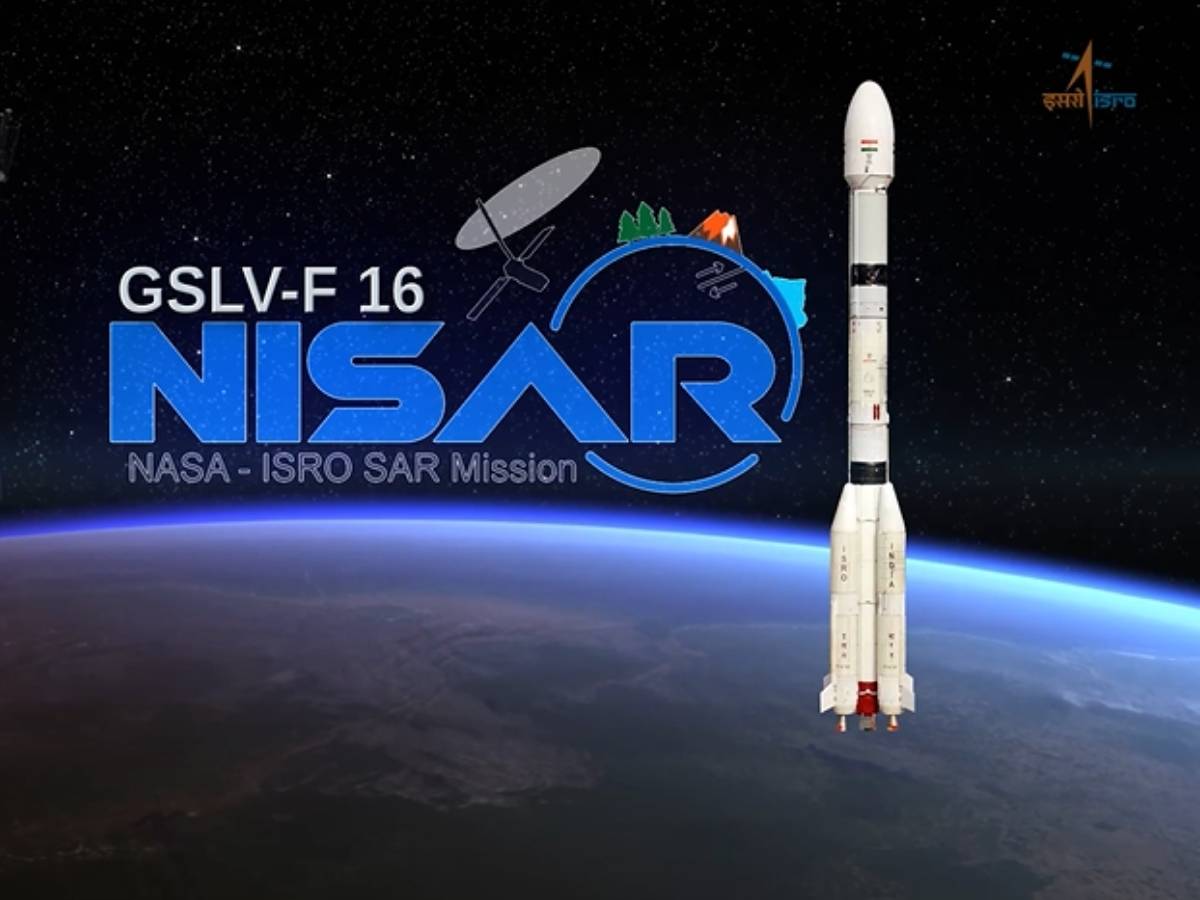

In a historic collaboration between two of the world’s leading space agencies, the Indian Space Research Organisation (ISRO) and NASA are all set to launch NISAR a first-of-its-kind joint Earth observation satellite from the Satish Dhawan Space Centre, Sriharikota, on July 30, 2025, at 17:40 IST.
NISAR (NASA-ISRO Synthetic Aperture Radar) represents a decade-long development effort that combines NASA’s L-band radar and ISRO’s S-band radar to offer unmatched capability in monitoring land, ice, and ocean surfaces. The dual-band Synthetic Aperture Radar (SAR) employs a revolutionary SweepSAR technique to deliver high-resolution, wide-area imaging every 12 days.
The mission’s unique radar technology will allow scientists to track land and ice deformation, crop growth, wetland ecosystems, sea-ice dynamics, mountain glaciers, and even natural hazards such as earthquakes, volcanoes, landslides, and groundwater changes.
NISAR’s massive 12-metre reflector antenna will be deployed 9 metres away from the satellite after launch using a complex multi-stage boom, designed by NASA’s Jet Propulsion Laboratory (JPL). The spacecraft itself is built around ISRO’s I-3K satellite platform.
ISRO has taken charge of the S-band radar, spacecraft, launch vehicle (GSLV-F16), data handling, and satellite operations. Meanwhile, NASA has contributed the L-band radar, GPS receiver, solid-state recorder, and the boom mechanism. Both agencies will manage ground station operations to receive and process data.
The launch will initiate a multi-phase mission:
-
Launch Phase
-
Deployment Phase
-
Commissioning Phase (90 days)
-
Science Phase
During commissioning, critical in-orbit checkouts will validate both mainframe and radar payloads. Once completed, the satellite will enter its science phase, conducting regular measurements and orbit maneuvers as per a jointly designed mission plan between ISRO and NASA.
The integrated radar payload, IRIS, was assembled and tested at NASA’s JPL before delivery to ISRO. The main satellite body and final system integration were completed at URSC, ISRO.
“This is one mission to watch Earth. #ISRO #NASA builds, Earth benefits,” ISRO posted on X (formerly Twitter), highlighting the global value of the mission.
As the Earth faces increasingly complex environmental changes, the ISRO-NASA NISAR mission promises to be a vital tool for governments, researchers, and climate scientists around the world.
ALSO READ: Perseids Meteor Shower 2025: Event Of Space Rocks Burning In Earth’s Atmosphere




