

Sotheby’s in New York is auctioning a rock weighing 25 kilograms (54 pounds) on July 16 at an estimated price of $2 million to $4 million. The precious rock known as ‘NWA 16788’ is believed to be largest piece of Mars to have ever been found on Earth.
Also going under the hammer is a juvenile Ceratosaurus dinosaur skeleton over 6 feet tall and nearly 11 feet long in size.
The July 16 auction is part of Sotheby’s Geek Week 2025 that features 122 items. The natural history-themed sale follows the ongoing ‘Space Exploration’ auction of 108 items, bidding for which ends on Tuesday, July 15.
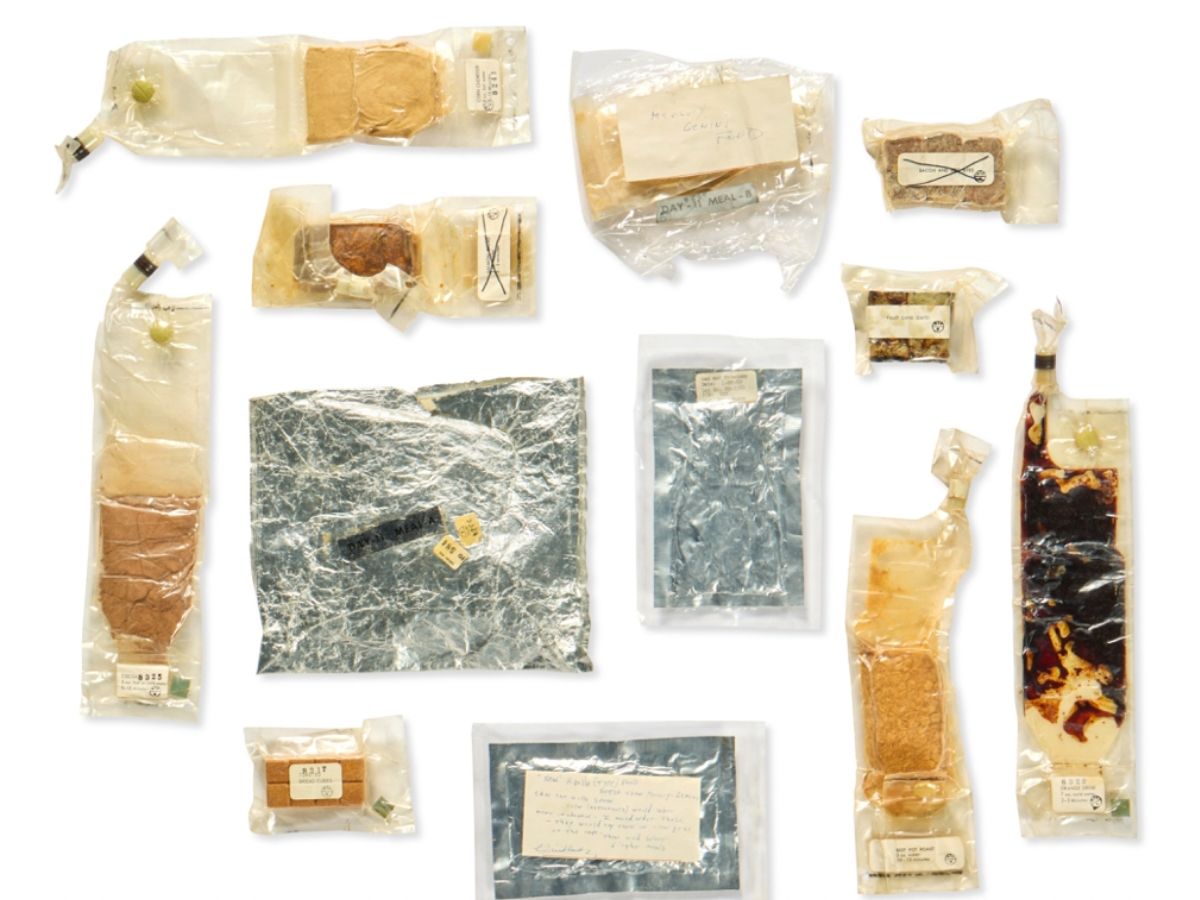
Among the 108 items placed under the hammer as part of ‘Space Exploration’ theme is a collection of food samples. What’s special about the lot is that these were foods astronauts carried in early spaceflights from Gemini and Apollo era, according to the Sotheby’s website.
Also Read: Biggest Piece of Mars on Earth Is Going Up for Auction in New York – Here’s What We Know
Collection Of Early NASA Astronaut Meals
Sourced directly from the estate of Charles “Chuck” Friedlander, former NASA Astronaut Support Office, KSC, Chief who served from 1963 to 1967, the food samples include that of corn chowder, bread cubes, cocoa, ham and potatoes, salmon salad, fruit cake, seasoned peas, roasted beef, and fortified grapefruit drink and orange juice. The estimated price for the foold items is 4,000 – 6,000 USD.
Largest Piece of Mars Ever Found on Earth Up for Auction!
Sotheby’s is auctioning NWA 16788, a 24.7 kg Martian meteorite, the biggest known on Earth on July 16 in New York.
It could fetch up to $4 million! Only ~400 Martian rocks exist here, and this one holds 7% of their… pic.twitter.com/RLaw3l893L
— Space Mechanics (@SpaceMechanicsY) July 13, 2025
According to the Sotheby’s website, the packet sizes of these samples vary from 15×3.5 inches to 3×4.5 inches, and come with handwritten annotations such as ‘New Apollo Type Food’ and ‘Mercury Food’.
Friedlander himself labelled and signed one packet that reads: “New” Apollo (TYPE) Type- food better than Mercury – Gemini can eat with spoon crew (astronauts) would select menu in advance – I would order these – they would try them in crew qtrs. at the cape – then we’d select light meals.”
What Was Special About The Meals Early NASA Astronaut Carried To Space?
Freeze-dried before the flight, the food items went through a long process before they were chosen to be astronauts’ meal in space.
“An astronaut would insert a probe into the valve at the end of the packaging and insert water,” the catalogue note on the Sotheby’s website reads about the Gemini-era food.
For the Gemini IV mission, it says, the meal plan featured a four-day cycle menu of four meals a day, which totalled 2,550 calories.
“Gemini V used a 3 day cycle of 3 meals a day, though the average caloric intake ended up at a much lower average of roughly 1,000 calories,” the note adds. “These early studies were important as NASA figured out how to sustain crews on longer missions to reach the Moon.”
#AuctionUpdate: New world auction record for Claude Monet and for any work of Impressionist Art. An undisputed masterpiece from his acclaimed Haystacks Series, ‘Meules’ from 1890, sells for $110.7 million at Sotheby’s New York. pic.twitter.com/jcODuYh8Pz
— Sotheby’s (@Sothebys) May 14, 2019
Friedlander’s inscription notes that the Apollo food was better than the oprions available for Gemini and Mercury projects that were undertaken in the past. This explains how technology advanced with time on what asgtronauts ate and how.
About the specific food samples under the hammer, the catalogue note says the sealed plastic, velcro, and inspection numbers indicate that they could have been used for training. A specific packet marked “Day-11, Meal B”, it says, may have been from the 14-day Gemini VII mission.
Zubair Amin is a Senior Journalist at NewsX with over seven years of experience in reporting and editorial work. He has written for leading national and international publications, including Foreign Policy Magazine, Al Jazeera, The Economic Times, The Indian Express, The Wire, Article 14, Mongabay, News9, among others. His primary focus is on international affairs, with a strong interest in US politics and policy. He also writes on West Asia, Indian polity, and constitutional issues. Zubair tweets at zubaiyr.amin




