
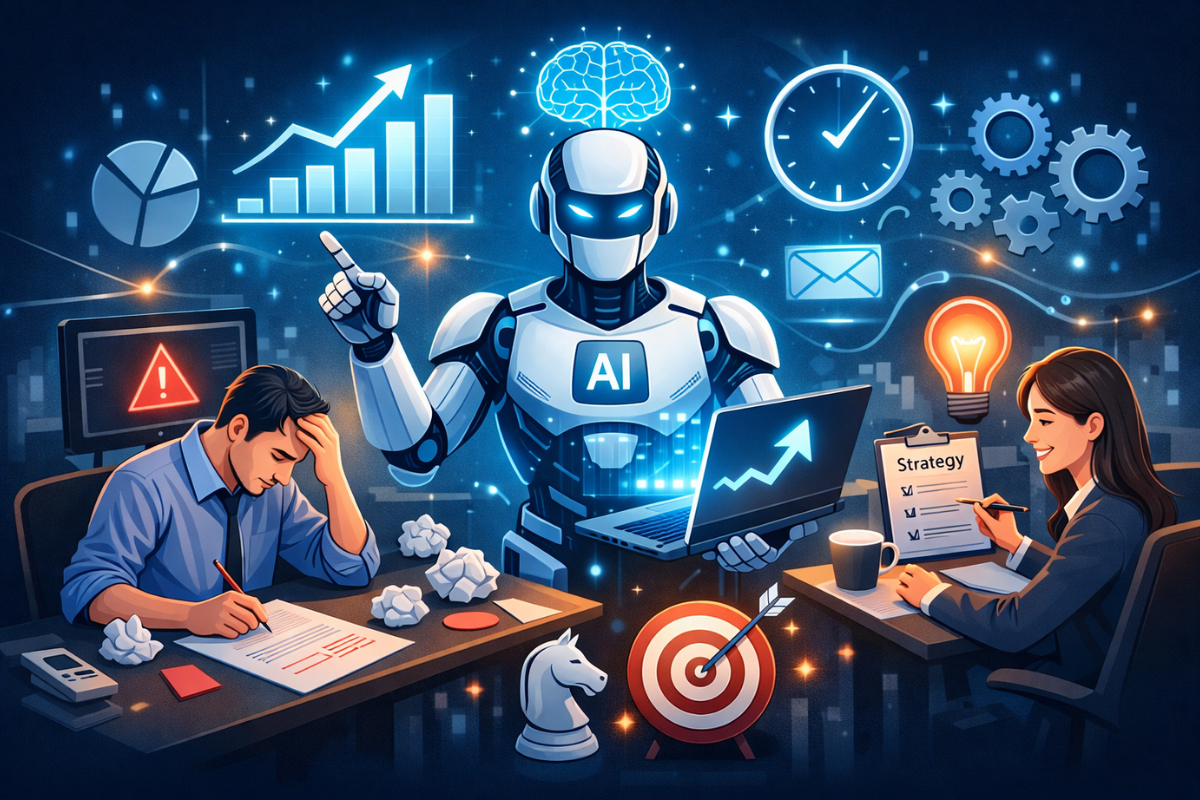

According to recent worldwide data published by Workday, there is a serious “productivity paradox” where businesses are not fully utilizing artificial intelligence. According to the study “Beyond Productivity: Measuring the Real Value of AI,” 85% of workers say they use AI technologies to save one to seven hours a week; nevertheless, rework currently accounts for approximately 40% of these time saves. The research characterizes this loss as a “false sense of productivity” caused by employees having to correct errors, rewrite content, and validate outputs from generic AI technologies.
The workforce is not equally burdened by this rework. Employees between the ages of 25 and 34 have the greatest burden, accounting for 46% of those who deal with the highest levels of AI correction, according to the statistics. Furthermore, those who use the technology most frequently are under the most strain; 77% of daily AI users report reviewing AI-generated work just as carefully as, or even more carefully than, work produced by humans. Because work structures and skill development have not advanced at the same rate, this friction implies that although AI improves capacity, it is not yet consistently producing superior results.
When it comes to AI preparation, there is a big gap between leadership priorities and the real employee experience. Just 37% of workers who struggle with the most rework report having access to skills training, despite the fact that 66% of bosses rank it as a top priority. Furthermore, many “employees are using 2025 tools inside 2015 job structures” because 89% of firms have modified less than half of their job responsibilities to match new AI capabilities. At the moment, businesses are more inclined to put AI-driven savings back into technology (39%) than in employee development (30%).
“Too many AI tools push the hard questions of trust, accuracy, and repeatability back onto individual users,” said Gerrit Kazmaier, head of product and technology at Workday. He underlined that the objective should be for AI to take care of the “complex work under the hood” so that workers may concentrate on their creativity and judgment.
According to the research, the most successful companies view time savings as a strategic resource. Employees who witness favorable results are much more likely to have received additional skill training and to use their free time for strategic thinking as opposed to simply taking on more work.
(input from ANI)
Also Read: Personal Intelligence In Gemini: Google Delivers Smarter, Privacy-Focused AI
Syed Ziyauddin is a media and international relations enthusiast with a strong academic and professional foundation. He holds a Bachelor’s degree in Mass Media from Jamia Millia Islamia and a Master’s in International Relations (West Asia) from the same institution.
He has work with organizations like ANN Media, TV9 Bharatvarsh, NDTV and Centre for Discourse, Fusion, and Analysis (CDFA) his core interest includes Tech, Auto and global affairs.
Tweets @ZiyaIbnHameed




