

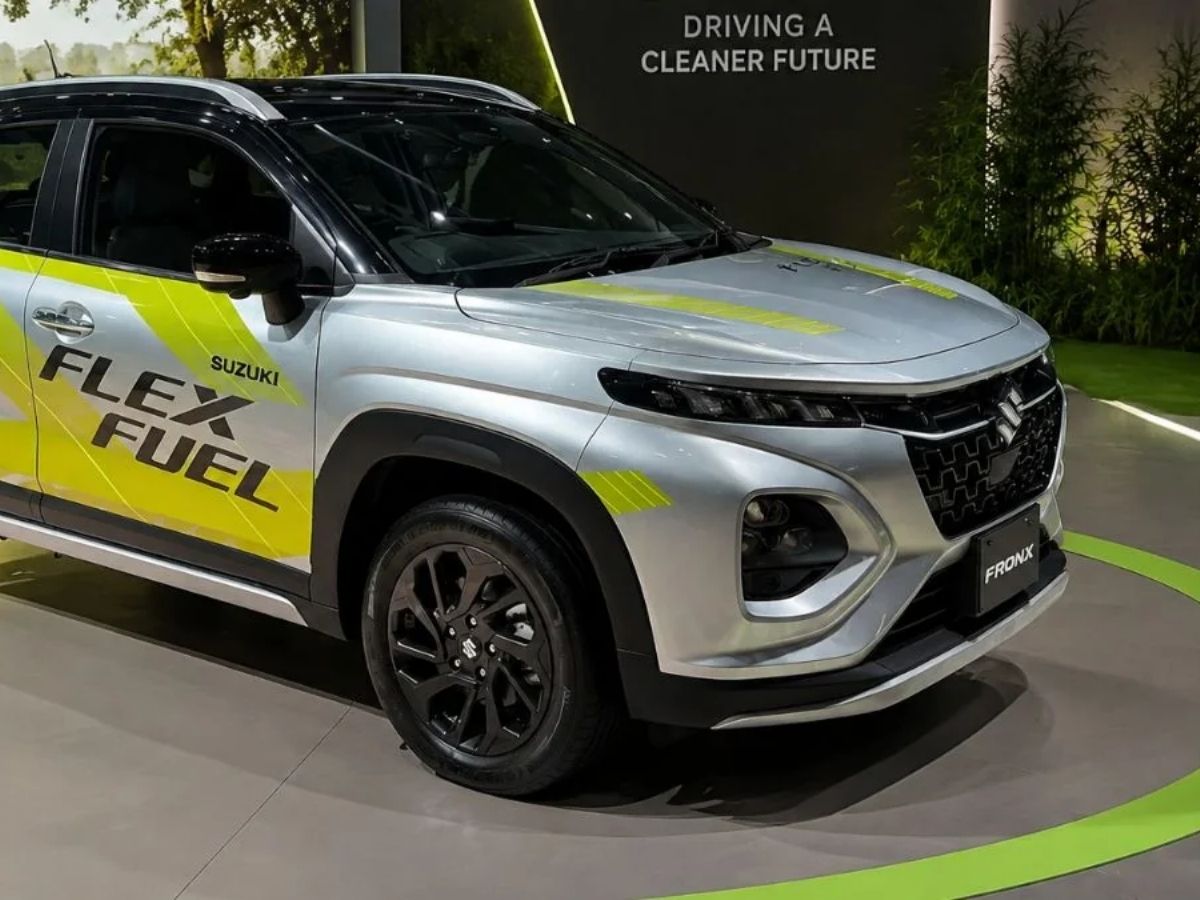
India’s largest carmaker, Maruti Suzuki, has done something the country’s auto industry has been waiting a long time for. On June 4, ahead of World Environment Day, the company unveiled India’s first mass-market flex-fuel passenger vehicle, one that can run on 100 percent ethanol, also known as E100. The event was held at the Taj Palace in Delhi and was attended by two of the most senior names in government. Union Minister for Road Transport and Highways Nitin Gadkari and Union Minister for Petroleum and Natural Gas Hardeep Singh Puri were both present at the launch.
This is not just another car launch. It is a step towards changing how India fuels its vehicles.
What Is a Flex-Fuel Car and Why Does It Matter
A flex-fuel vehicle, or FFV, is a car whose engine can run on more than one type of fuel. In this case, the car can use petrol, ethanol, or any mix of the two, including pure ethanol. Gadkari has been vocal about the need to reduce India’s dependence on petrol and diesel, pointing out that around 87 percent of these fuels are imported into the country. Ethanol, on the other hand, is made from crops like sugarcane and is produced domestically. That means less money leaving India to buy foreign oil.
Maruti’s WagonR flex-fuel prototype, which was developed locally with support from Suzuki Japan, was claimed to cut tailpipe emissions by 79 percent compared to a regular petrol car. That is a big number. And if the production version delivers even close to that, it could be genuinely good news for air quality in Indian cities.
The Wagon R and Fronx are the two strongest candidates for the flex-fuel launch, both having been shown as prototypes before. The Wagon R flex-fuel prototype was first shown at the Bharat Mobility Global Expo in Delhi in February 2024, while the Fronx flex-fuel version appeared at the Japan Mobility Show in 2025.
The Bigger Push Behind This Launch
This launch does not stand alone. Gadkari has confirmed that 12 companies, including Mahindra, Tata Motors and Toyota, are working on flex-fuel vehicles and says they will be introduced on a large scale soon. Maruti is simply the first to put a date on it.
The government is also planning to set up 5,000 E100 fuel dispensing stations across India over the next two years, which is a key part of making flex-fuel cars actually usable for everyday buyers.
There is a cost question, though. Adapting a vehicle for E100 ethanol is estimated to add Rs 40,000 to Rs 50,000 to production costs per unit. Whether that gets passed on to the buyer or absorbed by the company will decide how quickly people actually adopt it.
For now, Maruti has made history. The road ahead, quite literally, depends on whether the fuel pumps, the prices and the policies can keep up.
Syed Ziyauddin is a media and international relations enthusiast with a strong academic and professional foundation. He holds a Bachelor’s degree in Mass Media from Jamia Millia Islamia and a Master’s in International Relations (West Asia) from the same institution.
He has work with organizations like ANN Media, TV9 Bharatvarsh, NDTV and Centre for Discourse, Fusion, and Analysis (CDFA) his core interest includes Tech, Auto and global affairs.
Tweets @ZiyaIbnHameed





