
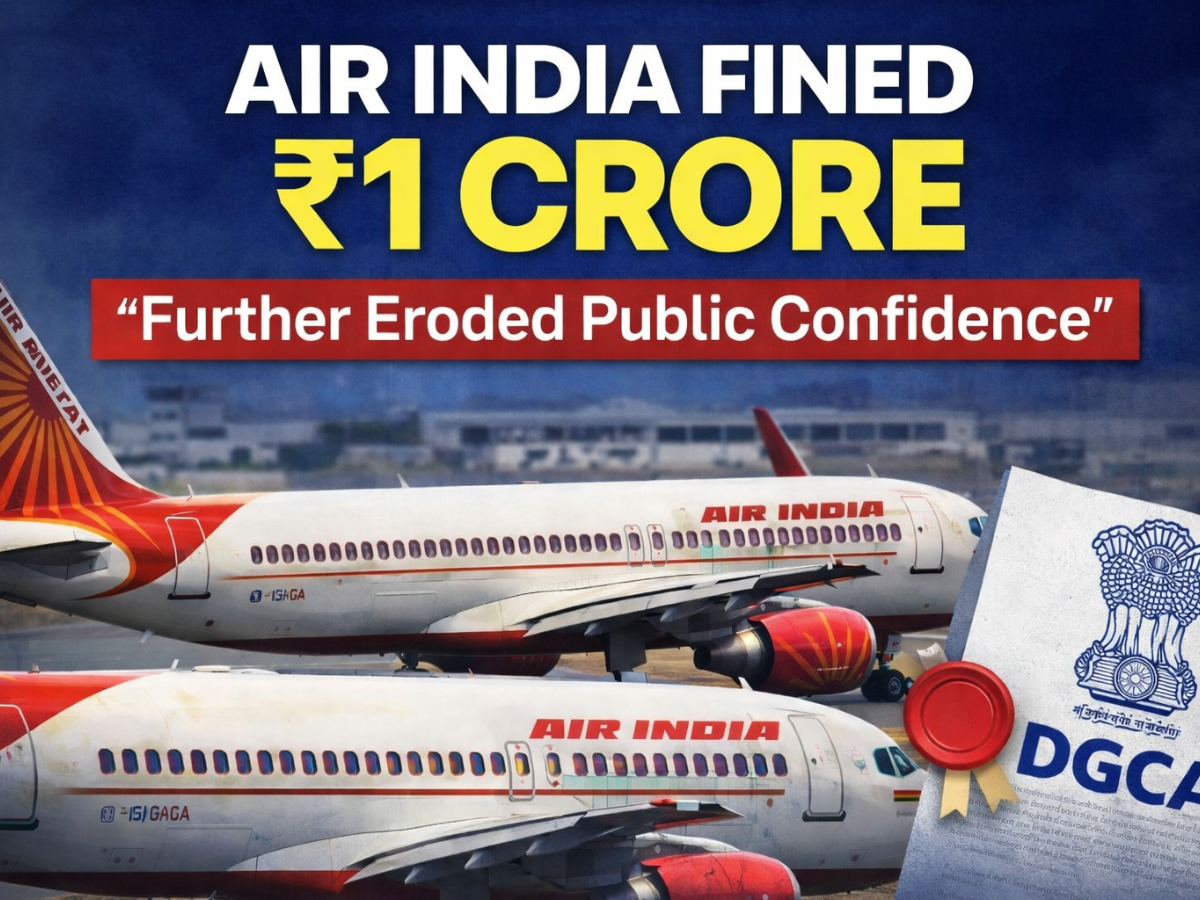

India’s civil aviation watchdog, DGCA has fined Air India Rs 1crore for operating an Airbus aircraft eight times without a valid airworthiness permit, according to a confidential order. The regulator said the lapse has “further eroded public confidence and adversely impacted the safety compliance of the organisation.”
The aircraft involved was an Airbus A320. It carried passengers between New Delhi, Bengaluru, Mumbai and Hyderabad on November 24 and 25 without the mandatory Airworthiness Review Certificate (ARC). The ARC is a key document issued every year by the regulator after an aircraft clears required safety and compliance checks.
Air India Internal Probe Flags ‘Systemic Failures’
Air India’s own internal investigation into the incident, which Reuters had reported in December, found “systemic failures.” The airline admitted there was an urgent need to improve its compliance culture.
The penalty order, issued on February 5 to Air India CEO Campbell Wilson, stated that the incident had “further eroded public confidence and adversely impacted the safety compliance of the organisation.” The order was signed by Joint Director General of Civil Aviation Maneesh Kumar.
“The accountable manager on behalf of Air India is found blameworthy for the above lapses,” Maneesh Kumar wrote in the order, referring to Wilson. Air India did not respond to Reuters queries on the matter.
Air India Given 30 Days to Pay
The airline has been directed to deposit Rs 1 crore, or $110,339, within 30 days. The development comes at a time when Air India is still dealing with the impact of last year’s major tragedy. In June, a Boeing Dreamliner crashed moments after take-off, killing 260 people in what was the airline’s worst disaster.
The internal probe into the Airbus incident also pointed to pilot lapses. It said the pilots who operated the eight flights did not comply with standard operating procedures before take-off, as Reuters has reported earlier.
Air India, owned by India’s Tata Group and Singapore Airlines, has also faced warnings from the aviation watchdog in recent months. These included concerns over operating aircraft without properly checking emergency equipment and other audit-related lapses.
(With inputs from Reuters)




