
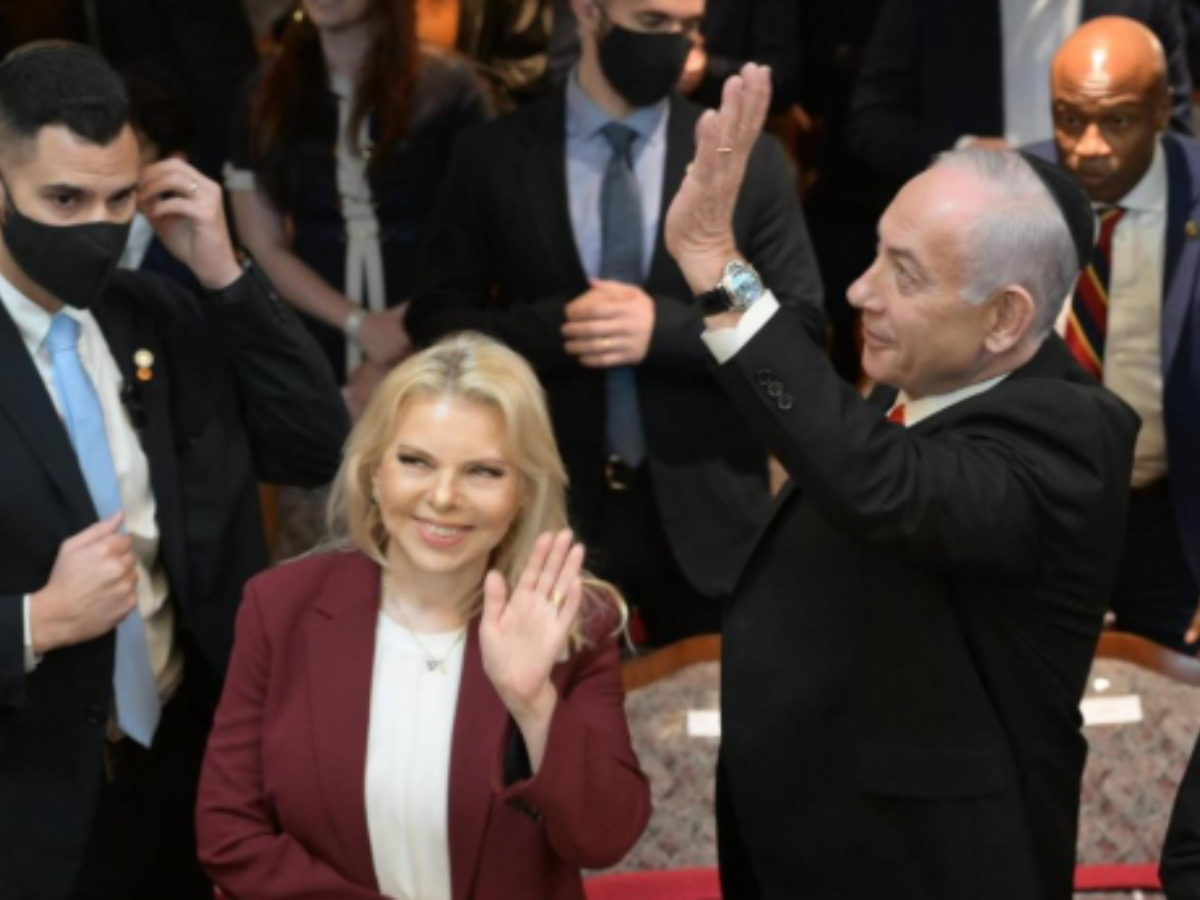

A fiery ethics debate has erupted in Israel after heavily retouched photos of Sara Netanyahu, the wife of Prime Minister Benjamin Netanyahu surfaced through official government channels and could potentially enter the country’s state archives.
The controversy began when images including those showing Sara Netanyahu alongside her husband Benjamin Netanyahu, U.S. Ambassador Mike Huckabee and Israeli soldiers lighting Hanukkah candles at the Western Wall were shared by the state with her appearance noticeably altered: poreless skin, overly defined eyes and perfectly styled hair. Critics have said that this is not just harmless editing but a distortion of reality that distorts official record‑keeping and ethical standards.
Why Sara Netanyahu’s retouched photos matter?
Veteran political journalist Shabi Gatenio, who broke the story, explained why this matters, he said that “All the pictures to this day in the archives in Israel are authentic pictures of reality as it was captured by the lenses of photographers’ cameras since the establishment of the state.” He further added “These images, if entered into the database, will forever infect it with a virtual reality that never existed.”
In response to the outcry, the government has taken the unprecedented step of crediting Sara Netanyahu by name in press releases that include manipulated photos, although it remains unclear whether such photos taken in the second half of last year will be included in the official archive. Mrs. Netanyahu’s personal spokesperson has not publicly responded to requests for comment.
Netanyahu’s pictures are never altered
Nitzan Chen, director of the Government Press Office, insisted that official images of the prime minister himself are never altered, saying: “No Photoshop, no corrections, no color. Nothing.” He also confirmed his office would not upload retouched photos to the state archive and said lawyers are currently debating how to handle images “processed by people other than GPO photographers.” The Justice Ministry is also examining the “criteria, limitations and possibilities” of such edits, although Chen stressed that touching up images is not illegal.
Digital forensics expert Hany Farid from the University of California, Berkeley, reviewed comparisons between raw video and published photos and concluded: “There’s been some Photoshop editing to, let’s call it ‘beautify,’ lighten, smooth the face.” He said that, “Is it nefarious? No. Is it a problem? Yes. This is about something bigger than, ‘she Photoshopped her face to make herself look younger.’ This is about trust. Why should I trust any official photo coming out of that administration?”
Tehilla Shwartz Altshuler, head of a digital democracy program in Jerusalem, said such practices reflect broader trends in political imagery: “This is exactly what Netanyahu and his surrounding circle have tried to do for many years. Presenting himself as a superhero, his wife as a supermodel, their family as a super loyal family. Even when it wasn’t the case, even at the expense of actual political work, administrative work and social work.” She warned that Israel has reached a critical moment for “archiving the truth, archiving history” in the digital age.




