
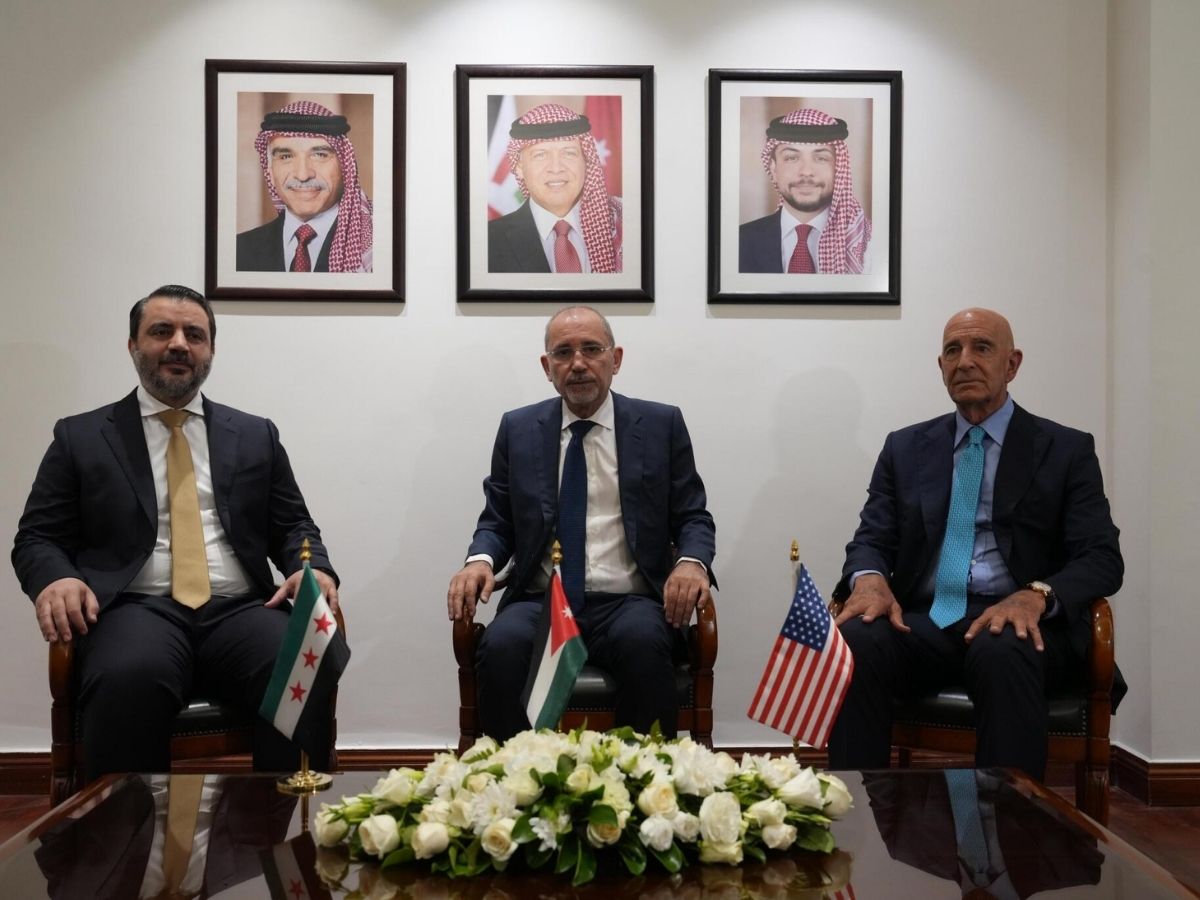

Jordanian Foreign Minister Ayman Safadi, Syrian Foreign Minister Asaad al-Shibani, and US Special Envoy Tom Barrack met in Amman on Tuesday to address Syria’s reconstruction following deadly clashes in Sweida province. The July conflict, which saw pro-government factions fighting with the Druze minority, ended with a ceasefire negotiated on July 18. The trialogue focussed on boosting security, easing humanitarian aid and supporting the rebuilding process.
Officials agreed on “practical steps aimed at supporting Syria in implementing the agreement, ensuring the country’s security and stability, protecting civilians, and upholding state sovereignty and the rule of law across all Syrian territory,” according to a report published by The Associated Press Tuesday.
The Hashemite Kingdom of Jordan today hosted a joint Jordanian-Syrian-American meeting to discuss the situation in Syria and explore ways to support the reconstruction process based on principles that ensure Syria’s security, stability, sovereignty, unity, and non-interference in… pic.twitter.com/aSy9k4mboY
— U.S. Embassy Syria (@USEmbassySyria) August 12, 2025
“Participants affirmed that As-Suwayda Governorate, with all its local communities, is an integral part of the Syrian Arab Republic, and that the rights of its people must be protected and upheld in the process of rebuilding a new Syria — one that is secure and inclusive for all its citizens and ensures their representation and participation in shaping Syria’s future,” a post from the US Embassy Syria on X, read.
A Costly Path to Rebuilding
Syria’s road to recovery is heavy with economic burden. While the UN in 2017 valued the country’s reconstruction at roughly $250 billion, experts now estimate that it may cost upwards of $400 billion, per AP. Rebuilding efforts have garnered financial interest with Aran World members including Saudi Arabia and Qatar having pledged billions toward revitalising Syria’s infrastructure, as reported by AP.
Pipeline Talks: Energy Lifeline in Focus
Meanwhile, Syrian Energy Minister Mohammed al-Bashir met with Iraqi counterpart Hayan Abdel‑Ghani to explore reactivating the Kirkuk–Baniyas oil pipeline, damaged during years of conflict. Reports suggest Syria currently imports about three million barrels of oil monthly to meet consumption needs.
Al-Bashir and Abdel-Ghani agreed to assess whether repairing or rebuilding the pipeline could support Syria’s energy recovery.
ALSO READ: Iran Says It Made 21,000 Arrests During War With Israel as Nuclear Talks Remain ‘Complicated’




