
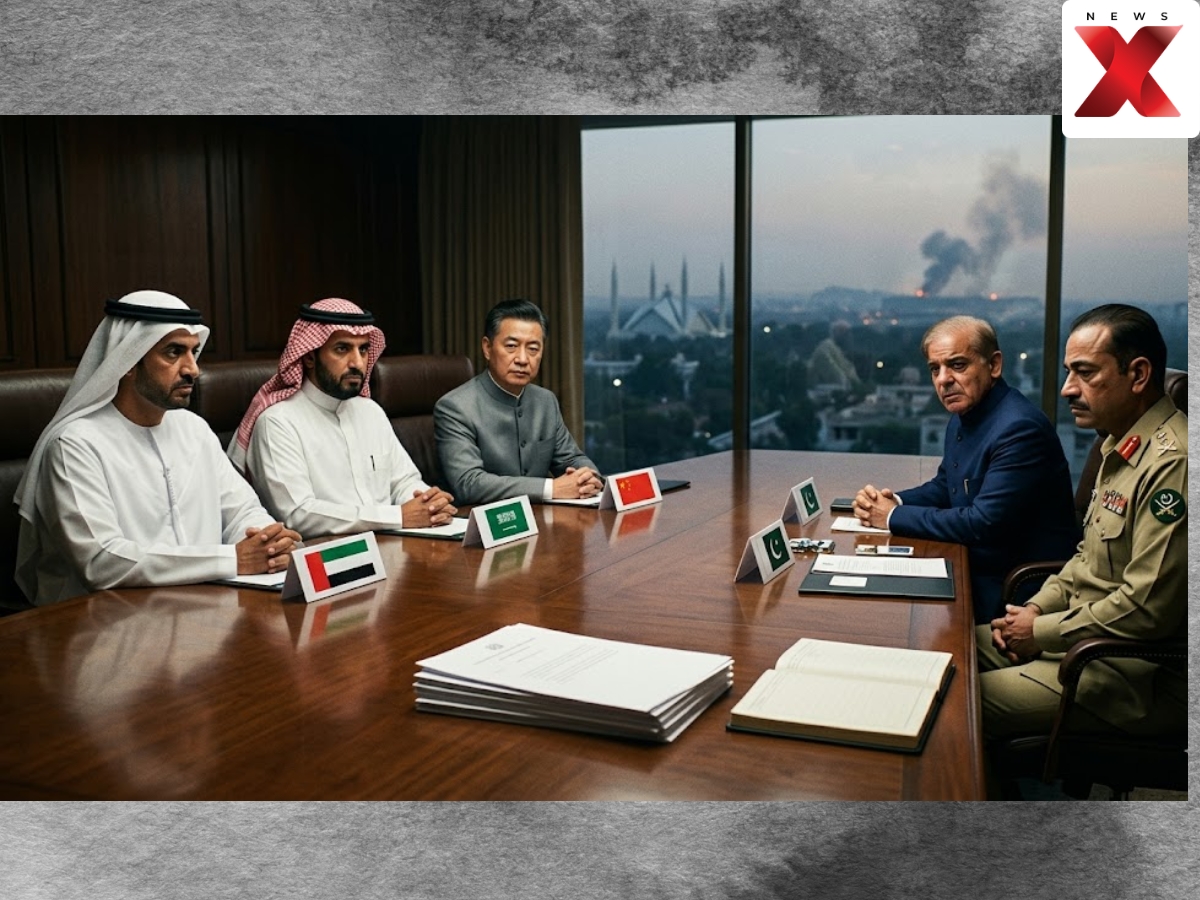

Pakistan is cornered as the war rages in Iran. The bankrupt Asian country is reportedly facing mounting pressure from the UAE, Saudi Arabia, and China to clear outstanding financial dues. Asim Munir and Shehbaz Sharif had projected a position of strategic neutrality in the ongoing regional war; however, it is now increasingly being viewed with suspicion by some Gulf countries, particularly the United Arab Emirates, which has borne direct consequences of the war.
Pakistan To Repay $3.5 Billion To UAE By April-End
As relations continue to sour, Pakistan has decided to repay its entire $3.5 billion debt to the UAE by the end of April. The Gulf state has reportedly sought the immediate return of the funds, according to a report.
A senior Pakistani cabinet minister confirmed the development to the media, saying the political leadership had taken the decision and that the full amount would be cleared.
At the same time, discussions are underway on the possibility of converting part of the outstanding amount into investment, according to senior officials cited by The Express Tribune.
Officials have already finalised the repayment schedule:
$450 million will be repaid on April 11, $2 billion will be returned on April 17 and $1 billion will be paid on April 23
Notably, $450 million of the total amount dates back to a one-year loan taken in 1996–97, which Pakistan is now set to clear nearly three decades later.
UAE, Saudi And China Debts
Under Pakistan’s $7 billion programme with the International Monetary Fund, three major partners, the UAE, Saudi Arabia, and China, had earlier committed to maintaining a combined $12.5 billion in deposits with the State Bank of Pakistan.
These deposits are expected to remain in place until the IMF programme concludes in September 2027, forming a key pillar of Pakistan’s financial stability framework.
Saudi Arabia Reportedly Seeks $6.3 Billion Loan Repayment
At the same time, Pakistan is reportedly facing pressure from Saudi Arabia, which has allegedly asked Islamabad to immediately repay a $6.3 billion loan.
The demand reportedly follows concerns that Pakistan did not uphold commitments under a bilateral defence agreement between the two countries, under which an attack on one nation is considered an attack on both.
Reports claim the situation has become increasingly tense, with Saudi officials reportedly unable to establish contact with Pakistan’s leadership, including Shehbaz Sharif and Asim Munir.
China Presses Pakistan Over Energy Sector Dues
Pressure is also emerging from China, which has asked Pakistan to clear $220 million in outstanding payments owed to United Energy Pakistan, according to a report by The News.
Report cites officials from Pakistan’s Petroleum Division saying the country’s envoy in Beijing conveyed the request, explaining that the dues relate to gas supplied by United Energy Pakistan to Sui Southern Gas Company.
The gas supplier currently provides around 260–270 million cubic feet of gas per day to the utility company.
Due to the delayed payments, United Energy Pakistan has reportedly taken cost-cutting measures, including reducing staff, as it faces liquidity constraints.
Zubair Amin is a Senior Journalist at NewsX with over seven years of experience in reporting and editorial work. He has written for leading national and international publications, including Foreign Policy Magazine, Al Jazeera, The Economic Times, The Indian Express, The Wire, Article 14, Mongabay, News9, among others. His primary focus is on international affairs, with a strong interest in US politics and policy. He also writes on West Asia, Indian polity, and constitutional issues. Zubair tweets at zubaiyr.amin




