
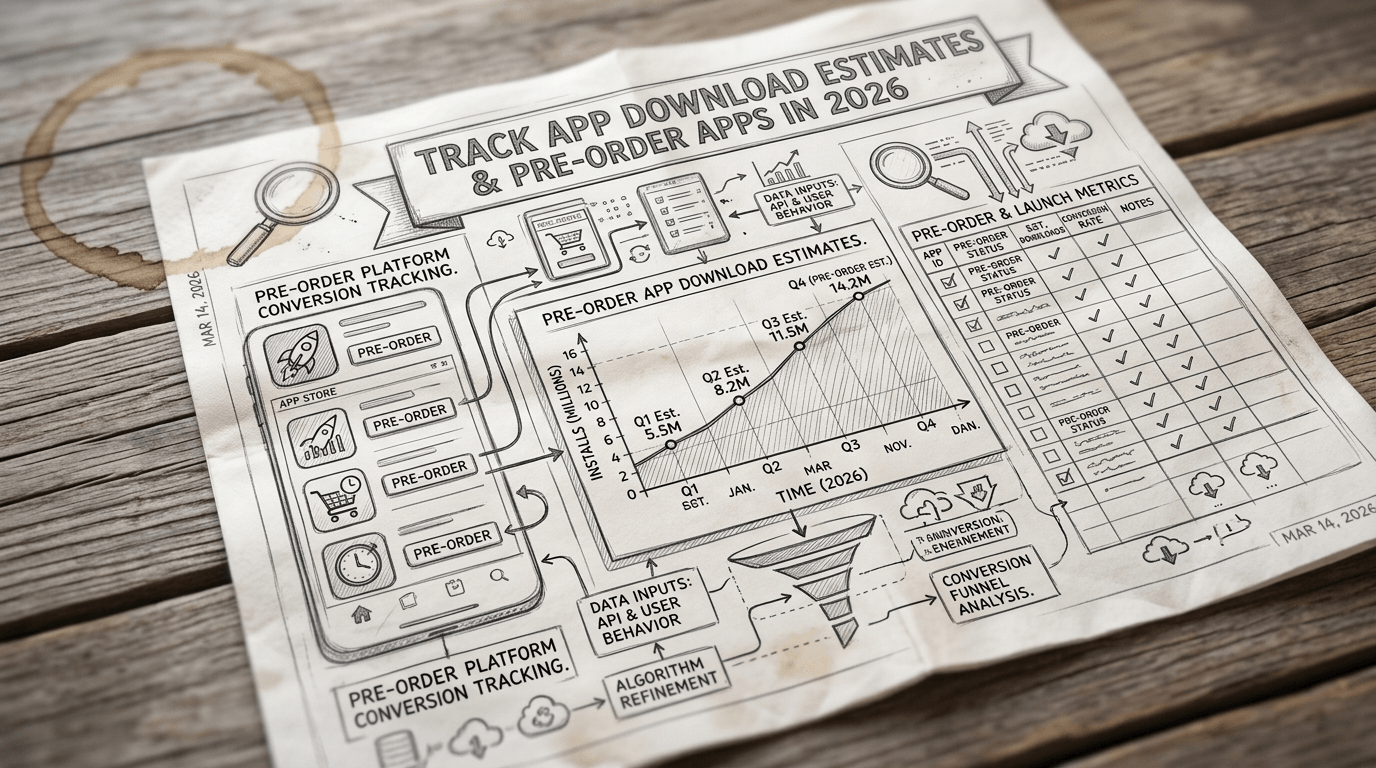

Over 255 billion app downloads were recorded globally in 2025, according to data.ai’s 2026 State of Mobile Report—and that number is still rising. If you’re building an app and guessing at your app download estimates, you’re losing ground to developers who aren’t. I have been deep into app store analytics dashboards, and the intelligence difference between those developers who are informed and those who are uninformed is brutal. Pre-order applications are already powering beyond their size in launch-week momentum, and the tracking sites that monitor them are now becoming very focused indeed. That is what the numbers will actually mean in 2026.
Why App Download Estimates Are Your Growth Compass
Practically speaking, you are unable to maximize what you cannot measure. App store analytics were directional opacities. In 2026, granular, near-real-time, unique, and reasonably priced is more stylish and fashionable than the granular and near-real-time install estimates.
Currently, the winning developers are not only monitoring their own numbers with app store intelligence but also re-engineering what works with competitors. That’s the actual edge.
The good download tracking informs you of the following:
● Trends change with time: Are there levels in your volume that seem to be steady today before a marketing burst or increasing exponentially after an ASO update?
● Category benchmarks: What position does your app take against the top 10 in your niche, not based on downloads but rather based on how many users can be acquired in the shortest amount of time?
● Geographic segmentation: Do you have two markets where you download iOS and a third market where you dominate Android? A signal to act on in mobile market intelligence.
● Pre-launch velocity: Pre-order apps on the Apple App Store and Google Play provide the developer with uncommon visibility before launch, and platforms that track this information allow you to be able to set realistic conversion expectations.
● Revenue correlation: Download estimates + app revenue estimates. You can estimate realistic ARPU ranges of competitor apps.
Pre-Order Apps: The Launch Intelligence Most Developers Ignore
The point is that in this case, the pre-order app system is not used to the full extent as a signal of strategy. By placing pre-orders, a competitor is signaling their launch schedule, their keyword focus, and their belief in organic sales.
The quarterly intelligence brief, prepared by AppMagic, showed mobile app tracking tools recorded a 34% annual growth in application developers using pre-order tracking functionality during Q1 2026. That’s not a coincidence. Its developers are finally treating pre-release periods not as dead air but as a period to study the development of the app.
According to Lexi Sydow, Head of Insights at data.ai, in a reminder of the industry brief in 2026, the period between pre-order and first launch is understandably given as one of the most data-rich times in the history of an application, where most developers have taken no data whatsoever.
Appark.ai does its best work there.
Appark.ai vs. The Field: A 2026 Tool Comparison
Not all application store smart systems are created with a similar user in mind. It ranks the largest players as of Q1 2026 in the following way:
| Tool | Download Estimates | Pre-Order Tracking | Pricing Entry Point | Best For |
| Appark.ai | Real-time | Yes | Freemium | Indie & growth-stage devs |
| Sensor Tower | Robust | Limited | ~$450/month | Enterprise teams |
| data.ai | Deep historical | Limited | ~$599/month | Large publishers |
| AppMagic | Good | Yes | ~$149/month | Mid-market |
| AppFollow | Basic | No | ~$99/month | Review management focus |
Real-World Example: How One Developer Used Download Data to Pivot Fast
An application developer in the tools subcategory, which I will refer to as TaskStack, was released in February 2026 with small expectations. With app download tracking on Appark.ai, the team determined that a rival app of the same app category rankings had spiked downloads on Android, following only one feature update.
They cross-compared this with metadata changes in app stores and changes in keyword ranking. TaskStack delivered an update on widgets within three weeks. Measurement: The number of organic installs wanted increased 2.1x within 30 days.
No paid user acquisition. No guesswork. Direct competitive intelligence on a certain, quantifiable signal.
What to Actually do with App Download Estimates
You have to have a workflow and not a dashboard. Here’s a tight process:
● Establish a baseline: calculate the weekly rather than monthly pulls in iOS downloads of your app and Android downloads.
● Find the three best competitors: Track their app store trends—download velocity changes after metadata or change update events.
● Follow pre-order activations: In case of a competitor pre-order, watch their store listing optimization in real time.
● Comparison to category averages: App benchmarking cannot be done in isolation. It could be elite or average, your 500 installs per day, depending on your vertical.
● Register with retention measures: Leaky bucket: Downloads without retention. Match possible pair install data with session frequency signals.
How to Start Monitoring App Growth Today
● Get download estimates in real-time, not monthly aggregated data—the market operates at a faster pace than that.
● Track pre-order apps in your niche before launch day; that’s where pricing, keyword, and positioning intelligence lives.
● Use a step-by-step tool: Begin with a free site such as Appark.ai, and then give a four-figure payment per month for enterprise intelligence.
The data is out there. The developers working in it in 2026 are not exceptional people; they are reading the correct signals. Start there.




