
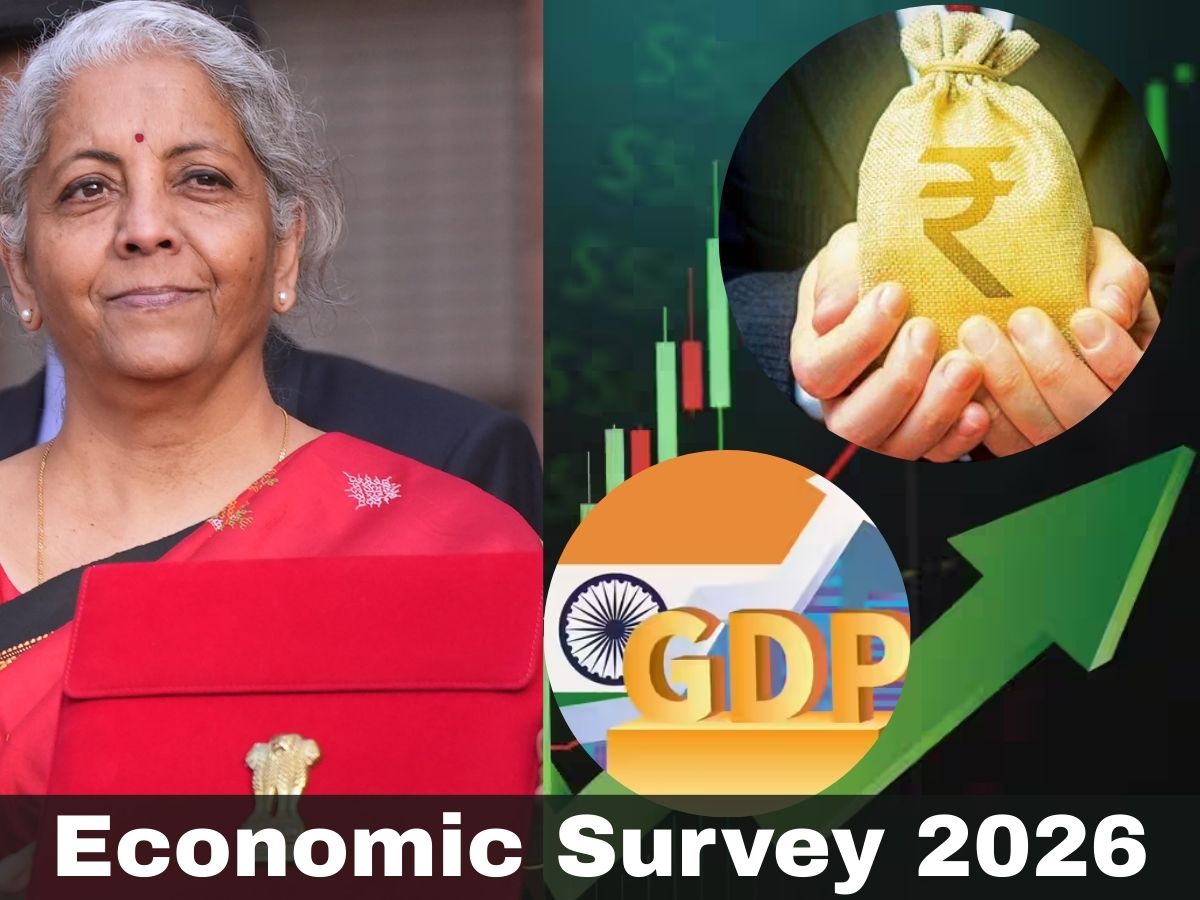

India’s Resilience Amid Global Trade Disruptions
Even as global trade faces renewed disruption from unilateral tariff actions and rising geopolitical tensions, India’s economy has demonstrated resilience, with strong domestic fundamentals helping offset external headwinds, the Economic Survey 2025–26 has said. The Survey notes that the global economic environment has become increasingly uncertain, with trade policy now shaped more by strategic and political considerations than by multilateral rules.
“Trade policy is now shaped primarily by security and political considerations rather than efficiency or multilateral rules,” it observed, warning that the global system has become “less coordinated, more risk-averse, and more exposed to non-linear outcomes.”
Referring to recent tariff actions by the United States, the Survey recalled that the announcement of additional penal tariffs on Indian exports came as a surprise, especially when India was expected to be “one of the early winners in the new tariff regime of the United States.” These developments led to downward revisions in growth forecasts and heightened volatility in global markets. However, the Survey underlined that India’s growth momentum remained intact.
“Growth is good; the outlook remains favourable; inflation is contained; banks are healthy; and corporate balance sheets are strong,” it stated, adding that policy dynamism and structural reforms helped sustain economic activity despite external pressures.
External Risks and the Currency Paradox
At the same time, the document highlighted a broader paradox confronting the economy.
“The paradox of 2025 is that India’s strongest macroeconomic performance in decades has collided with a global system that no longer rewards macroeconomic success with currency stability, capital inflows, or strategic insulation,” it said. The Survey pointed out that heightened global uncertainty, driven by trade conflicts, geopolitical realignments, and weakening rule-based systems, has had a visible impact on capital flows and investor sentiment. Financial markets tend to react first, with uncertainty triggering a wait-and-see approach that delays investment and raises risk premia.
According to the Survey, emerging market economies are more vulnerable to such uncertainty. While global trade growth is projected to slow sharply in 2026, “trade policy uncertainty is likely to have a more pronounced impact on the trade volumes of EMDEs than on those of advanced economies.” For India, the external risks manifest less as immediate macroeconomic stress and more as intermittent pressure on exports, capital flows, and currency stability. The rupee, the Survey observed, “does not accurately reflect India’s stellar economic fundamentals” and is “punching below its weight,” partly due to global risk aversion. Nevertheless, an undervalued currency has helped cushion the impact of higher American tariffs, while India’s export sector has shown adaptability through diversification toward alternative markets.
Steady Growth Outlook Despite Global Challenges
Looking ahead, the Survey cautioned that the principal risk lies not in any single external shock but in prolonged global fragmentation. “Fragility, uncertainty, and episodic shocks are increasingly structural features of the system,” it noted. Despite these challenges, the Survey maintained an optimistic outlook, projecting steady growth supported by domestic demand, healthy balance sheets, and sustained reform momentum. “The outlook, therefore, is one of steady growth amid global uncertainty, requiring caution, but not pessimism,” says the Survey.
(This article has been syndicated from ANI)
Aishwarya is a journalism graduate with over three years of experience thriving in the buzzing corporate media world. She’s got a knack for decoding business news, tracking the twists and turns of the stock market, covering the masala of the entertainment world, and sometimes her stories come with just the right sprinkle of political commentary. She has worked with several organizations, interned at ZEE and gained professional skills at TV9 and News24, And now is learning and writing at NewsX, she’s no stranger to the newsroom hustle. Her storytelling style is fast-paced, creative, and perfectly tailored to connect with both the platform and its audience. Moto: Approaching every story from the reader’s point of view, backing up her insights with solid facts.
Always bold with her opinions, she also never misses the chance to weave in expert voices, keeping things balanced and insightful. In short, Aishwarya brings a fresh, sharp, and fact-driven voice to every story she touches.




