
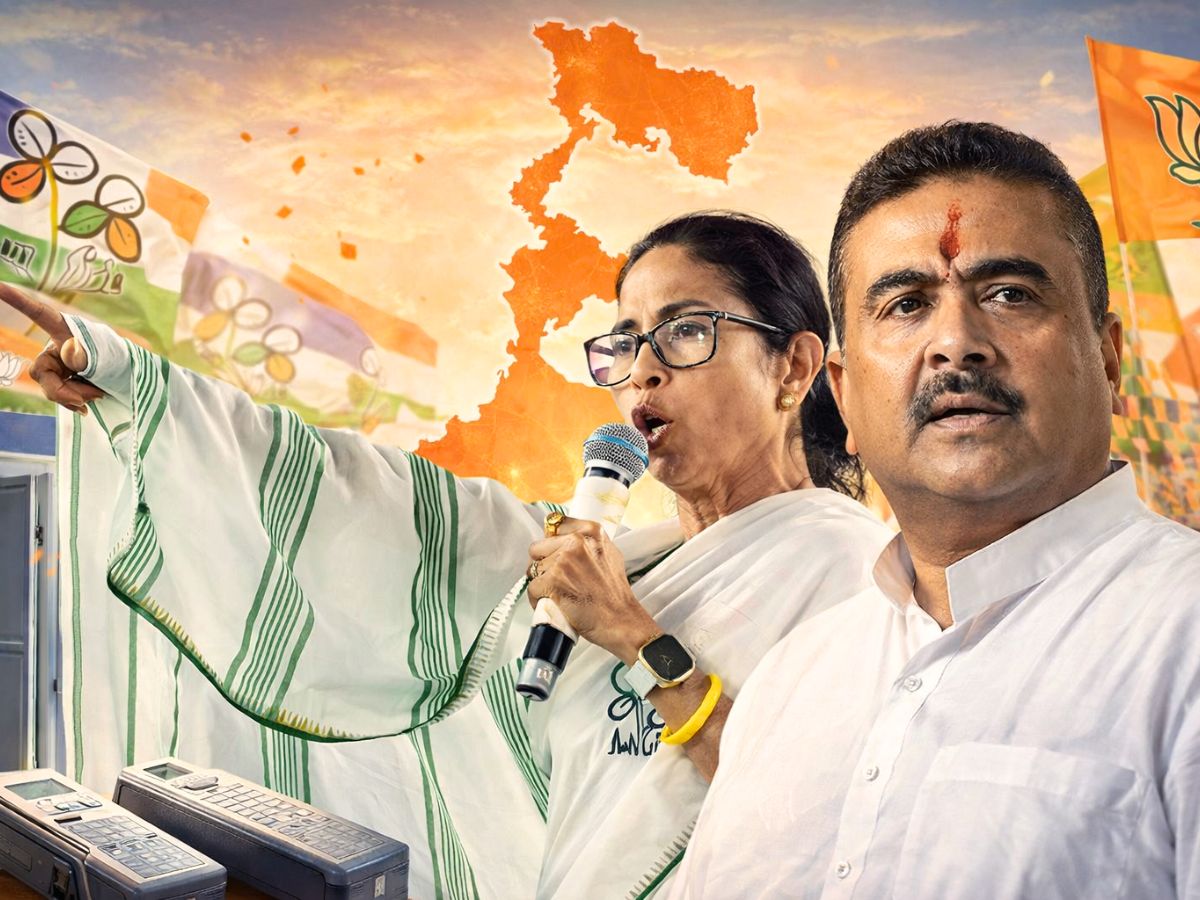

West Bengal Assembly Election 2026: West Bengal is moving towards the state assembly polls that are about to be held in coming days. As of now, the political scenario has become highly aggressive.
The two phases of elections will take place on April 23 and April 29 for all 294 seats in West Bengal. As the BJP and TMC continue to compete intensely for power, certain constituencies in West Bengal have become crucial battlefields for the poll results.
Bhabanipur: The Chief Minister’s Political Fortress
Bhabanipur, long considered a TMC stronghold, remains a crucial seat for Mamata Banerjee. After her 2021 defeat in Nandigram, Banerjee returned to the Assembly through a bypoll victory here, reaffirming her political dominance.
In 2026, the stakes are even higher. Suvendu Adhikari is contesting from both Nandigram and Bhabanipur, setting up a high-voltage face-off. The constituency has become a symbol of political prestige, where victory or defeat could carry far-reaching implications for both leaders.
Nandigram: The Epicentre of Bengal’s Political Rivalry
Few seats carry as much symbolic and political weight as Nandigram. Represented by BJP leader Suvendu Adhikari, the constituency remains central to the party’s ambitions in the state. Adhikari’s victory over Chief Minister Mamata Banerjee in 2021 still resonates strongly in Bengal politics.
With nearly 49% vote share in the last election and an even stronger performance in 2016, Adhikari has established a firm grip over the seat. However, the TMC has fielded Pabitra Kar, a former BJP insider once considered close to Adhikari, making this contest deeply personal and politically charged.
TMC general secretary Abhishek Banerjee has taken direct charge of the campaign, underlining the party’s determination to reclaim the constituency. Nandigram is not just a seat it is a prestige battle.
Murshidabad: A Rare Triangular Contest Amid Tensions
Murshidabad stands out as one of the few constituencies witnessing a triangular fight between the TMC, BJP, and the Indian National Congress.
BJP’s Gauri Shankar Ghosh, who won the seat in 2021, faces a tough challenge from TMC’s Shaoni Singha Roy, who has switched political sides over the years. Congress candidate Siddiqi Ali also remains in contention.
Adding to the political intensity are recent reports of violence in the region, making Murshidabad not just electorally crucial but also politically sensitive.
Jadavpur: Left’s Last Hope vs TMC’s Hold
Jadavpur reflects the shifting political currents in Bengal. Once a bastion of the Communist Party of India (Marxist), the seat has seen alternating control in recent elections.
TMC’s Debabrata Majumdar is set to face CPI(M)’s Bikash Ranjan Bhattacharya. For the Left, Jadavpur represents a crucial opportunity to regain lost ground, while for TMC, it is about retaining urban influence.
Kharagpur Sadar: The ‘Dada’ Face-Off
Kharagpur Sadar is gearing up for a high-profile contest between BJP’s Dilip Ghosh and TMC’s Pradeep Sarkar.
After losing the seat in 2021, Ghosh is attempting a comeback, while the TMC aims to retain its foothold. The contest reflects the broader BJP-TMC rivalry playing out across the state.
Kolkata & South Bengal: TMC’s Electoral Core
The Kolkata metropolitan region, along with South 24 Parganas and surrounding districts, continues to be the backbone of TMC’s electoral strength. Constituencies like Bhabanipur, Ballygunge, and Kolkata Port have historically favoured the ruling party.
These urban and semi-urban belts played a decisive role in TMC’s 2021 landslide and remain critical for its 2026 strategy.
North Bengal & Western Districts: BJP’s Expansion Zones
In contrast, North Bengal including districts like Cooch Behar and Jalpaiguri has emerged as the BJP’s stronghold. The party is banking on consolidating gains made in 2021 and expanding further.
Meanwhile, western districts such as Bankura, Purulia, and Jhargram are evolving into swing regions where even minor shifts in voter preference could alter the electoral outcome.
West Bengal will witness Close Contests and Emotional Undercurrents
Narrow election results have been one of the distinguishing characteristics of elections in West Bengal. In 2021, it was seen that about 35 seats were won by a margin of less than 5000 votes.
The 2026 assembly elections will be fought on the basis of various emotive issues, ranging from the issue of security, violence, polarisation and even electoral roll revision. Accusations by both the parties further escalate the political tension.
The elections in West Bengal are never fought through waves but through constituency-based fights. While the Trinamool Congress is dependent upon its stronghold in the South Bengal and urban areas, BJP on the other hand is focussing on North Bengal and swing seats.
In the current wave of campaigning, the seats such as Bhabanipur, Nandigram and Murshidabad are certain to dominate the political discourse not only because of their significance as election seats but also as symbols of power and prestige in Bengal’s electoral battle of 2026.
Sofia Babu Chacko is a journalist with over five years of experience reporting on Indian politics, crime, human rights, gender issues, and stories about marginalized communities. She believes journalism plays a crucial role in amplifying unheard voices and bringing attention to issues that truly matter. Sofia has contributed articles to The New Indian Express, Youth Ki Awaaz, and Maktoob Media. She is also a recipient of the 2025 Laadli Media Awards for gender sensitivity. Beyond the newsroom, she is a music enthusiast who enjoys singing. Connect with Sofia on X: https://x.com/SBCism




