
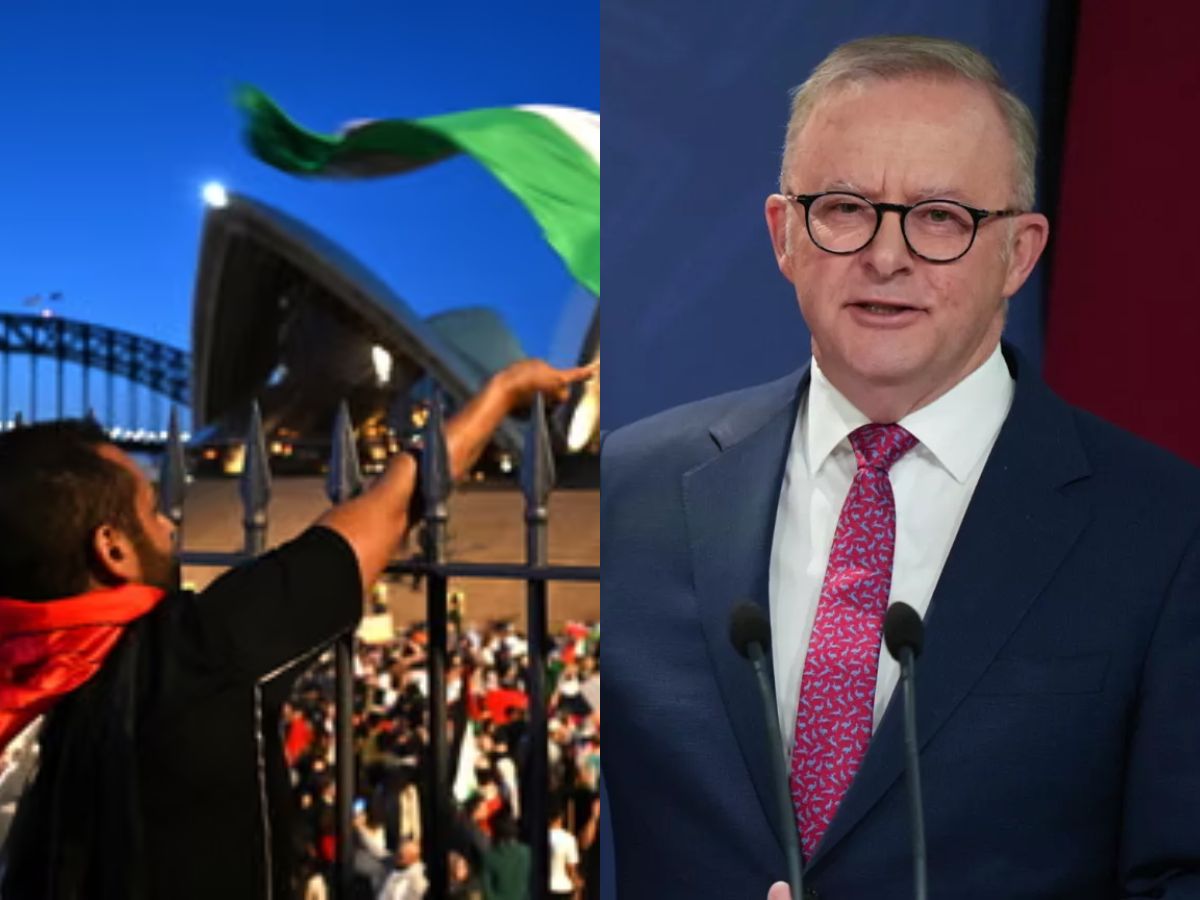

Australia will formally recognise a Palestinian state, Prime Minister Anthony Albanese announced on Monday, joining the growing ranks of nations signalling similar moves, including France, Britain and Canada.
The decision follows weeks of mounting calls from Cabinet members and public figures urging recognition, amid increasing criticism within the government over the worsening humanitarian crisis in Gaza.
‘Two-State Solution is Humanity’s Best Hope’
Speaking after a Cabinet meeting on Monday, Albanese said, “a two-state solution is humanity’s best hope to break the cycle of violence in the Middle East and to bring an end to the conflict, suffering and starvation in Gaza,” reported the Associated Press.
Also Read: IDF Strike Kills 5 Journalists In Gaza, Israel Alleges Hamas Link: All You Need To Know
The Prime Minister confirmed the decision will be formalised at the United Nations General Assembly in September and is “predicated on commitments Australia has received from the Palestinian Authority.”
G7 Shift in Stance on Palestine
While most countries worldwide already recognise Palestinian statehood, upcoming announcements from France and Britain mark a significant diplomatic turn — they would be the first members of the powerful Group of Seven (G7) to take this step, as well as permanent members of the UN Security Council.
Their stated goal is to apply diplomatic pressure on Israel to alleviate the humanitarian crisis in Gaza and revive peace talks with Hamas.
The move comes amid growing international division on the issue. The United States has imposed sanctions on Palestinian officials and joined Israel in condemning recognition as rewarding what it calls “Hamas’s monstrous terrorism.”
US Vice-President JD Vance has reiterated Washington’s position, stating the US has no plans to recognise a Palestinian state due to what it sees as the absence of a functional government.
What Recognition Would Mean in Practice for Palestine
Recognition of Palestinian statehood is largely symbolic but carries substantial diplomatic and moral weight, according to experts.
“We’re talking about major countries and major Israeli allies,” BBC quoted Alon Pinkas, an Israeli political analyst and former consul general in New York.
Julie Norman, an associate professor at University College London specialising in Middle Eastern politics, told the BBC that there is potential for tangible changes. For instance, Britain’s current “Palestinian mission” in London could be upgraded to a full embassy, and the UK could eventually open its own embassy in the West Bank, where the Palestinian Authority has limited self-rule under Israeli occupation.
Current International Status of Palestine
At the UN, Palestine holds the status of a “permanent observer state,” which allows participation but not voting rights.
Australia’s planned recognition follows similar announcements from France, Japan, Canada and the UK, though some have attached conditions. New Zealand has said it will decide on the matter in August, ahead of formal discussions in September.
If both France and the UK proceed with recognition next month, Palestine would have the backing of four of the five permanent members of the UN Security Council – China, Russia, France and the UK – leaving the US as the sole holdout among them.
Also Read: After France, Britain, Canada, This Country Plans To Recognise Palestinian State Within Days
Zubair Amin is a Senior Journalist at NewsX with over seven years of experience in reporting and editorial work. He has written for leading national and international publications, including Foreign Policy Magazine, Al Jazeera, The Economic Times, The Indian Express, The Wire, Article 14, Mongabay, News9, among others. His primary focus is on international affairs, with a strong interest in US politics and policy. He also writes on West Asia, Indian polity, and constitutional issues. Zubair tweets at zubaiyr.amin




