
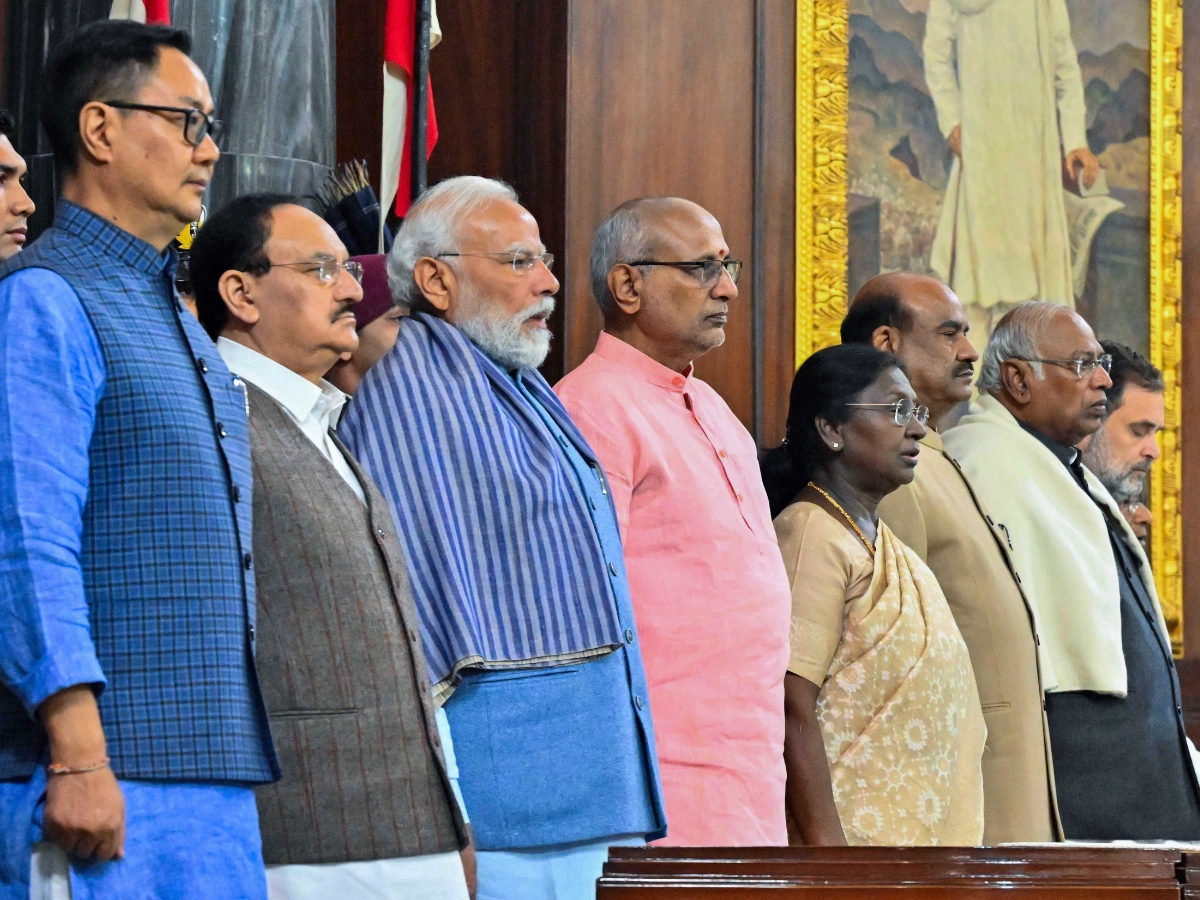

Vande Mataram Controversy: Prime Minister Narendra Modi, speaking in the Lok Sabha, started the debate commemorating the 150th anniversary of India’s national song, Vande Mataram. PM its enduring significance in the country’s struggle for independence.
“The mantra of Vande Mataram gave power and inspiration to the entire country during the freedom struggle,” PM Modi said.
PM Modi Recalls The Origins and Historical Significance of Vande Mataram
Recalling the origins of Vande Mataram, the Prime Minister emphasized its importance in India’s independence movement.
“We are sitting here because lakhs chanted Vande Mataram and fought for Independence. Remembering this national song today is a great privilege for all of us in this House,” he remarked.
PM Modi noted that the song emerged during a time when British rulers were attempting to popularize their anthem, God Save the Queen, across Indian households.
PM Modi on 50, 100, and 150 Years of Vande Mataram
The Prime Minister spoke about the song’s journey through India’s history.
“When Vande Mataram completed 50 years, India was under British rule. When it completed 100 years, India was in the clutches of Emergency, and patriots were imprisoned. Today, marking 150 years of Vande Mataram is an opportunity to reinstate pride in this great part of our past. This song inspired us to attain freedom in 1947,” he said.
Also Read: ‘Send Usha Back’ Backlash Erupts After JD Vance Calls Mass Migration ‘Theft Of The American Dream’
He further described Vande Mataram as more than a song.
“It is a mantra, a slogan that gave energy, inspiration, and showed the path for sacrifice and penance to the freedom movement. It is a matter of pride that we are witnessing 150 years of Vande Mataram. This is a historic moment.”
“We recently celebrated 75 years of our Constitution. The country is also observing the 150th birth anniversaries of Sardar Patel and Birsa Munda, and the 350th martyrdom day of Guru Teg Bahadur ji. Now, we are celebrating 150 years of Vande Mataram.”
Politics Around Vande Mataram
The Lok Sabha debate is part of year-long celebrations marking 150 years of Vande Mataram. The national song was penned by Bankim Chandra Chatterjee and set to tune by Jadunath Bhattacharya. The discussion, allocated eight hours in the Lower House, began with the Prime Minister’s address.
Union Home Minister Amit Shah is scheduled to be the opening speaker in the Rajya Sabha on Tuesday, with the House taking up the debate on Wednesday.
The Congress has nominated its deputy leader in the Lok Sabha, Gaurav Gogoi. In the Rajya Sabha, party president Mallikarjun Kharge will lead the Opposition’s intervention.
Modi had recently criticised the Congress, alleging that the party removed key stanzas from the national song in 1937 and “sowed the seeds of partition”. On November 7, he launched the year-long anniversary celebrations aimed at deepening awareness among youth and students about the song’s legacy.
Vande Mataram History: Birth of the Poem
In the 1870s, Bankim Chandra Chatterjee, then deputy collector of Jessore under the British government, wrote Bande Mataram in his Chinsurah residence (now Bankim Bhawan), north of Calcutta. Inspired by the Sanyasi Rebellion, the poem, written in Bengali and Sanskrit, was first printed in his literary magazine Bangadarshan to fill a blank page.
It later featured in his novel Anandmath, set against the backdrop of the Bengal famine of 1770. The book followed a group of monks resisting colonial rule and Bengal’s Muslim rulers. Historian R.C. Majumdar wrote that the novel “inspired the Bengali youths to supreme self-sacrifice during the hectic days of the Swadeshi movement”.
The poem soon evolved into a rallying cry during the freedom struggle. It was sung in public meetings, invoked during lathi charges, and widely used as a greeting. The British viewed it as seditious.
Controversies Around Vande Mataram
Despite its position in the national consciousness, Vande Mataram has frequently been at the centre of debate. During the freedom movement, some Muslim leaders felt alienated by its depiction of the motherland through the imagery of Goddess Durga and Kali.
By 1937, leaders from both the Muslim League and the Congress considered parts of the poem inconsistent with a secular national movement. A compromise restricted the song to its first two stanzas.
In a Congress Working Committee statement from October 28, 1937, Mahatma Gandhi said, “The other stanzas in the song are little known and hardly ever sung. They contain certain allusions and a religious ideology which may not be in keeping with the ideology of other religious groups in India.”
Majumdar argued that the imagery in Anandmath suggested that “Bankim Chandra’s nationalism was Hindu rather than Indian”.
Controversies continued post-Independence. In the 1980s, sections of the Dravidian movement opposed the song as symbolic of North Indian culture. In 2017, a confrontation in the Meerut Municipal Corporation saw Muslim councillors walk out during its rendition, prompting chants of “Hindustan mein rehna hai toh Vande Mataram kehna hai”.
The BJP, including Amit Shah, has repeatedly criticised the Congress for dropping the later stanzas.
Who Was Jadunath Bhattacharya? The First Composer Of Vande Mataram
Although Vande Mataram has been rendered in many styles, its earliest known composition came from Jadunath Bhattacharya of the Bishnupur gharana. Court musician to the Panchetgarh estate and teacher to both Tagore and Bankim, Bhattacharya’s contribution remains less recognised.
There is disagreement over the original raga; some believe it was Desh, while others argue it was Kafi. Rabindranath Tagore
recited the poem at the 1896 Congress session in Calcutta, and in a 1934 recording featuring Sati Devi, Jaya Das and Bijoya Das, the rendition is in raag Desh.
Rabindranath Tagore’s Composition And Journey of Vande Mataram Post-Independence
The version commonly sung today, heard in schools and national ceremonies such as the Beating Retreat, is closer to the Tagore composition. Many believe it was arranged by Pandit Ravi Shankar, who served as All India Radio’s music director from 1949 to 1956. Some credit flute maestro Pannalal Ghosh.
One of the most celebrated renditions remains Pandit Bhimsen Joshi’s performance in the Central Hall during the Golden Jubilee of Independence in 1997.
Also Read: Rajnath Singh’s Bold Remark on Op Sindoor: ‘Could Have Done Much More, But Chose Restraint’
Zubair Amin is a Senior Journalist at NewsX with over seven years of experience in reporting and editorial work. He has written for leading national and international publications, including Foreign Policy Magazine, Al Jazeera, The Economic Times, The Indian Express, The Wire, Article 14, Mongabay, News9, among others. His primary focus is on international affairs, with a strong interest in US politics and policy. He also writes on West Asia, Indian polity, and constitutional issues. Zubair tweets at zubaiyr.amin




