
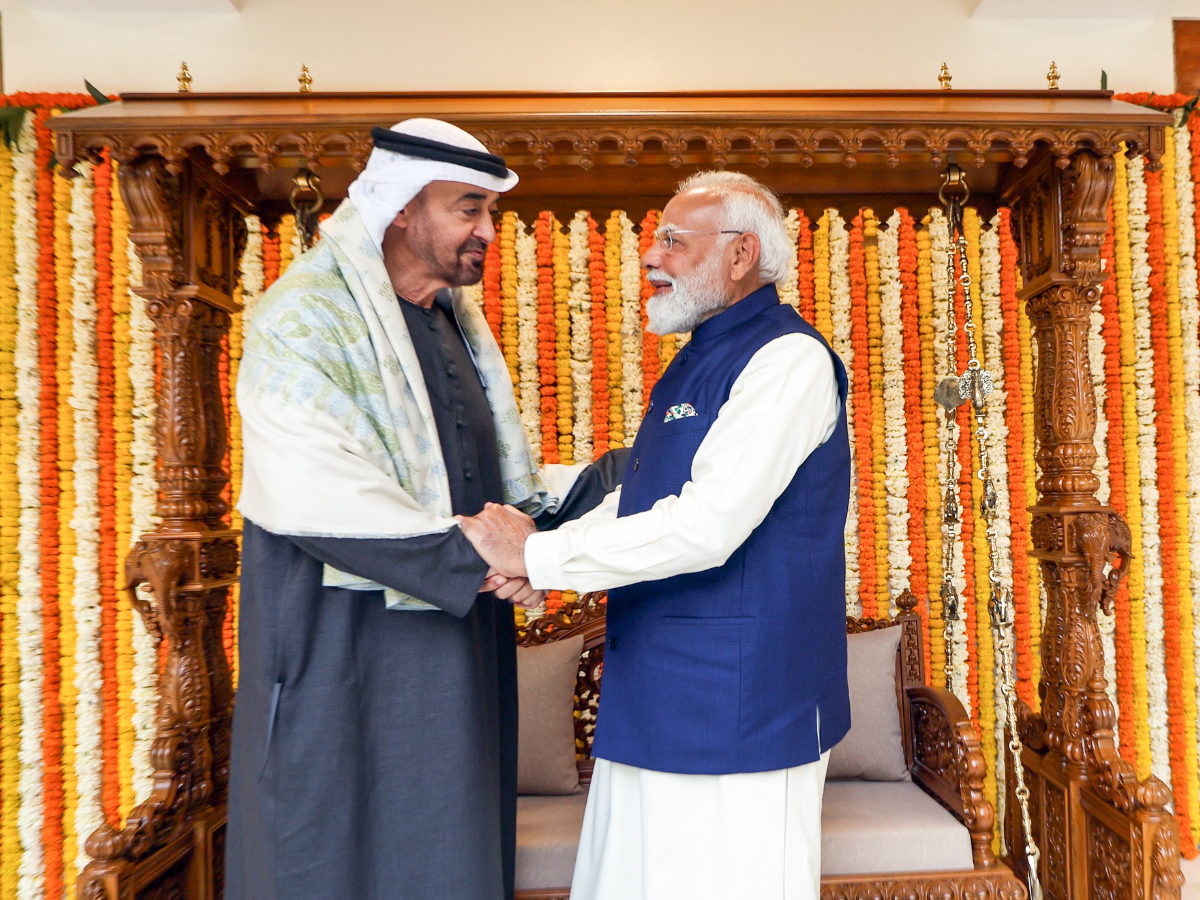

India-UAE have signed a new defence partnership agreement, a move that comes as the region’s security landscape is quickly changing. The pact was agreed during a visit to New Delhi by UAE President Sheikh Mohamed bin Zayed Al Nahyan, who was warmly welcomed at the Palam Air Base by Indian Prime Minister Narendra Modi.
The defence deal between India-UAE was part of a larger set of agreements covering business, energy, space, and advanced technology cooperation. India and the UAE also agreed to work together on new areas like artificial intelligence and food security, not just military cooperation.
At the meeting, Prime Minister Modi said the visit “illustrates the importance he attaches to a strong India-UAE friendship.”
India-UAE pact a counter to ‘Islamic NATO’?
This pact is widely seen as a response to recent security moves in the Gulf and South Asia, especially the mutual defence agreement signed between Saudi Arabia and Pakistan in September 2025. That pact includes a clause saying “any aggression against either country shall be considered an aggression against both.” This clause has been compared by analysts to a NATO-style collective defence arrangement and has led some experts to talk about the possibility of an “Islamic NATO” made up of countries such as Saudi Arabia, Pakistan, Turkey and others.
For India-UAE, the new defence partnership bolsters their long-standing ties and helps balance shifting alliances. UAE also has strong relations with Israel as they signed the Abraham Accords, and with the United States. It is important to note that Saudi Arabia has not signed the Abraham Accords. This wider network of relationships adds strength to the India-UAE cooperation.
India-UAE further agreed to a US $200 billion by 2032
Indian Foreign Secretary Vikram Misri made it clear that the letter of intent on defence “does not imply India’s involvement in regional conflicts.” He said cooperation does not mean India will necessarily be drawn into wars in the Middle East.
Beyond defence, India and the UAE also agreed to a 10-year liquefied natural gas (LNG) deal, with plans to double their bilateral trade to US $200 billion by 2032.
Some analysts see the UAE-India pact as a strategic countermove to the Saudi-Pakistan agreement and the evolving idea of an “Islamic NATO”. The UAE’s growing closeness with India challenges the region’s traditional fault lines, and adds a new layer to Gulf and South Asian geopolitics.
Also Read: Gates Foundation Shutdown: Bill Gates To Cut 500 Jobs As He Moves To Give Away $200 Billion Fortune




