
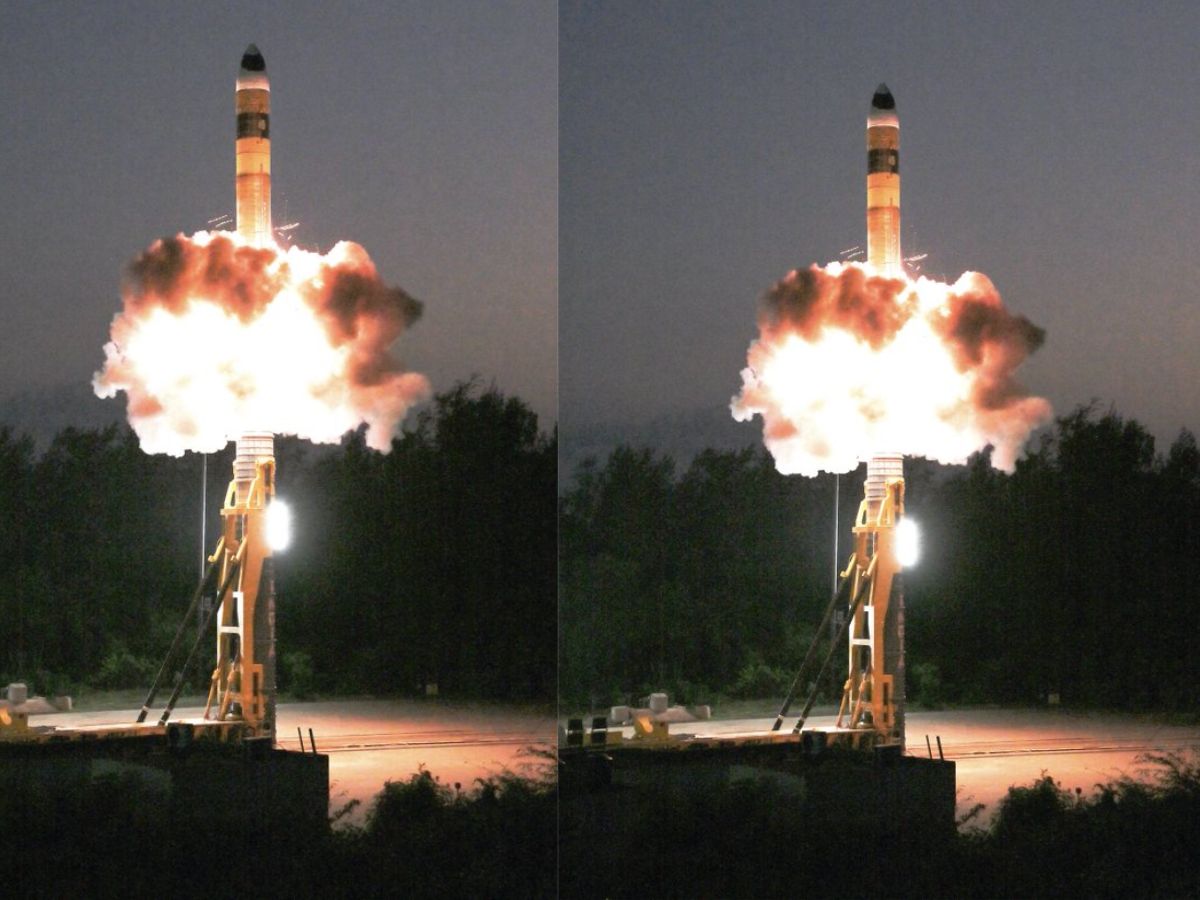
Advanced Agni Missile: India has conducted a successful Flight trial of an Advanced Agni missile with MIRV (Multiple Independently Targeted Re-Entry Vehicle) system from Dr APJ Abdul Kalam Island in Odisha on May 8 2026. The missile was flight tested with Multiple payloads, targeted to different targets spatially distributed over a large geographical area in the Indian Ocean Region. The telemetry and tracking were carried out by multiple ground and ship-based stations. These systems tracked the entire missile trajectory from lift-off till the impact of all payloads. Flight data confirmed that all mission objectives were met during the trial. With this successful trial, India once again demonstrated the capability to target multiple strategic targets using a single missile system.
Sharing an X post, DRDO wrote, “Advanced Agni missile with MIRV (Multiple Independently Targeted Re-Entry Vehicle) system was successfully tested from Dr. APJ Abdul Kalam Island, Odisha on 08th May 2026. The missile was flight tested with Multiple payloads, targeted to different targets spatially distributed over a large geographical area in the Indian Ocean Region.”
Advanced Agni Missile Developed By DRDO
The missile is developed by DRDO laboratories with the support of Industries across the country. The trial was witnessed by senior scientists of DRDO and the Indian Army personnel.
Defence Minister Rajnath Singh has complimented DRDO, the Indian Army, and Industry on the successful flight-test. This will add an incredible capability to the country’s defence preparedness against the growing threat perceptions, he said.
The MIVR Tech Equipping India’s Advanced Agni Missile
India’s advanced Agni missile system is equipped with MIRV technology, a feature that significantly boosts the missile’s strike capability by allowing a single missile to carry and deploy multiple warheads.
MIRV, or Multiple Independently Targetable Reentry Vehicle, enables one missile to launch several nuclear or conventional warheads, with each warhead capable of striking a different target.
In simple terms, instead of firing five separate missiles at five different locations, a country can launch just one MIRV-equipped missile. Once the missile reaches space, the warheads separate from the main missile body and independently travel towards different targets.
This capability makes the system far more powerful and considerably more difficult for missile defence systems to intercept.
How MIRV Technology Works
After the missile is launched and travels beyond the Earth’s atmosphere, the warheads detach from the primary missile structure. These warheads then move independently, each following its own path towards separate locations.
Because multiple targets can be hit through a single launch, the technology dramatically increases operational efficiency and strategic effectiveness.
Why MIRV Capability Matters For India
The MIRV feature offers several major strategic advantages:
It increases strike capability while reducing the number of missile launches required.
It makes interception by missile defence systems more challenging.
It allows simultaneous targeting of multiple strategic locations.
It strengthens long-range deterrence capability.
India Demonstrates Advanced Missile Capability
Zubair Amin is a Senior Journalist at NewsX with over seven years of experience in reporting and editorial work. He has written for leading national and international publications, including Foreign Policy Magazine, Al Jazeera, The Economic Times, The Indian Express, The Wire, Article 14, Mongabay, News9, among others. His primary focus is on international affairs, with a strong interest in US politics and policy. He also writes on West Asia, Indian polity, and constitutional issues. Zubair tweets at zubaiyr.amin





