
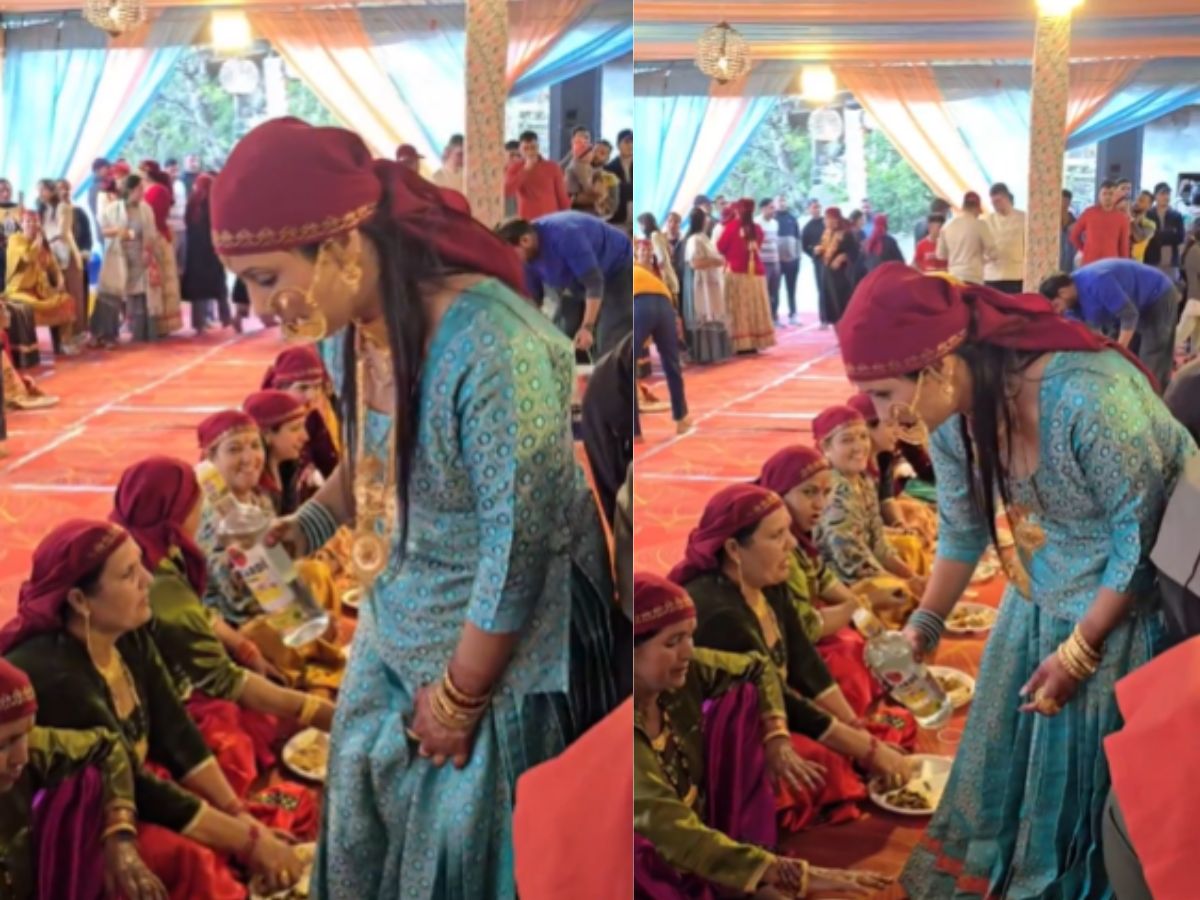

The digital world currently operates with immense excitement because the account ‘Go Himachal’ on X has released a viral video that shows a special wedding custom from the mountains.
The video displays a young woman who wears vibrant traditional apparel and displays her vast collection of gold jewelry while she serves Bacardi to a group of women who sit together in a ceremonial tent.
The post presented itself as a tribute to Himachal Pradesh’s female hospitality traditions, but it instead sparked an intense discussion about how people should accurately present their cultural heritage and their current customs.
Himachali Traditions and Cultural Authentication
The main dispute centers around two opposing viewpoints between the Himachali customs, which the uploader claims, and the actual customs, which local people practice.
This is the Tradition of Himachal. pic.twitter.com/SDSW7NjSfu
— Go Himachal (@GoHimachal_) April 6, 2026
The video shows an ancient ritual that integrates contemporary spirits, yet internet users have documented that the visual elements, particularly the clothing and social gathering methods, show a stronger connection to the Jaunsar Bawar area of the Uttarakhand border territory. The Himalayan region presents authentication challenges because all of its territories share a common “Pahari” identity, which extends beyond various state boundaries.
Local residents oppose development projects because they want to safeguard their traditional heritage. People believe that the Kinnaur and Lahaul-Spiti tribes originated the local drinks Chhang and Lugri, yet they consider branded commercial liquor at wedding events to be an unauthorized practice that does not meet the standards of a traditional custom. People believe that modern social changes exist as ancestral customs that individuals use to attract social media attention.
Alcohol Normalization in Himalayan Social Rituals
The viral video has raised awareness about how rural and semi-urban celebrations have started to accept alcohol consumption as normal behavior.
Some users defended the practice, which provides women-only tents for safe relaxation and exciting activities, while others showed deep concern about how drinking alcohol is presented as a positive thing. People wondered whether the Bacardi bottle appeared in a sacred or ceremonial space because of authentic cultural evolution or temporary urban trend adoption. Various hill communities, which include the Dogras of Jammu, maintain social systems that permit alcohol consumption during special events.
The internet skepticism that exists today has created two opposing viewpoints about this issue because one group sees it as a sign of progress that creates social spaces that empower women, while another group perceives it as a threat to the region’s spiritual and cultural heritage.
The discussion about this issue shows that the “Internet” has transformed from its previous role as an observer to its current position as a cultural truth gatekeeper.
A recent media graduate, Bhumi Vashisht is currently making a significant contribution as a committed content writer. She brings new ideas to the media sector and is an expert at creating strategic content and captivating tales, having working in the field from past four months.




